
To reduce customer support costs, with AI or without it, work in this order: stop the questions you can prevent, answer the repeat questions without a person, then make every remaining reply quicker. AI helps with the last two: an AI chatbot answers the repeat questions and an inbox assistant drafts the rest. Many teams start at the end, by hiring or buying a tool, and skip the first two steps, which are the cheapest.
This guide is written for small businesses (founders and small support teams) rather than contact centres. It covers:
- What support costs, with the sums shown and where the popular benchmarks come from.
- Nine ways to cut it, cheapest first.
- How much AI saves, and how AI tools charge.
Disclosure: we make Resolve247, an AI support chatbot, and it appears here as one example. Every other figure links to its source.
What Customer Support Costs
People are most of the bill. In MetricNet’s worldwide benchmark of service desks, agent salaries and benefits made up 53.6% of the cost, and all staff costs together about 73%. Technology was 11.6%. Those are IT service desks, but a customer support team’s operating costs have the same shape: you mostly pay for people’s time.
So start with the cost of one person:
- US: the median customer service representative earned $44,770 a year ($21.53 an hour) in May 2025. For office and administrative staff, wages are 68.7% of what employers pay once benefits are added. By our estimate, that puts the real cost at about $65,000 a year, or $5,400 a month, before software, management and desk space.
- UK: customer service assistants earn £20,000 to £30,000. On £25,000, employer National Insurance (15% above £96 a week) and the minimum 3% workplace pension take the cost to about £28,600 a year, roughly £2,400 a month.
If you’re a founder answering support yourself, the cost is your time: 150 emails a month at six minutes each is 15 hours, about two working days. That’s $470 a month even at an agent’s loaded rate of about $31 an hour, before you count what your own time is worth or the context switching.
For SaaS companies, the median spend on customer support and customer success together is 9% of annual recurring revenue. That figure comes from SaaS Capital’s 2026 survey of more than 1,000 private B2B SaaS companies. Our SaaS customer support playbook shows what that budget buys at each stage, from founder-only support to a first hire.
Cost per Contact: The Benchmarks Worth Using
| Contact type | Cost per contact | Source |
|---|---|---|
| Assisted (phone, chat or email), median | $13.50 | Gartner, 2024 |
| Self-service, median | $1.84 | Gartner, 2024 |
| Phone ticket | $17.19 | MetricNet, 2021 (IT service desks) |
| Email ticket | $16.13 | MetricNet, 2021 |
| Chat ticket | $15.72 | MetricNet, 2021 |
| Self-help ticket | $2.37 | MetricNet, 2021 |
Chat and email aren’t the cheap channels they’re often assumed to be: per contact they cost about the same as a phone call, because what you’re paying for is a person’s time. Self-service is about seven times cheaper than an assisted contact. The “80 to 100 times” you’ll still see quoted traces back to a 2019 Gartner poll that put the gap at 80 times.
Where the popular numbers come from. Many articles give $2.70 to $5.60 as the cost of an ecommerce support ticket. That range is a contact-centre cost per phone call that has been relabelled along the way. The $22.50 per ticket that also circulates is an IT service-desk figure. And the claim that chatbots “reduce customer service costs by up to 30%” goes back to a 2017 IBM blog post quoting Chatbots Magazine. Work out your own number instead. It takes 10 minutes.
How to Work Out Your Cost per Ticket
Cost per ticket = (people costs + tools + other support costs for the month) ÷ conversations that month
Use loaded people costs (pay plus benefits or employer taxes), include any founder or manager time spent on support, and count conversations the same way your helpdesk does.
Here are three worked examples using the US median loaded cost of $5,431 a month per person. The conversation volumes and tool costs are our assumptions:
| Team | Conversations a month | Monthly cost | Cost per conversation |
|---|---|---|---|
| Founder doing it alone | 150 | 15 hours of your time (about $470 at $31 an hour) | about $3.13 in time |
| Two-person team | 800 | $10,862 people + $150 tools | $13.76 |
| Five-person team | 2,500 | $27,155 people + $500 tools | $11.06 |
The two-person team lands almost exactly on Gartner’s $13.50 median, which is a useful sanity check. The larger team is cheaper per conversation because each person handles more of them.
Cost per contact or cost per resolution? If a customer emails three times about one problem, that’s three contacts but one issue to resolve. Divide by resolved issues as well as by contacts. If the cost per resolution is much higher, back-and-forth is part of what you’re paying for, and clearer first replies or a better help article will cut it.
How to Reduce Customer Support Costs: 9 Ways, Cheapest First
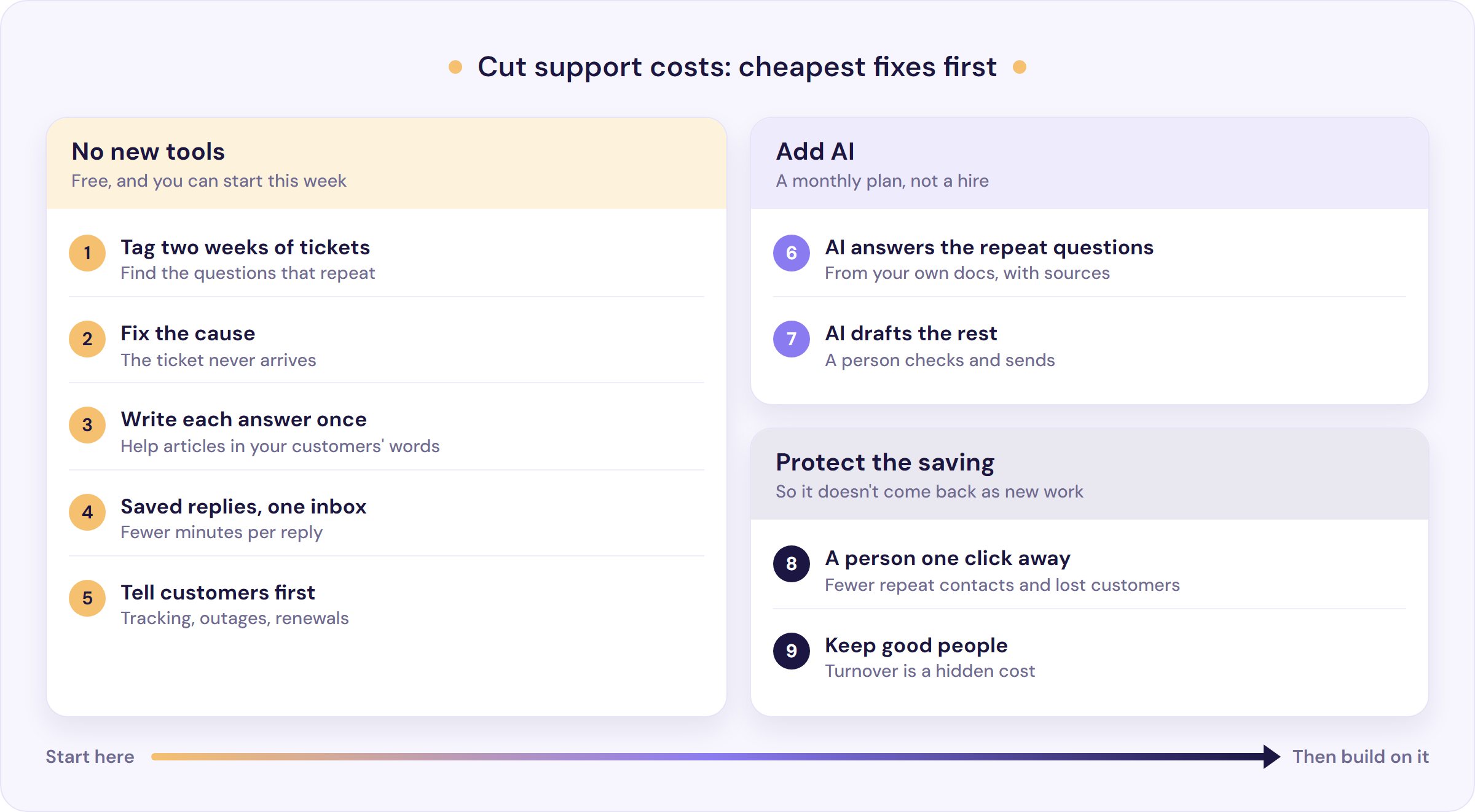
The first five cost nothing but time, the next two add AI, and the last two protect the saving.
1. Tag Two Weeks of Tickets Before You Change Anything
For two weeks, tag every conversation with its reason: where’s my order, how do I, billing, bug, password, pre-sales. A handful of questions usually make up a large share of the total. Your mix of questions decides the saving more than any tool does. Our guide on how to reduce support tickets has a tagging sheet to copy, and the quickest fix for each common reason.
One support lead at a 500-person software company described running the same AI product on two brands. On a technical product it handled 10-15% of questions after six to eight months of work (“it’s a wash”, in their words). On a simple consumer product it handled 70-85% within two months.
2. Fix the Cause, Not the Ticket
Many repeat questions are product or process problems in disguise: a confusing screen, a billing status customers can’t see, a cancel option they can’t find, a delivery estimate that’s wrong. Fixing the cause removes the ticket for good, and it’s often the cheapest fix on this list. Start with the top three reasons from your tagging.
3. Write Each Answer Once
Turn the top questions into help centre articles, written in your customers’ words, and put them where people get stuck: checkout, settings, the order confirmation email. Self-service only saves money when it works. In 2024, Gartner found that just 14% of service issues are fully resolved in self-service, and only 36% of “very simple” ones, often because customers can’t find relevant content. These knowledge base examples show what good looks like. Our guide to self-service customer support covers what to set up first for a small team.
4. Use Saved Replies and One Inbox
Before any AI, give every common question a saved reply, and bring email, chat, SMS and social messages into one inbox so nothing is answered twice. One ecommerce team logged their 20 most common questions and found prepared answers covered 35% of tickets, with no AI involved. Saved replies don’t remove the conversation, but they cut the minutes it takes.
5. Tell Customers Before They Ask
Proactive messages stop questions arriving: post-purchase shipping updates with tracking, a status page during outages, renewal reminders, “your refund is on its way”. When customers get tracking updates without asking, many where’s-my-order questions never come in.
6. Let an AI Chatbot Answer the Repeat Questions
An AI chatbot in your live chat, trained on your own help content, answers repeat questions instantly and 24/7, without a rota. (Here’s how conversational AI for customer service works.) Three things decide whether it saves money or creates work:
- It answers from your own pages and documents, and shows the source.
- It says when it doesn’t know, rather than guessing.
- A person is one click away, and the conversation goes with the customer.
That’s how Resolve247’s AIChatbot works: it answers from your content in the customer’s language, and source links and “Contact a Human” are both on by default. On our own figures, it answers 82% of customer questions instantly. Your share will depend on your question mix (step 1).
7. Let AI Draft the Rest
For questions that need a person, AI can still do the typing. An inbox assistant drafts each reply from your knowledge base and past replies, and an agent checks, edits and sends it. This “draft and review” pattern keeps a human on refunds, pricing and anything sensitive while cutting average handle time. Resolve247’s ResponseAssistant works this way inside Help Scout and Front, and in HubSpot or Crisp the AIChatbot can post its answers as internal notes for your team to check first.
8. Make a Person Easy to Reach
Hiding the contact button is a false saving. A customer who can’t reach a person comes back through another channel, angrier, or leaves. In Gartner’s 2026 survey, only 27% of customers would try a chatbot again after a bad experience. Most (87%) said access to a human agent is essential when companies use generative AI in customer service.
A handover that passes the whole conversation lets the person pick up where the AI stopped, so the customer doesn’t start again and the issue isn’t paid for twice. Our guide to customer service automation covers how to design that route to a person. Some AI providers still bill when a person takes over, and our chatbot to human handoff guide shows how each one counts it.
9. Keep Good People, and Count the Hidden Cost of Outsourcing
Turnover is a hidden support cost. Contact-centre agent turnover reached 38% a year in 2022, and replacing one service-desk agent costs about $12,000 once recruiting, training and the learning curve are counted (MetricNet). For a small team, losing your one experienced person costs more than any tool.
Outsourcing can lower the hourly rate, but it creates work inside your business. Someone has to write documentation an outsider can follow, check quality and handle escalations. Budget that time before you compare quotes.
How Much Can AI Reduce Customer Support Costs?
How far you can reduce support costs with AI depends on two things: your mix of questions, and whether the time AI frees up turns into money.
What AI support providers say. Each publishes a resolution rate for its own product:
| Provider | Published figure |
|---|---|
| Resolve247 AIChatbot | Answers 82% of customer questions instantly |
| Fin | 76% average resolution rate across 12,000+ customers |
| Help Scout (Scout, formerly AI Answers) | 73.19% average resolution rate |
| HubSpot Customer Agent | 70% average resolution rate |
| Tidio Lyro | 75% average resolution rate |
| Gorgias AI Agent | 60% of tickets auto-resolved |
| Zendesk AI agents | Up to 80% automation |
Figures checked 1 October 2026. Definitions differ: some providers count a conversation as resolved when the customer leaves without asking for more help, so compare these figures with care.
What service teams report. In Salesforce’s survey of 6,500 service professionals, AI handled about 30% of cases in 2025, a share they expect to reach 50% by 2027. Named results mostly come from larger companies: salon chain HelloSugar reports a 66% automation rate and $14,000 a month saved with Zendesk’s AI agents, and Lyft cut customer service resolution time by 87% while passing complex cases to people. For the wider picture of where AI helps and where it still struggles, see AI in customer service.
Where the saving shows up. Time the AI saves turns into money in four ways:
- A hire you don’t need yet as volume grows.
- 24/7 cover, including evenings, weekends and seasonal peaks, without a rota or temporary staff. Our 24/7 customer support cost comparison prices the other ways to get it.
- Founder hours back for building or selling.
- Faster replies. These matter even when the AI handles a small share. One team saw AI remove just over 10% of cases, yet response times fell from three to four hours to 15 to 20 minutes.
It rarely means letting people go. In Klaviyo’s 2026 research, 44% of service leaders saw no significant change in team size after adopting AI or automation, 25% grew their team and 12% shrank it.
Here’s the two-person team from earlier: 800 conversations a month, assuming eight minutes each, at the loaded rate of $31.33 an hour.
| AI resolves | Conversations | Hours back a month | Value of that time |
|---|---|---|---|
| 30% | 240 | 32 | about $1,000 |
| 50% | 400 | 53 | about $1,670 |
| 70% | 560 | 75 | about $2,340 |
As a percentage of this team’s monthly support cost (about $11,000), the time freed is worth roughly 9%, 15% and 21%. That’s the ceiling on the cost reduction, before the AI’s own price. It’s lower than the resolution rate because, at eight minutes a conversation, answering conversations takes under a third of the team’s paid hours.
Even at 70%, the 75 hours freed are under half of one person’s month, so they won’t remove a role, but they do absorb growth. If volume rises by half, to 1,200 conversations a month, an AI resolving 70% leaves the team fewer conversations than it has today. Without it, you would need a third hire at $5,400 a month.
Budget for upkeep too. Someone has to keep the AI’s knowledge current when prices, policies or features change, and review what it couldn’t answer. The more complex the product, the more time this takes: one enterprise team reported that keeping its bot viable became one full-time and two part-time jobs.
AI Tools That Reduce Support Costs, and How They Charge
Sort AI tools and solutions for cutting support costs by the job they do, not by brand. The providers in the resolution table above (Fin, Help Scout, HubSpot, Tidio, Gorgias, Zendesk and Resolve247’s AIChatbot) sit in the first row; Resolve247’s ResponseAssistant sits in the second.
| Type of tool | What it does | What it saves |
|---|---|---|
| Customer-facing AI chatbot | Answers customers from your content and hands over to a person | Conversations a person never sees; out-of-hours cover |
| Inbox drafting assistant | Drafts replies for an agent to check and send | Minutes per reply |
| Triage and routing | Tags tickets and sends them to the right person | Sorting time (Zendesk says its AI saves 45 seconds per ticket compared with manual triage) |
| AI search on your help centre | Finds the right article for the question | Contacts that never start |
Then look at how each one charges: the pricing model can matter more than the headline price. The main models are:
- Flat monthly plan with a message allowance.
- Credits, where each reply uses some up.
- Per resolution (or “per outcome”), where you pay for each conversation the AI is judged to have resolved.
- Per seat, an AI add-on for each agent.
Here is what the two-person team’s AI would cost a month:
| AI resolves | Per resolution, at $0.50 to $0.99 | Flat plan |
|---|---|---|
| 30% | $120 to $238 | $35 |
| 50% | $200 to $396 | $35 |
| 70% | $280 to $554 | $35 |
Per resolution uses list prices from HubSpot ($0.50), Help Scout ($0.75) and Fin ($0.99), before any base fee or the plan each provider requires. The flat plan is Resolve247 Starter: 2,000 AI messages a month (each AI reply is one message), enough for 800 conversations at 2.5 AI replies each. Prices checked 29 September 2026.
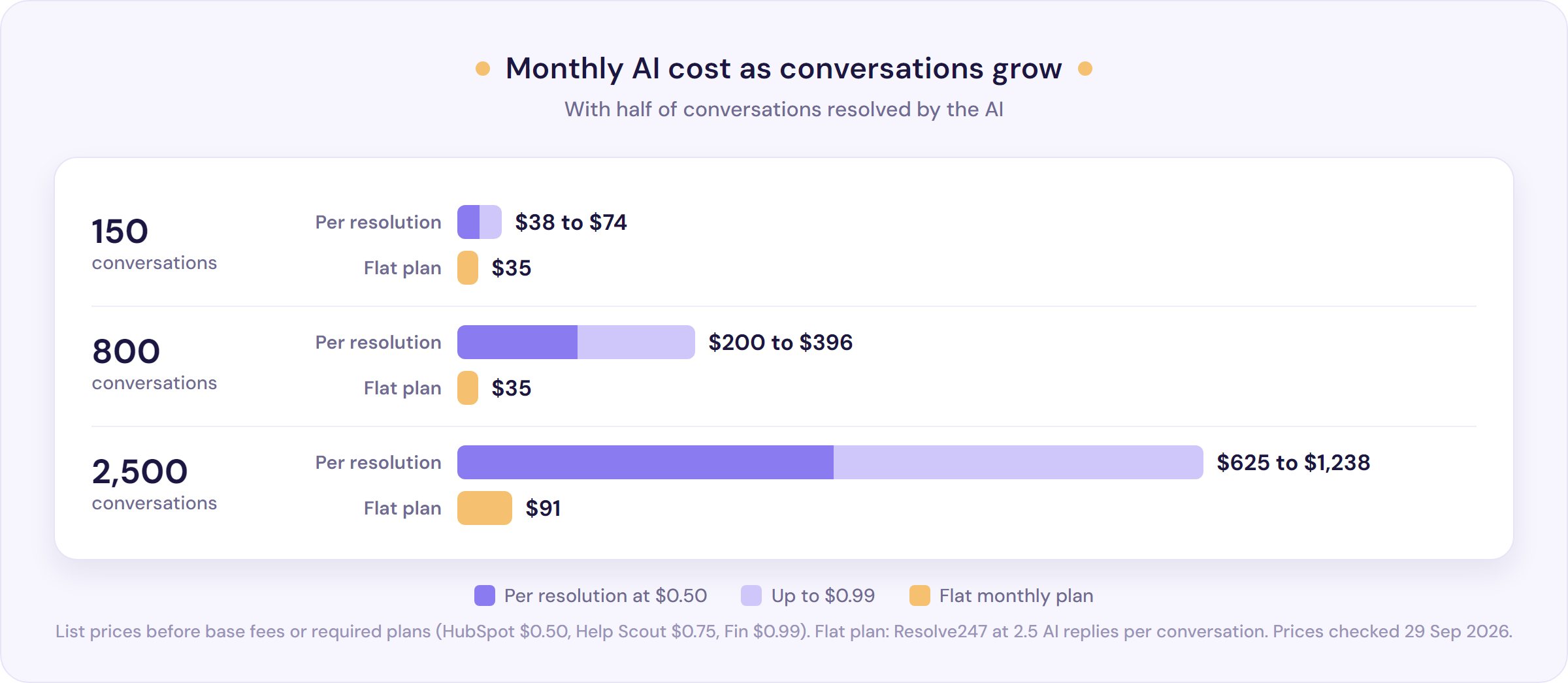
A per-resolution bill grows with your volume and with the AI’s success. That can still suit you if you already pay for that helpdesk and your volume is low or seasonal. For every provider’s exact billing rules, see our AI chatbot pricing guide. If you’re on HubSpot, here’s how to reduce HubSpot AI chatbot costs.
To lower your cost per resolution without lowering customer satisfaction, choose an AI support chatbot with:
- Answers grounded in your own content, with sources. An accurate answer stays resolved; a wrong one comes back as two tickets. See how accurate AI support chatbots are.
- A price that doesn’t climb as the AI succeeds, or a cap you control.
- An easy handover with the conversation attached.
- Setup in hours, not months, and little upkeep.
- A report of what it couldn’t answer, so you can close the gaps.
- A fit with the tools you already use, so you don’t pay to switch helpdesk.
B2B SaaS teams can see how Resolve247 handles technical docs on our AI chatbot for SaaS page. For a fuller checklist, read how to choose an AI customer support chatbot or compare customer service chatbots.
Cost-Cutting That Backfires
Some savings come back as bigger bills:
- Counting deflection instead of resolution. A customer the bot “deflected” who comes back tomorrow has cost you twice. The difference between deflection rate and resolution rate matters here.
- Letting the AI make promises. Refunds, discounts and delivery dates need firm rules or a person to approve them.
- Stale answers. An AI quoting last month’s prices creates new tickets and refunds.
- Cutting staff before the AI has proved itself. In February 2024 Klarna said its AI assistant was doing the equivalent work of 700 full-time agents. In May 2025 its CEO told Bloomberg that letting cost dominate had led to “lower quality”, and that Klarna was hiring people so customers could always reach a human.
How to Tell It’s Working
To prove the return on investment (ROI), track four numbers each month, comparing AI-handled conversations with human ones:
- The share resolved without a person, not just “deflected”. Ticket deflection is only a saving when the issue stays solved.
- Reopens or repeat contacts within seven days. This is the best early warning of answers that look right but aren’t.
- Time from “this didn’t help” to a person. Long waits here undo the saving.
- Customer satisfaction (CSAT) and refund rate. The CSAT calculator makes the satisfaction score easy to compare.
Then spend 15 minutes a week reading what the AI closed and what it couldn’t answer. That keeps the feedback that used to reach you through the inbox, and it shows which help articles to write next. In Resolve247, the analytics show how many conversations needed no human and an estimate of the time saved, and the Knowledge Gaps report lists the questions it couldn’t answer. The first contact resolution rate on human conversations is worth watching too: as AI takes the easy questions, the ones left for your team get harder. Our guide to chatbot analytics shows how to check each of these numbers in 30 minutes a week.
Frequently Asked Questions
How much does customer support cost per ticket?
Gartner’s 2024 benchmark puts the median assisted contact (phone, chat or email) at $13.50 and a self-service contact at $1.84. In our worked examples, small US teams paying median wages land at about $11 to $14 per conversation. To work out yours, divide a month’s loaded people costs plus tools by that month’s conversations.
How do AI chatbots reduce customer support costs, and by how much?
An AI chatbot answers repeat questions without a person, and an inbox assistant drafts replies for the rest. Providers publish resolution rates of 60% to 82% on their own measures; service teams surveyed by Salesforce put AI at about 30% of cases in 2025. In our worked example, the time freed is worth 9% to 21% of a small team’s support cost, mostly as a hire you don’t need yet.
What is the most cost-effective AI support chatbot for a small business?
Look for one whose price doesn’t climb as it succeeds, that answers from your own content with sources, and that hands over to a person easily. At small-business volumes, a flat plan usually costs less than per-resolution pricing. At 800 conversations a month with half resolved, $0.50 to $0.99 per resolution comes to $200 to $396, against $35 for Resolve247’s flat Starter plan.
What can AI handle in customer support, and what still needs a person?
AI handles questions your documentation answers: delivery times, how-to questions, policies, account basics and pre-sales questions. People should handle complaints, refunds and exceptions, anything that needs judgement or account access, and upset customers. A good setup lets customers reach a person at any point, with the conversation passed along.
How do you reduce customer service costs without hurting customer satisfaction?
Start with changes customers welcome: prevent the question with a clearer product and proactive updates, make answers easy to find, and answer repeat questions instantly. Keep a person easy to reach, and track reopens and customer satisfaction (CSAT) on AI-handled conversations alongside cost.
The Bottom Line
The cheapest way to reduce customer support costs is to stop tickets arriving. Tag your tickets, fix the causes, write each answer once and tell customers before they ask. Then let AI answer the repeat questions and draft the rest, keep a person one click away, and judge it on resolution, not deflection.
For a small team, the payoff is rarely a smaller team. It’s avoiding the next hire, covering evenings without a rota, and getting your own hours back.
If you want to see what that looks like on your own questions, start a free 30-day trial (no card needed), or compare plans and pricing. Running a small business? See how an AI chatbot for small business fits in, or how a knowledge base chatbot turns your help centre into instant answers.