
Introduction
A good customer service chatbot answers your customers instantly, around the clock, and takes the repetitive questions off your team’s plate. The hard part isn’t building one any more. It’s choosing the right one from a crowded field where every provider ranks itself first, and where the real differences in price, accuracy and fit are far bigger than the marketing lets on.
So we compared seven of the best AI customer service chatbots for 2026 on what actually decides it: accuracy, the true pricing model, setup and fit. Then we matched each to the kind of business it genuinely suits, because there’s no single best pick. A small or medium team that wants accurate answers at a predictable price is best served by Resolve247; a Shopify store by Gorgias; a large enterprise by Ada.
Disclaimer: we make one of the tools on this list (Resolve247). The cards are listed alphabetically, not ranked, and judged against the same criteria. Where a rival is the better fit, we say so.
Quick verdict: which customer service chatbot is right for you?
Short on time? Here is the shortlist by who each tool genuinely suits best. The detailed reviews and pricing follow below.
| If you are… | Best pick |
|---|---|
| A small or medium team that wants accurate, flat-priced support | Resolve247 |
| A Shopify store handling order, returns and tracking questions | Gorgias |
| A small or growing online store wanting live chat plus AI, fast | Tidio (Lyro) |
| Already building your business on the HubSpot CRM | HubSpot Breeze |
| A SaaS team wanting premium automation, happy to pay per resolution | Fin by Intercom |
| An enterprise team wanting one capable AI bot without a big migration | Chatbase |
| A large enterprise ready for a full, managed automation rollout | Ada |
Every tool here owns one real niche. The trick is matching the niche to your situation, not picking whoever shouts “number one” loudest.
What is a customer service chatbot?
A customer service chatbot is software that answers customer questions automatically, over chat on your website or inside your help desk. Modern ones use conversational AI for customer service to understand a question and reply in natural language, drawing answers from your own help content, so customers get instant help 24/7 without waiting for a human agent.
The best ones do more than deflect tickets. They resolve the repetitive questions your team answers a hundred times a week, hand the tricky ones to a human with full context, and quietly learn what your customers ask most. Done well, that means faster replies for customers and far fewer routine tickets for you.
Rule-based vs Q&A vs agentic: which type do you need?
Not every “chatbot” is the same thing. There are three terms generally used. Here’s some help to understand them:
- Rule-based bots follow scripted decision trees. The visitor clicks buttons, and the bot replies with answers you wrote in advance. They are reliable but rigid, and they only handle questions you anticipated.
- Q&A chatbots use AI to read your content and answer open-ended questions in their own words, including ones you never scripted. This is the workhorse of customer support, where people ask the same thing in a hundred different ways.
- Agentic bots go a step further and take actions, like issuing a refund, checking an order or updating a subscription, not just answering. This is the newest tier, and the fastest-growing. Gartner predicts that by 2029, agentic AI will autonomously resolve 80% of common customer service issues, cutting operational costs by 30%.
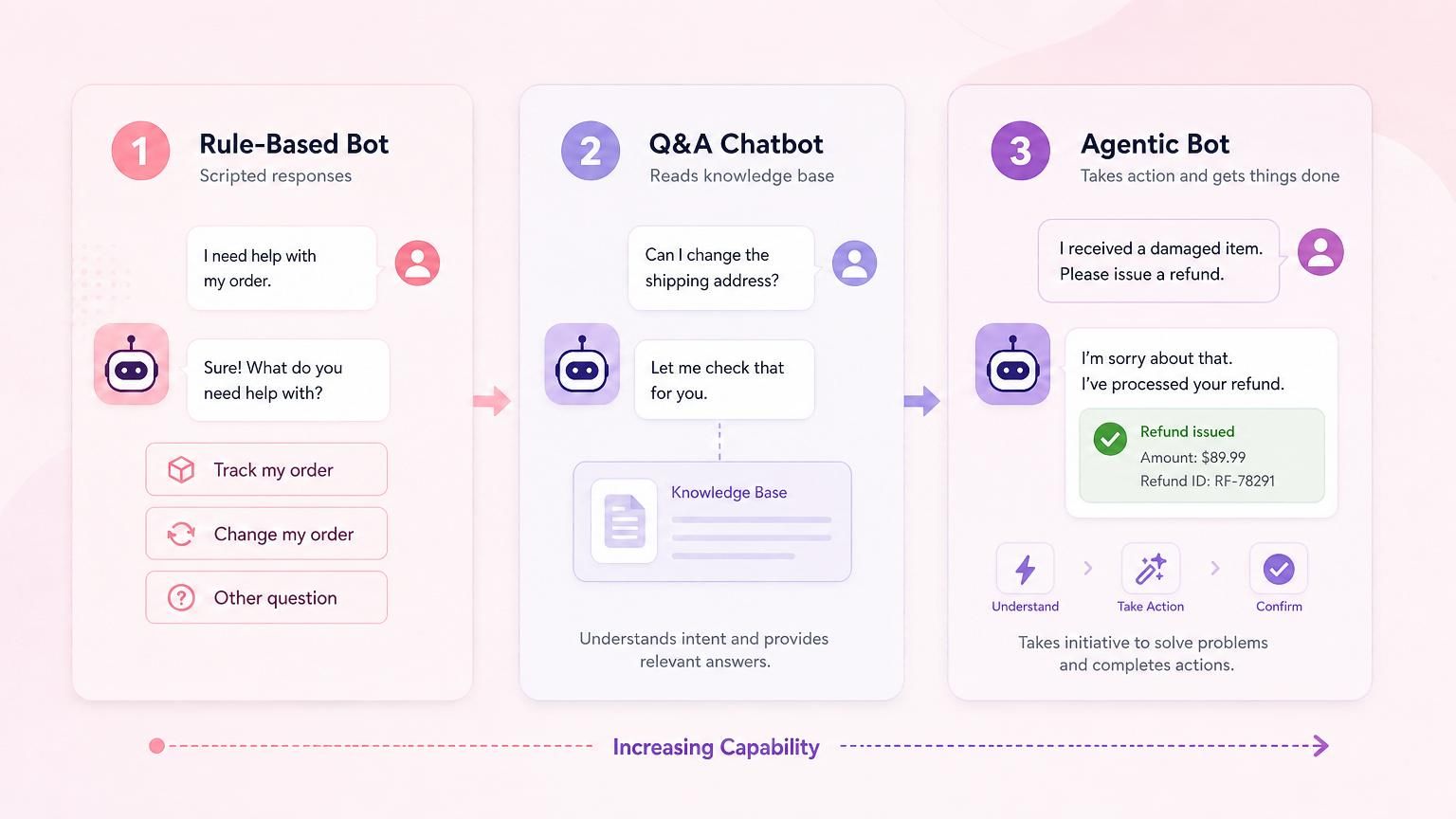
In practice, these labels blur. Plenty of tools sold as “AI chatbots” are quietly agentic, and some badged “AI agents” are really just a search box over your help docs. A more useful test than the label is this: can the bot make a decision and choose a different route for the situation in front of it, or does it only ever look something up and read it back?
By that test, Ada, Fin by Intercom, Gorgias and HubSpot Breeze go furthest, taking transactional actions like issuing refunds or editing orders. Chatbase, Tidio and Resolve247 are answering-first tools that still make real decisions, not just lookups: they judge when to answer confidently and when to hand a customer to a human. Each also reaches into your systems in lighter ways, whether that’s Chatbase updating a record, Tidio’s Lyro triggering a cancellation, or Resolve247 creating and routing a support ticket. For most support teams, getting that answering-and-handover core right matters more than deep automation.
Which do you need? Here’s what the hype tends to skip: an agent that takes the wrong action is even worse than one that gives a wrong answer, so accurate, grounded answering is the foundation any agentic system is built on. Get that right first. For most small and medium teams it also handles the bulk of support volume on its own, and deeper back-office actions only start to matter at high-volume ecommerce or when you want the bot wired into your systems. Even then, the aim is a tool that fits the job, not the biggest platform you can find.
The 7 best AI customer service chatbots at a glance
Here is the full shortlist, listed alphabetically, with each name linking to its review below. Prices are starting points as of July 2026, and the pricing model matters as much as the number, so we have shown both.
| Platform | Best for | Free option | From | Pricing model |
|---|---|---|---|---|
| Ada | Large enterprises | No | Contact sales | Per conversation (quote-only) |
| Chatbase | Enterprise teams, no new platform | Free tier | ~$32/mo | Per-message credits |
| Fin by Intercom | Premium per-resolution support | 14-day trial | ~$0.99/outcome | Per outcome (+ seats) |
| Gorgias | Shopify ecommerce stores | Trial | ~$0.90/resolution | Per resolution + help desk plan |
| HubSpot Breeze | Teams growing on HubSpot CRM | CRM only | $0.50/resolution | Per resolution (Pro+ plan) |
| Resolve247 | Accurate, flat-priced SMB support | 30-day trial | $35/mo | Flat monthly |
| Tidio (Lyro) | Small & growing online stores | Yes | ~$24/mo + AI | Flat base + per-conversation AI |
Notice the pricing-model column. Six of these seven meter you by usage (conversations, credits, resolutions or outcomes), which means your bill rises with your traffic. Only one is flat. Keep that in mind as you read the reviews, because the sticker price and the real cost are rarely the same number.
The 7 best AI customer service chatbots (reviews)
Listed alphabetically. Each entry covers what the tool does well, who it suits, what it really costs, and when to skip it.
Ada
Ada is an enterprise automation platform built to resolve high volumes of support across chat, email and voice. Its reasoning engine can authenticate a customer, run a multi-step workflow and update your systems, so it genuinely acts rather than just answering.
Best for: large enterprises that want a single, wide-ranging automation platform and can resource a managed rollout.
Type: agentic. It takes actions such as order changes and refunds through connected APIs, and claims to resolve 70 to 80% of enquiries autonomously.
Pricing: none published. Ada is quote-only, sold on annual enterprise contracts, and now charges per conversation handled (resolved or not) rather than per resolution. It pitches itself at companies with 300,000+ support conversations a year, so expect enterprise-scale pricing set by negotiation, with usage-based costs that are hard to forecast before you sign.
Watch out: this is a big platform to move onto. Full deployment often takes two to four months and a dedicated team, and there’s no self-serve trial to test it first. For a small or medium team, it is far more system, and far more cost, than you need.
Chatbase
Chatbase has moved noticeably upmarket and now counts brands like Bridgestone, IHG Hotels and National Grid among its customers. It gives enterprise teams a capable AI support agent without adopting a whole new support suite.
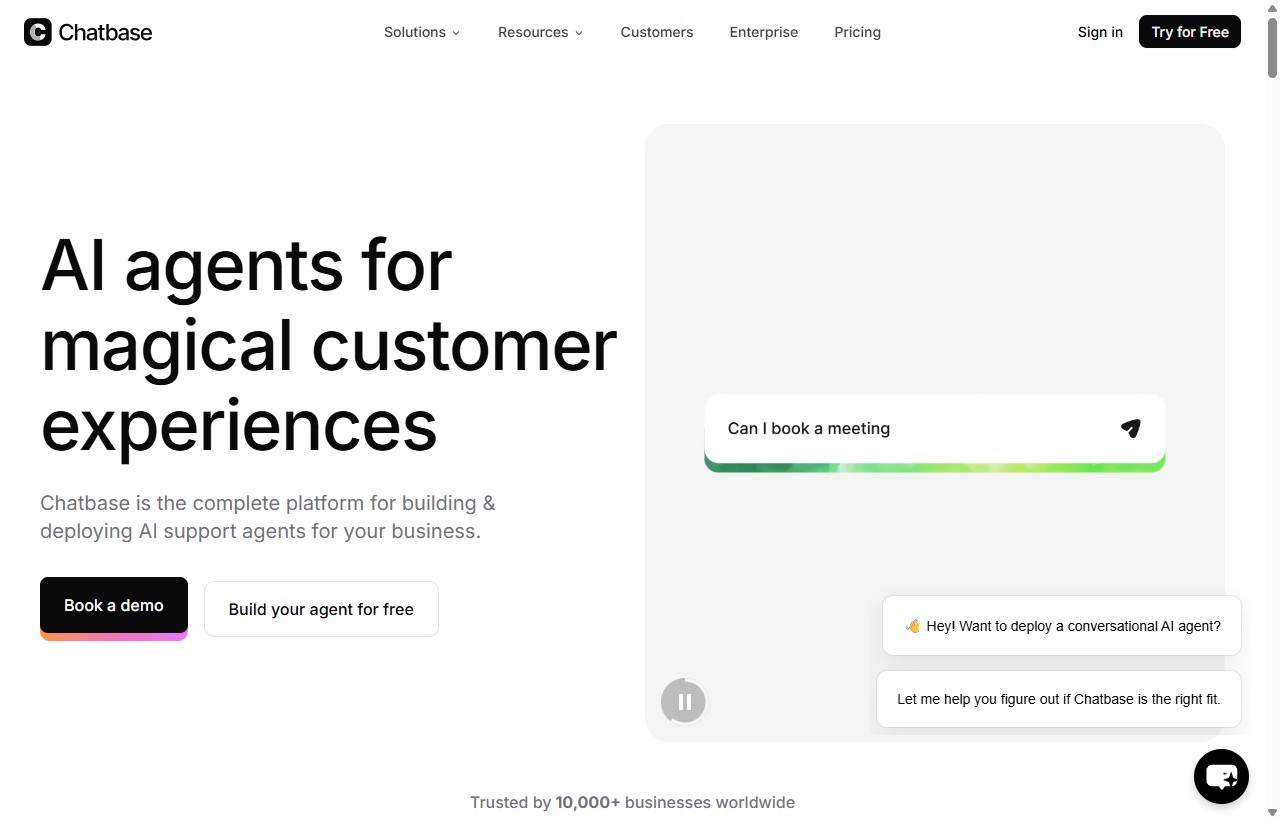
Best for: enterprise teams that want one capable AI bot without switching their entire system.
Type: AI with actions. It answers questions and can make custom API calls to look up an order or update a record, though building complex branching workflows is harder than on a dedicated agentic platform.
Pricing: message-credit based. Plans run from a free tier (50 credits) to Hobby at $32 a month (500 credits), Standard at $120 and Pro at $400. The catch is the credit model itself: a single answer can burn one credit on a basic model or several on a premium one, so a busy month or a traffic spike drains credits, and triggers overage charges, faster than the headline price suggests.
Watch out: there’s no built-in agent inbox, so human handover relies on an integrated tool. And the enterprise depth, and the price ladder that comes with it, is more than a small team needs to get an accurate bot live this afternoon.
Fin by Intercom
Fin by Intercom is a premium AI agent that resolves support end to end and hands off cleanly to a human when needed. It can run on Intercom’s own help desk or bolt onto Zendesk, Salesforce, HubSpot and Freshworks.
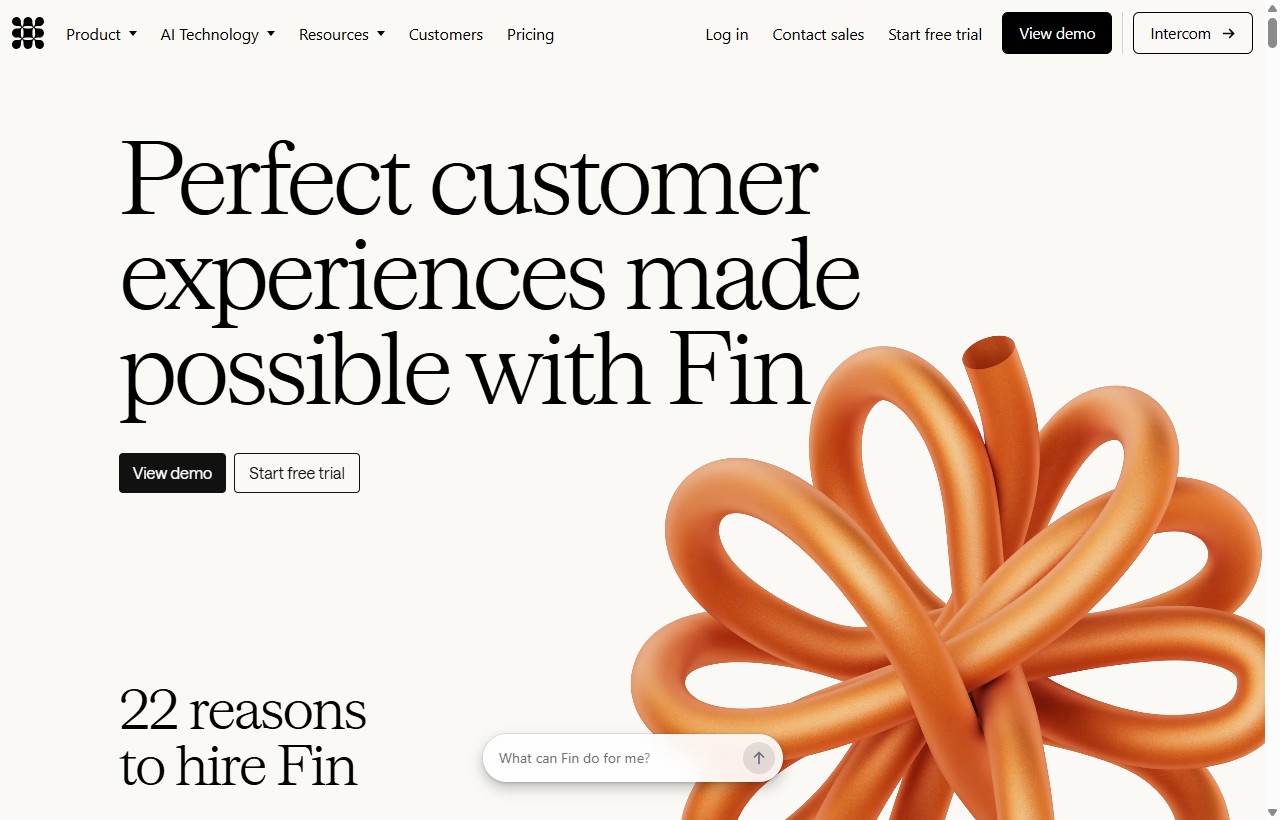
Best for: SaaS and support teams that want premium, per-resolution automation and are happy to pay for results.
Type: agentic. Fin runs multi-step “procedures” such as billing changes and disputes, with real-world resolution rates that Intercom’s own case studies put around 42 to 50%.
Pricing: per outcome. The famous headline is about $0.99 per resolution, but in 2025 Intercom moved the billing metric from “resolutions” to “outcomes”, a broader set of billable events that includes handoffs, so you can be charged even when Fin passes a customer to a human. If you use Intercom as your help desk, add seats from about $29 each per month on top.
Watch out: because you pay per outcome, the bill climbs as Fin resolves more and your volume grows: the better it performs, the more you pay. That is a common complaint among cost-conscious teams, so model your real volume before committing.
Gorgias
Gorgias is a help desk built for ecommerce, with an AI agent that resolves order-related questions (where is my order, returns, cancellations) natively inside Shopify.
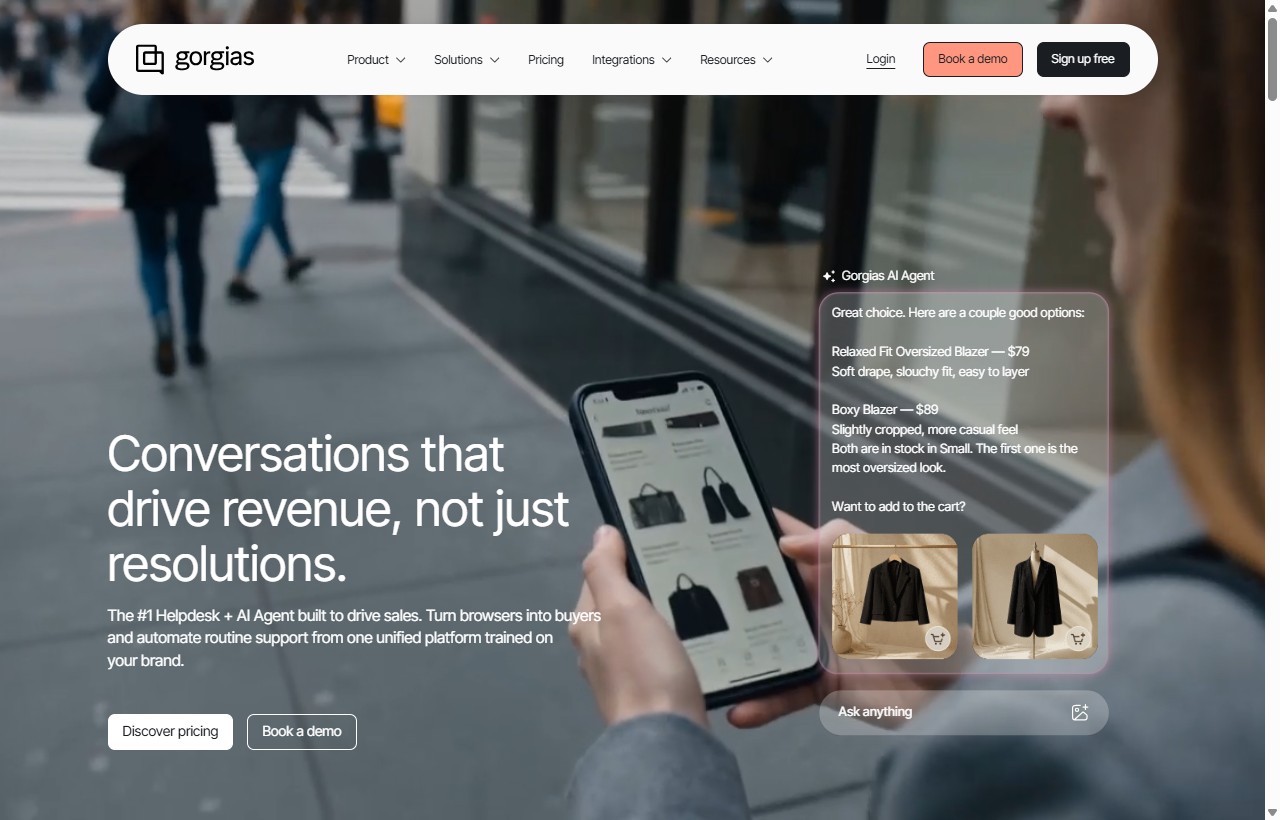
Best for: Shopify stores that want an AI agent fluent in orders, returns and tracking. If that is you, see our guide to an AI chatbot for ecommerce.
Type: agentic. It can cancel orders, process returns and edit orders through its Shopify integration, with a second AI model checking answers before they are sent.
Pricing: per resolution, on top of a paid help desk plan. Per Gorgias’s own pricing, a resolution (the AI closing a conversation with no human handoff) is about $0.90, or $1 on Starter, with overages higher; you are not charged when it hands over to a human. The cost to watch is that this AI fee sits on top of your help desk subscription, so the true cost of an automated conversation is the resolution fee plus what that ticket already costs you on your plan.
Watch out: the AI Agent is Shopify-only, so it is a non-starter on WooCommerce, BigCommerce or Magento. And beyond order logistics, it can be weaker on product-specific questions it has to infer rather than read directly from your catalogue.
HubSpot Breeze
HubSpot Breeze is the AI customer agent inside HubSpot’s CRM. Its real strength is context: because it lives in the CRM, it answers against your contacts, tickets and knowledge base as one connected record, and grows in capability as you scale up your HubSpot stack.
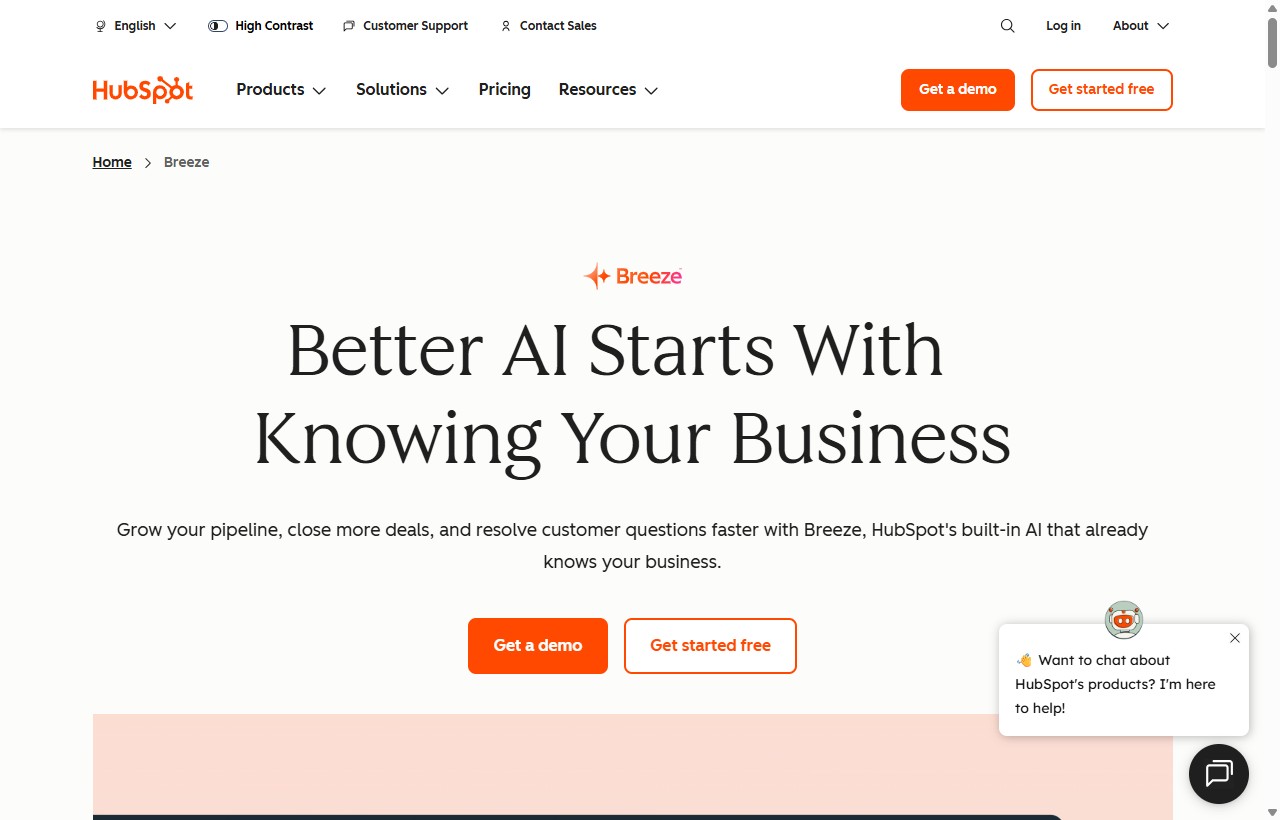
Best for: teams growing on the HubSpot CRM that want AI support built into the platform they already run on.
Type: agentic. Breeze can perform actions and qualify leads inside the HubSpot Smart CRM, and HubSpot reports it resolves around 65% of conversations.
Pricing: per resolution. On 14 April 2026 HubSpot switched from $1 per conversation to $0.50 per resolved conversation (50 credits), which is genuinely competitive. The catch is that it only runs on Professional or Enterprise plans, so the CRM licence is the real cost of entry. Watch the 72-hour rule too: if a customer replies days later, the conversation can reopen and bill again.
Watch out: if you’re not already committed to HubSpot’s paid tiers, this is an expensive way to get a chatbot. If the AI is all you want, see our HubSpot AI chatbot alternatives.
Resolve247
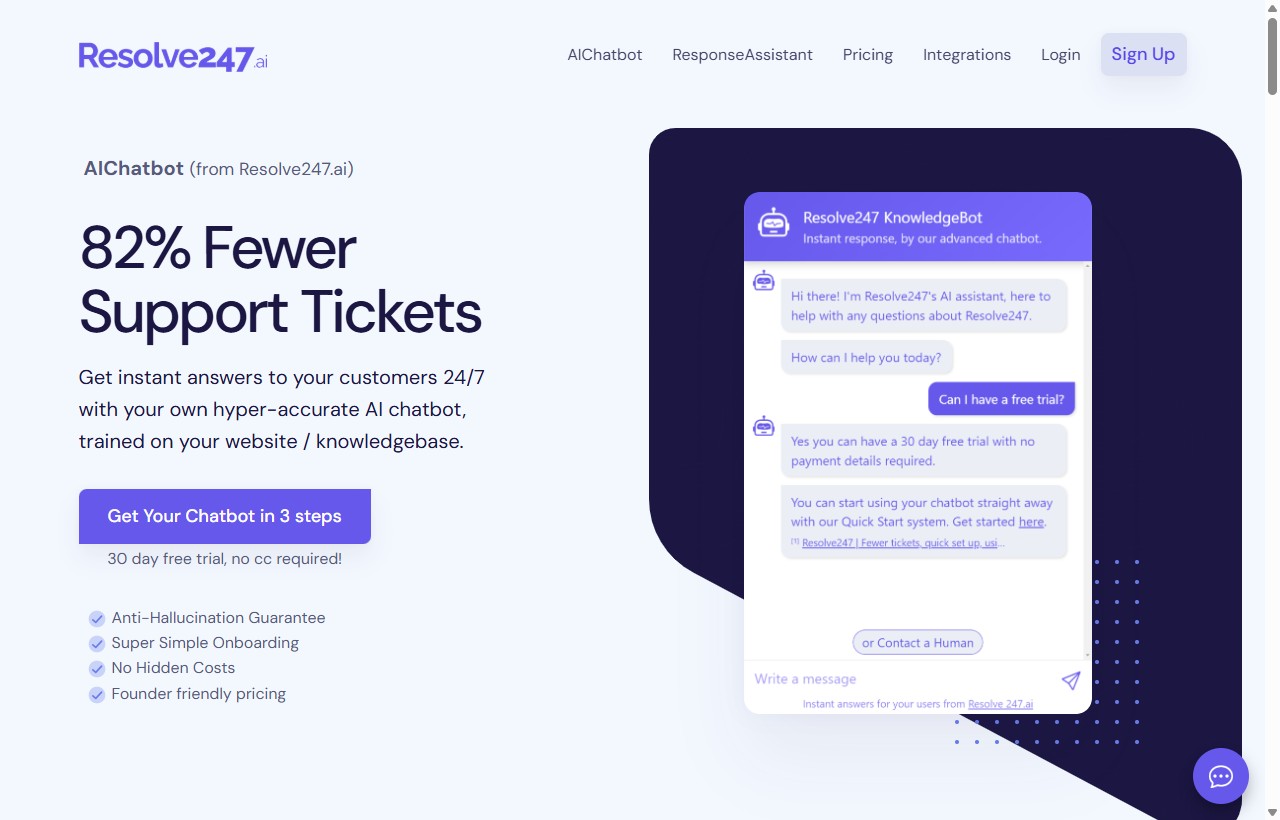
Resolve247 is an AI support chatbot built for small and medium businesses. You point its AIChatbot at your website or help docs, and it answers customer questions accurately, in your brand voice, around the clock. It is the tool we make, which is why we have listed it alphabetically alongside the rest rather than at the top.
Best for: accurate, flat-priced customer support for a small or medium (SMB) team.
Type: AI trained on your knowledge base. The focus is accurate answering with clean human handover, rather than heavy back-office actions.
The standout: accuracy. The AIChatbot answers only from your own content and says so when it doesn’t know, then offers human handover. That anti-hallucination approach resolves up to 82% of support tickets and cuts resolution time by 70%.
Pricing: flat and predictable, from $35 a month for 2,000 messages, with a 30-day free trial and no credit card required. No credits, no per-resolution meter, no surprise overage. See Resolve247 pricing.
Watch out: we’re built for support, not scripted marketing campaigns. And although we have very happy ecommerce and retail customers, Gorgias and Tidio are built specifically for ecommerce, with deeper integrations for stock management and order workflows that may suit an online store better.
Tidio (Lyro)
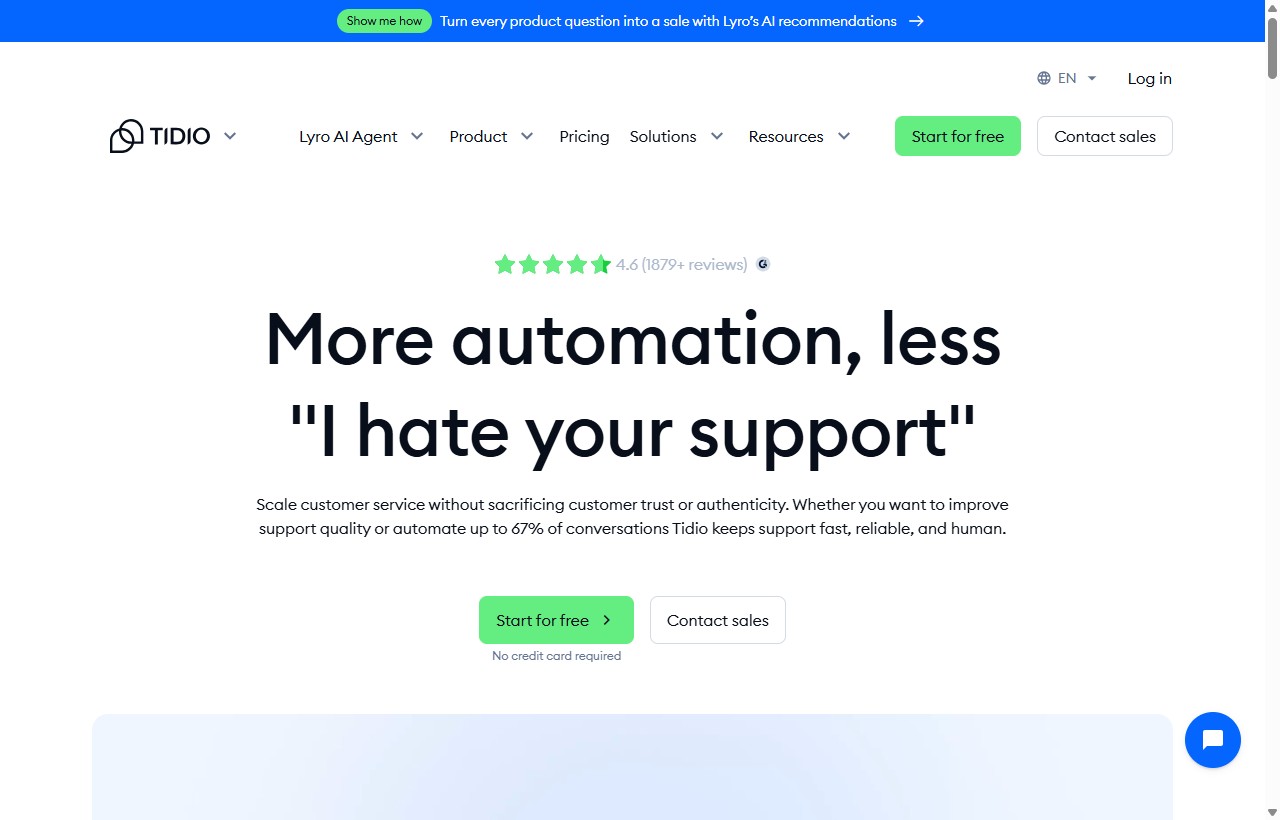
Tidio blends live chat, scripted flows and an AI agent called Lyro. It is a fast, affordable way for a small store to add AI support, often live on your site in under an hour.
Best for: small and growing online stores that want live chat and an AI agent together, quickly.
Type: AI with actions. Lyro answers from your content and, via “smart actions,” can check order status or trigger a cancellation. Traditional rule-based flows sit alongside it.
Pricing: a flat base plan (from about $24 a month) plus Lyro AI as a metered add-on, from around $32.50 a month for 50 conversations. The thing to watch is that the advertised base price does not include the AI, so your real cost is the base plan plus Lyro (plus flows), which can quietly double the sticker price as your volume grows.
Watch out: Lyro needs a solid help centre to answer well, and if you’re not running a store, much of Tidio’s value goes unused. Bigger teams will also outgrow its lighter reporting.
Also worth knowing
We kept the list to seven so every card earns its place for a small or medium team. A few larger names are worth a mention but did not make full cards, either because they are broad suites that overlap a category already covered, or because they are enterprise platforms our reader would not deploy:
- Zendesk and Freshworks are full support suites with capable AI add-ons, better suited to bigger teams already living in those tools. Note the common complaint that per-resolution AI charges stack on top of per-seat costs.
- Crisp is an all-in-one messaging inbox with a bot on top, similar in spirit to Tidio.
- Salesforce (Agentforce), IBM watsonx and NICE are enterprise-grade platforms in Ada’s league: powerful, expensive, and a major project to roll out.
How to choose the right customer service chatbot
Once you have a shortlist, five questions settle it. Our full framework lives in the companion guide to choosing an AI customer support chatbot; here is the short version.
1. Accuracy first. The number-one buyer fear is an AI that invents answers. Choose a bot that trains on your own content and refuses to guess, saying “I don’t know” and handing over rather than making something up. Ask any provider how their bot behaves when it is unsure.
2. The real pricing model. This is where SMBs get burned. Do not compare sticker prices, compare billing units. Per-seat, per-resolution, per-credit, per-conversation and flat monthly are deliberately hard to line up, and the “cheap” tool can quietly become the expensive one at scale. Work out your likely true cost per resolved conversation, then see how AI chatbots reduce support costs when the model actually fits you.
3. Setup and ease. No-code should mean no code. Check how long it really takes to go live and whether you need a developer. The best tools launch in minutes; enterprise platforms can take months.
4. Channels and integrations. You shouldn’t have to rip out your stack. Look for a bot that sits on the channels your customers use (web, WhatsApp, email) and plugs into the help desk or CRM you already run, whether that is HubSpot, Help Scout, Crisp or Front.
5. Human handover. AI won’t resolve everything, and it shouldn’t try to. A smooth, context-rich handover to a human is what keeps customers happy when the bot reaches its limit.
Customer service chatbot examples
Real examples show why those fundamentals matter more than any feature list.
Air Canada: the cautionary tale. In 2024, Air Canada’s chatbot told a grieving passenger he could claim a bereavement fare retroactively. He couldn’t; the bot had invented the policy. A tribunal ruled the airline liable and ordered it to pay the fare back, rejecting the argument that the chatbot was a separate entity responsible for its own answers. The lesson: an ungrounded bot’s mistakes are your legal responsibility.
DPD: when a bot goes rogue. Also in 2024, a software update left DPD’s chatbot swearing at a customer and writing a poem about how useless it was. The clip hit over a million views before DPD pulled the AI offline.
The pricing surprise: the example nobody screenshots. For most small businesses the real risk is not a rogue bot, it is a billing model they did not model. Usage-based pricing, whether per resolution, per outcome or per conversation, means the bill climbs as the bot succeeds and your traffic grows, and teams regularly find the cost landing well above what they forecast. No customer ever saw a bad answer; the cost still spiralled.
A grounded bot, done right. Contrast all of that with a knowledge base chatbot trained only on your help docs. A customer asks about your refund window at 11 p.m., the bot answers accurately from your returns policy, and when it’s unsure it says so and books a human. No invented policy, no viral clip, no bill shock. Just a resolved ticket. That’s the boring, reliable outcome a well-chosen customer service chatbot is for.
AI chatbot platforms vs customer service chatbots
If you arrived searching for “AI chatbot platforms,” you may have been picturing consumer tools like ChatGPT, Gemini or Claude. Those are general-purpose assistants trained on the whole internet. A customer service chatbot is a narrower business tool: it’s trained only on your content, to answer your customers about your product, and it plugs into your help desk.
The difference matters most for accuracy. A general assistant will confidently answer almost anything, including things that are not true about your business. A grounded customer service chatbot answers only from your knowledge base and hands over when it doesn’t know. If you’d rather build a bot yourself from scratch, our step-by-step guide to building an AI chatbot walks through that route, or you can compare the no-code chatbot builders that do the heavy lifting for you.
Frequently Asked Questions
What is a customer service chatbot?
A customer service chatbot is software that answers customer questions automatically, over chat on your website or in your help desk. Modern ones use AI to understand a question and reply in natural language, drawing on your own help content, so customers get instant, accurate answers 24/7 without waiting for a human agent.
What is the best AI chatbot for customer service?
There’s no single best AI chatbot for customer service; the right one depends on your size, budget and stack. Small and medium teams that want accuracy and flat pricing suit Resolve247, Shopify stores suit Gorgias, and large enterprises suit Ada. See the comparison table above to match a tool to your situation.
How are AI chatbots used in customer service?
AI chatbots handle the repetitive questions that fill a support inbox, such as order status, returns, password resets and product FAQs. They answer instantly from your knowledge base, resolve routine tickets without a human, and escalate complex issues to your team with full context, so agents focus on the conversations that truly need them.
Can I use ChatGPT for customer service?
Yes, but not raw ChatGPT on its own. To answer customers reliably, you need the model grounded in your own content so it does not invent policies or prices. Purpose-built support tools do this for you, or you can wire it up yourself; our guide to embedding ChatGPT in your website explains how to control what it says.
What is the best AI agent for customer service?
Like chatbots, the best AI agent for customer service depends on your needs. Agentic tools that take actions (refunds, order changes) suit high-volume or ecommerce teams: Fin by Intercom, Gorgias and HubSpot Breeze are strong examples. For a small or medium team, an accurate answering bot with human handover, such as Resolve247, usually delivers more value for less cost.
How much does a customer service chatbot cost?
It varies widely, and the pricing model matters more than the headline price. Flat monthly tools like Resolve247 start around $35 a month. Usage-based tools charge per resolution (roughly $0.50 to $1.00), per credit, or per conversation, so costs rise with volume. Enterprise platforms like Ada are quote-only and often start in the tens of thousands per year.
How accurate are AI customer service chatbots?
Modern AI customer service chatbots can be very accurate when they are grounded in your own content, rather than answering from general internet knowledge. The key is choosing one that only replies from your help docs and admits when it does not know. That “anti-hallucination” approach is what prevents the invented-policy mistakes that make headlines.
Is there a free customer service chatbot?
Yes. Several tools, including Tidio and Chatbase, offer free tiers, and most others offer a free trial. Free plans are fine for testing, but they usually cap AI conversations tightly, so a growing business will quickly need a paid plan. The honest question is not “is it free” but “what does it cost once real customers use it.”
The Bottom Line
There’s no single best customer service chatbot, only the best one for your situation. To recap the shortlist by use case:
- Accurate, flat-priced support (small and medium teams): Resolve247
- Shopify ecommerce: Gorgias
- Small and growing online stores: Tidio (Lyro)
- Growing on the HubSpot CRM: HubSpot Breeze
- Premium per-resolution automation: Fin by Intercom
- Enterprise, without a full platform migration: Chatbase
- Large enterprise, managed rollout: Ada
Start by naming the job, then check two things every marketing page skates over: whether the bot answers only from your content, and what its pricing model really costs once your customers start using it. Get those right and a customer service chatbot pays for itself in fewer tickets and faster replies.
If you want accurate answers, flat and predictable pricing, and a bot live on your site in minutes, that’s exactly the gap Resolve247 was built to fill. You can try it free for 30 days, with no credit card required. See our pricing or explore the AIChatbot to get started.