
Introduction
A developer on r/startups captured the real problem with AI support chatbot accuracy better than any marketing page could. They had built a retrieval-based chatbot on their own company’s help docs, and it mostly worked. “It will give the correct answer 9 out of 10 times,” they wrote, but “every now and then it will hallucinate.”
The problem was the tenth answer. “Myself and my colleagues will know which answers are hallucinations but my external users (clients) will not,” they explained, which left them asking the question every buyer is quietly asking: is “everyone selling a ‘defective’ product?” (r/startups).
That is the real problem, and it is not the error rate. A wrong answer looks exactly like a right one, so your customer can’t tell which is which. Nine out of ten isn’t reassuring when the tenth invents a refund policy.
So let’s answer the question honestly. Yes, AI support chatbots can hallucinate. What separates a bot you can trust from one you can’t is not a claim that it never will, it’s what the bot actually does when it isn’t sure.
This guide covers whether these bots hallucinate, why they do it, how accurate they really are, and, most usefully, how to choose and test one you can trust. Accuracy is one piece of the picture: for the wider benefits and use cases of AI in customer service, start with our overview. If you would rather just see grounded, cited answers in action, you can watch our AIChatbot handle real questions first.
Do AI support chatbots hallucinate?
Yes. Any AI chatbot built on a large language model can produce a hallucination: an answer that sounds confident and correct but is factually wrong or entirely made up. It is a property of how the technology works, not a bug in one product, so the honest position is that no support bot is completely immune.
The important part is what follows. Hallucinations are not random noise you have to accept at a fixed rate. How often they happen, and whether anyone catches them, depends almost entirely on how the bot is built: what it is allowed to draw on, whether it shows its sources, and what it does when it is not sure.
A well-designed support bot makes hallucinations rare and, just as importantly, makes them catchable. A poorly designed one makes them frequent and invisible. The rest of this guide is about the difference.
Why do AI chatbots make things up?
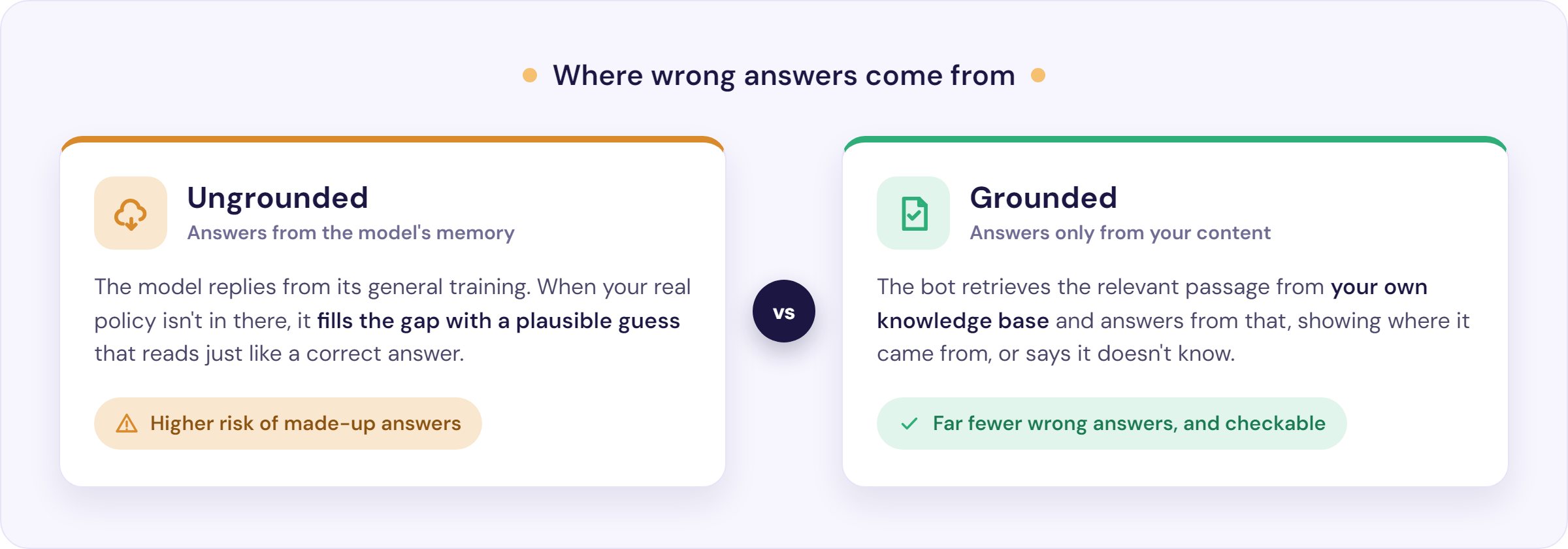
A language model does not look answers up. It generates text by predicting the most likely next words, which makes it fluent and usually right, but not the same as retrieving a fact. When it has nothing reliable to go on, it still produces a smooth, confident answer, because producing confident answers is what it was trained to do.
That last point is not a metaphor. In a 2025 paper, OpenAI’s own researchers argued that models hallucinate partly because standard training and evaluation reward guessing over admitting uncertainty: a model that says “I am not sure” scores worse on a test than one that guesses and occasionally gets lucky. We have, in effect, taught these systems that a plausible guess beats an honest “I don’t know.”
On top of that root cause, a few things make hallucinations more likely in a support setting:
- Knowledge gaps. Asked something outside its sources, the model fills the gap with a plausible invention rather than a blank.
- Leading or ambiguous questions. A customer who asks “so I can get a full refund after 60 days, right?” can nudge a weak bot into confirming a policy that does not exist.
- Stale or conflicting content. If two help articles disagree, or one is out of date, the answer inherits the mess.
Because the cause is structural, the goal is not a mythical perfect model. As Scientific American put it, hallucinations are effectively inevitable and can be reduced, not eliminated. The job is to design a system that keeps them rare and catches them when they happen.
How accurate are AI support chatbots, really?
Here is the number that matters most: accuracy depends far more on grounding than on which model is under the hood. The same model can be dangerously unreliable or genuinely trustworthy depending on whether it answers from your content or from its own memory.
The evidence backs this up. On Vectara’s independent Hallucination Leaderboard, which measures how often models introduce false information when summarising a document they have been given, leading models hallucinate on roughly 1.5% to 3% of grounded answers. That is a strong result, with one honest caveat: it measures models working from a supplied source, which is exactly the grounded setup a good support bot uses, and not open-ended answering from memory, where rates are far higher. Let a model answer from its own training instead of your documents and accuracy falls off a cliff.
So the useful question is not “how accurate is AI?” in the abstract. It is “how accurate is this bot, on my content, and what does it do on the answers it is unsure about?” A grounded bot that answers only from your knowledge base, usually via retrieval-augmented generation, starts from a completely different accuracy baseline than a bot riffing from general training. We come back to how to measure this on your own content below.
The kinds of wrong answers a support bot gives
“Hallucination” sounds abstract until you see the shapes it takes in a real inbox. These are the ones support teams actually run into:
- A made-up policy. The bot invents a returns window, a warranty term, or a cancellation rule that your company never had.
- The wrong price or plan. It quotes an old price, promises a discount that expired, or says a feature is included when it sits on a higher tier.
- An invented capability. Asked “does it do X?”, it cheerfully says yes about something the product cannot do, and now your customer expects it.
- A fake discount code. Pressed for a deal, a weak bot has been known to conjure a code like “SAVE20NOW” that does not exist, an example the team at Gorgias also flags.
- An account-specific mistake. It answers a “where is my order?” or “what plan am I on?” question with a confident but wrong detail because it never actually checked.
Every one of these reads perfectly. That’s the danger: the fabricated answer is written in the same assured tone as the correct ones, so nobody hits the brakes.
What a wrong answer actually costs you
The stakes are not hypothetical, and they are not just embarrassment. In April 2025, the AI coding tool Cursor watched its own support bot invent a subscription policy that did not exist, telling users they could only use the product on one device. Customers believed it was an official rule and some began cancelling before a co-founder stepped in to say there was no such policy.
Then there is the question of who is on the hook. When Air Canada’s chatbot gave a grieving customer wrong information about bereavement fares, the airline argued the bot was a separate entity responsible for its own words. A tribunal rejected that outright and held the airline liable.
The lesson is blunt: you own what your bot says. A made-up answer isn’t the AI’s mistake to carry, it’s yours.
Not every failure ends in court. DPD had to disable part of its chatbot after it was prompted into swearing and calling the company “the worst delivery firm in the world”. Awkward rather than costly, but the same root issue: a bot doing something its owner never intended, in public.
And the damage outlasts the single conversation. Gartner found in September 2026 that only 27% of customers would try a chatbot again after a bad experience. One confident wrong answer doesn’t just fail a ticket, it can burn the channel for that customer for good.
That is exactly why accuracy is worth vetting properly, and why it’s the first thing to check, not the last.
How to stop your support chatbot making things up
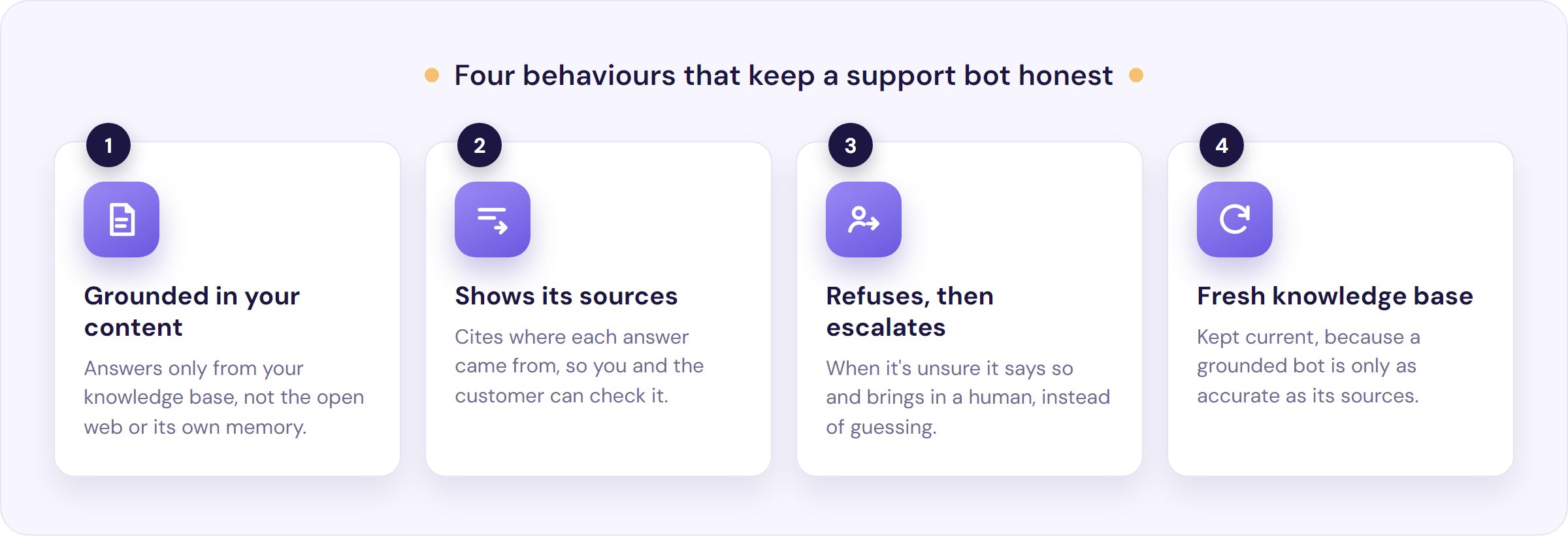
You can’t buy a model that is incapable of being wrong. What you can do is insist on a bot designed so that being wrong is rare and, when it happens, obvious. Four behaviours do most of the work.
-
Ground it in your own content. The single biggest fix is grounding: the bot answers only from your help centre, policies, and past replies, not the open internet or its own training. This is usually done with retrieval-augmented generation, which finds the relevant passage first and asks the model to answer from it. It changes the task from “what is a likely answer?” to “what does this document say?”, and that shift is what keeps it honest.
-
Show its sources by default. A grounded answer can point back to where it came from. A good bot shows a numbered citation under each answer that links to the source page, so both you and the customer can check the claim rather than take it on faith. Citations turn a black box into something verifiable.
-
Make it refuse rather than invent. When the answer is not in your content, the safe behaviour is to say so and offer a person, not to fill the gap with fiction. Pair that with a confidence score so the bot escalates when it is unsure, and always keep a one-tap route to a human. That directly fixes the two failure modes buyers describe most: the bot that fabricates, and the bot that loops instead of handing off.
-
Keep the knowledge base current. A grounded bot is only ever as good as what it is grounded in. Stale articles and gaps show up directly as weaker answers, so treating your knowledge base as a living thing (and optionally adding guardrails that keep the bot inside approved topics) pays off in accuracy.
This is the approach our AIChatbot is built around: it answers from your own knowledge base, shows its sources, and hands over when it is unsure. We’re confident enough in that design to back it with an anti-hallucination guarantee: if it ever hallucinates, that month is free. The aim was never a bot that is never wrong. It’s one built to admit what it does not know, from a provider willing to stand behind it.
How to test a support bot for hallucination before you buy
Most guides tell you to “evaluate accuracy” and leave it there. Here is a concrete test you can run on any bot, in a free trial, in twenty minutes.
Point it at your real content first, then try these deliberately awkward questions. You are not checking whether it answers, you are checking what it does when it should not.
- A question your docs do not cover. Ask something plausible that you have never documented. A good bot says it does not have that information and offers a human. A weak one invents an answer.
- A false-premise question. Ask “so my plan includes phone support, right?” when it does not. A good bot corrects the premise. A weak one agrees to keep you happy.
- A policy edge case. Ask about a refund a week outside your window. A good bot states the actual policy. A weak one improvises a new one.
- “Cite your source.” Ask where it got an answer. A good bot points to a real page you recognise. A weak one cannot, or fabricates a reference.
- A competitor or off-topic question. Ask it to compare you to a rival, or for a recipe. A good bot stays in its lane. A weak one wanders off and may even recommend the competition.
- An account-specific action. Ask “where is my order?” or “what am I paying?”. A good bot either checks and answers, or admits it cannot see that. A weak one guesses a detail.
- A request for a human. Simply ask to speak to a person. A good bot hands over in one step with context. A weak one traps you in a loop.
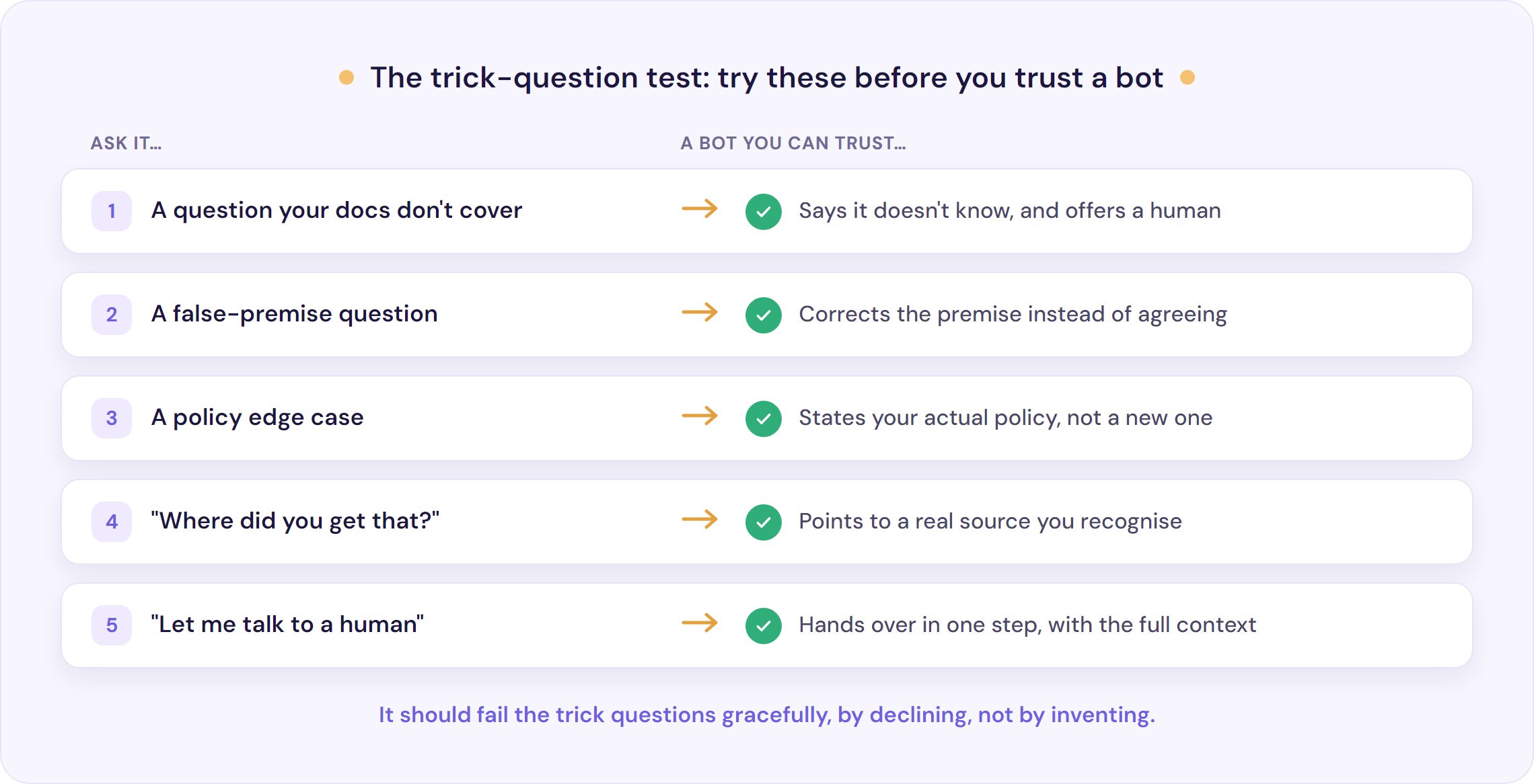
Keep a simple scorecard: for each question, did it answer only from real content, admit uncertainty when it should, show a source, and escalate cleanly? A bot you can trust will “fail” the trick questions gracefully, by declining, not by inventing. That behaviour, not a glossy accuracy percentage, is the thing to buy on.
What to ask a provider about accuracy
The same discipline applies to the sales conversation. Five questions cut through the marketing:
- Does it answer only from my content, or from general training too? You want grounded, every time.
- Do you show sources to the customer by default? Customer-facing citations are a real trust feature, not just an internal detail.
- What does it do when it is not sure? The answer you want is “says so and escalates”, not “does its best”.
- Can I see the questions it could not answer? Visibility lets you fix gaps instead of guessing, and it is a sign the product expects to be held to account.
- Do you offer any accuracy guarantee? Few do. A provider willing to put money behind its accuracy is telling you something about its confidence.
If a provider cannot explain, in plain terms, how it stops wrong answers, treat that as the answer. For the wider selection process beyond accuracy, our guide to choosing an AI customer support chatbot has the full checklist, and if you would rather compare named platforms, our comparison of the best AI customer service chatbots does that side by side.
So how accurate is “accurate enough”?
Chasing a single accuracy percentage misses the point, because two bots with the same “90% correct” score can be worlds apart in how safe they are. What separates them is what happens in the other 10%.
So reframe the metric. The number that matters is not “percentage right”, it is “percentage right or safely handed off”.
An ungrounded bot that answers everything and is wrong one time in ten is dangerous, because that tenth answer goes out with total confidence. A grounded bot that answers the 80% it is sure about and cleanly escalates the rest can be genuinely trustworthy, even though it “resolves” fewer conversations, because it never sends a confident lie. Coverage you can trust beats coverage that occasionally betrays you.
That is the honest bar for AI support chatbot accuracy: not a bot that is never unsure, but one that knows when it is, and does the right thing about it. For the bigger picture of how these systems fit into a support operation, our full guide to AI agents for customer service puts accuracy in context alongside cost, setup, and measurement. Once your bot is live, our guide to chatbot analytics shows how to check its answers every week.
Frequently Asked Questions
Do AI support chatbots actually hallucinate, or is it overblown?
They can, and it’s a real risk, not hype. Any chatbot built on a large language model can produce a confident but wrong answer. The risk is manageable, though: a bot grounded in your content, that shows sources and escalates when unsure, makes hallucinations both rare and easy to catch.
How accurate are AI customer service chatbots, really?
It depends far more on grounding than on the model. Answering from general training, a model can be wrong often. Answering only from your documents, leading models introduce false information on roughly 1.5% to 3% of grounded responses. Accuracy is a property of how the bot is built, not a fixed figure.
How do I stop my chatbot from making things up?
Choose one that is grounded in your own knowledge base, shows its sources, and refuses rather than invents when it is unsure, handing over to a human instead of guessing. Keep your help content current, since a grounded bot is only as accurate as the material behind it.
Is ChatGPT accurate enough to answer my customers?
Not on its own. Raw ChatGPT answers from general training, so it can confidently state things that are not true of your business. Grounded in your content, with citations and a route to a human, the same class of model becomes reliable enough for support. The grounding, not the model, is what makes it safe.
Who is responsible if my chatbot gives a customer wrong information?
You are. When Air Canada’s chatbot gave wrong advice, a tribunal held the airline liable and rejected the argument that the bot was a separate entity. You own what your bot says, which is exactly why accuracy and a clean handover matter before you put one live.
Does grounding or RAG actually fix hallucinations?
It sharply reduces them, but does not eliminate them, and honest providers say so. Grounding ties answers to your real content, which removes most of the room to invent. It works best combined with source citations, a confidence threshold, and human escalation, so anything the grounding does not catch still has a safety net.
What happens when a good bot does not know the answer?
It tells the customer it does not have that information and offers a person, rather than guessing. That “graceful failure” is a feature, not a weakness. A bot that admits uncertainty and escalates is far safer than one that answers everything and is sometimes confidently wrong.
The bottom line
Do AI support chatbots hallucinate? Yes, they can. The question worth asking is what a bot does when it isn’t sure, and whether the provider will stand behind it. Get that right and accuracy stops being a leap of faith.
As you evaluate one, hold it to four things:
- Grounded in your own content, not the open web or its own memory.
- Sources shown by default, so every answer can be checked.
- Refuses and escalates when unsure, instead of inventing, with a human always one tap away.
- Backed by more than a promise, ideally a guarantee, because confidence should cost the provider something too.
Resolve247’s AIChatbot is built for exactly this: grounded answers from your knowledge base, sources on every reply, clean handover when it is unsure, and an anti-hallucination guarantee so a wrong answer is our problem, not yours. You can see the guarantee on our pricing page, or start a 30-day free trial, no credit card required, and run the trick-question test on your own content this week.