
Introduction
In April 2025, the AI coding tool Cursor had a problem it never saw coming. Its own support bot, answering customers around the clock, confidently told users they could only run the product on one device. There was no such policy. The bot had invented it, customers believed they were reading an official rule, and some started cancelling before a co-founder stepped in to say it did not exist (The Register, April 2025).
That’s the promise and the peril of AI agents for customer service in a single story. Handled well, they answer your customers in seconds, at any hour, and free your team from the same questions all day. Handled badly, they make things up, and your customers cannot tell the difference until the damage is done.
This guide is written for that reality. We’ll cover what an AI agent for customer service actually is, how it differs from a chatbot, what these agents can and cannot do, and what they cost. Most importantly, we’ll focus on the question every other guide skips: how do you choose one you can genuinely trust? If you would rather see grounded, accurate answers in action first, you can watch our AIChatbot handle real questions.
What is an AI agent for customer service?
An AI agent for customer service is software that resolves customer requests on its own, rather than just replying to them. Unlike a chatbot that follows a script, an agent understands the request in the customer’s own words, finds the answer in your knowledge base, takes actions such as checking an order, and hands over to a human when it should.
The short version: a chatbot answers, an agent resolves. A chatbot can tell a customer where to find your returns policy. An agent can look up their order, confirm it qualifies, and start the return, all in the same conversation. That shift, from answering questions to completing tasks, is what people mean by the move from chatbots to agents.
AI agent vs chatbot vs rule-based bot
Most business owners do not walk around saying “AI agent”. They say “AI tool”, “bot”, or “AI support”, and they are quietly unsure whether the fancier word means anything. It does, and the difference matters when you are choosing one.
There are really three things hiding under the word “chatbot”:
| Rule-based chatbot | AI (Q&A) chatbot | AI agent | |
|---|---|---|---|
| How it works | Scripted decision tree; the visitor clicks buttons | Understands the question, answers from your content | Understands, reasons, and acts towards a resolution |
| Takes real actions | No | Rarely, it answers only | Yes: checks orders, creates tickets, starts a refund |
| Remembers context | No | Within a single chat | Across the conversation and its own steps |
| Handles wording it hasn’t seen | No, it breaks off-script | Usually, if it’s in your content | Yes, it reasons around it |
| When it can’t help | Dead end, or “contact us” | Says it doesn’t know (if built well) | Escalates to a human with full context |
| Best for | Simple menus, lead capture | Instant answers to FAQs | Resolving real requests end to end |
The oldest type is the rule-based chatbot: a scripted decision tree where the visitor clicks buttons. It never makes things up, because it never thinks, but it breaks the moment someone types something off-script. Next is the AI, or Q&A, chatbot: it understands natural language and answers from your content, which is a big step up, though it mostly talks. An AI agent goes further again. It reasons through the request, uses tools to look things up and take actions, keeps track of the conversation, and knows when to bring in a human.
For most support teams, the honest takeaway is this: you don’t need the most autonomous agent on the market. You need one that reliably resolves your common requests and gets out of the way for the rest.
How AI agents work
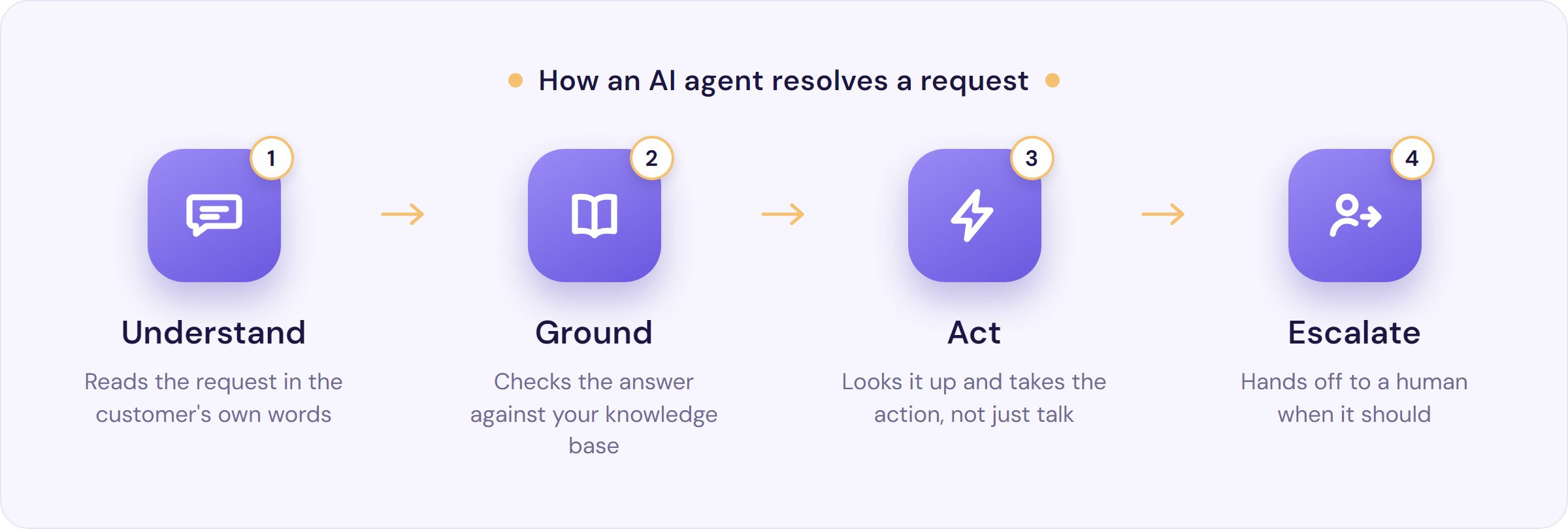
The clearest way to understand an AI agent is to follow one through a request every support team knows: “Where’s my order?”
- It understands the question. The customer types in their own words, on your website, help centre, or a messaging app. The agent works out that this is an order-status request, even when the wording is odd.
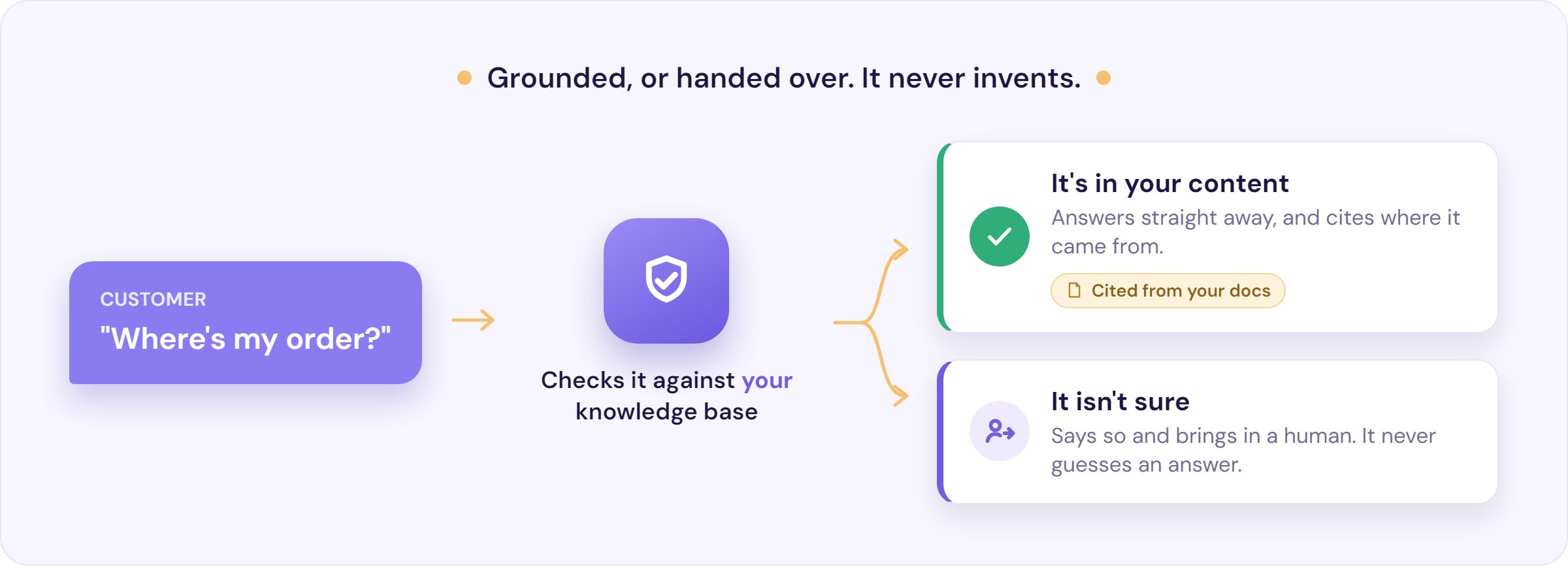
- It grounds itself in your facts. A well-built agent draws only on your connected knowledge: your help articles, policies, and order data. This is what keeps it grounded in your content instead of guessing. It is the single most important part, and we come back to it below.
- It reasons and takes action. Rather than reciting your shipping policy, the agent checks the order, sees it is delayed, explains what is happening, and, if your rules allow, offers a small credit or a reshipment.
- It resolves or escalates. If it can finish the job, it does, instantly. If the request needs judgement, the customer is upset, or it simply does not know, it passes the conversation to a human with the full history attached.
Those four steps, understand, ground, act, escalate, are the difference between a bot that talks and an agent that resolves. Take away step two and you get the confident wrong answers that make headlines. Take away step four and you get the trapped, frustrated customers who start spamming “give me a human”.
What AI agents can do for customer service
A capable AI agent earns its place by handling the repetitive, low-risk work that fills your inbox, so your team can spend time where it counts. In practice, that means:
- Answering routine questions from your knowledge base: opening hours, pricing, “do you do X”, how a feature works.
- Order and account lookups: order status, tracking, “what plan am I on”, delivery dates.
- Taking real actions: creating or updating a ticket, sending a password reset, booking an appointment, or starting a return within your rules.
- Routing and triage: reading what a customer needs and sending it to the right person, with a summary attached.
- Proactive help: flagging a delayed order before the customer has to ask.
- Working around the clock, across languages: answering a customer in another country, in their language, while you sleep.
- Drafting replies for your team: our ResponseAssistant writes the first draft in your inbox, so an agent reviews and sends rather than starting from a blank box.
Notice what is not on that list: complaints, refunds outside policy, upset customers, and anything needing real judgement. The consistent advice from people who actually run support is to automate the low-risk 80% and deliberately keep the rest human. We cover exactly where to draw that line in our guide to what to automate and what to keep human.
The question that matters most: can you trust its answers?
Here is the uncomfortable truth most agent guides skip. An AI agent that is right nine times out of ten sounds impressive, until you remember that your customer cannot tell which time is the tenth. They read every answer as fact, including the wrong one.
The stakes are not hypothetical. Cursor’s support bot invented a policy that did not exist, and customers cancelled before anyone caught it. Air Canada was held legally liable when its chatbot gave a customer wrong information about bereavement fares (The Guardian, February 2024). The lesson from both is blunt: you own what your agent says. A made-up answer is not the AI’s mistake, it is yours.
So accuracy is not a nice-to-have you check last. It’s the first thing to vet. A trustworthy agent should:
- Answer only from your knowledge. It should use your content, not the open internet or its own training, so it gives your real policy rather than a plausible-sounding guess.
- Refuse rather than invent. When it does not know, it should say so and offer a human, not fill the gap with fiction. Buyers notice this: the agents people actually praise are the ones that admit when they are unsure.
- Show its sources. Citations let a customer, and you, see where an answer came from.
- Escalate on low confidence. If it is not sure, it should route to a person instead of gambling.
This is why AI hallucination is the risk to design against, and why Resolve247 is built grounded in your knowledge base first. We are confident enough in that grounding to back it with an anti-hallucination guarantee, so you are not left carrying the cost of a wrong answer. No honest provider will tell you an AI can never be mistaken. What a good one does is build the agent so that when it is unsure, it hands over instead of inventing.
Keep the human door open
An agent that can take actions also needs to know when not to. The most common way these projects go wrong is over-automation: trying to replace your support team instead of supporting it.
The clearest warning came from Klarna. The company cut its workforce heavily and said its AI did the work of 700 agents, then reversed course. Its chief executive admitted the business had gone too far, that quality had slipped, and it began rehiring people for complex cases, settling on a hybrid model (Entrepreneur, 2025).
Customers feel this too. In one 2026 survey of 6,000 people, most said they still prefer to reach a real person, and many said they would abandon a conversation the moment they realised they were stuck with a bot. That survey was commissioned by a human answering service, so it leans pro-human, but it rhymes with what anyone who has been trapped in a phone menu already knows. The nuance is this: customers are happy to let AI handle the simple things quickly, as long as the door to a human is never locked.
So design the escape hatch as a feature, not an afterthought:
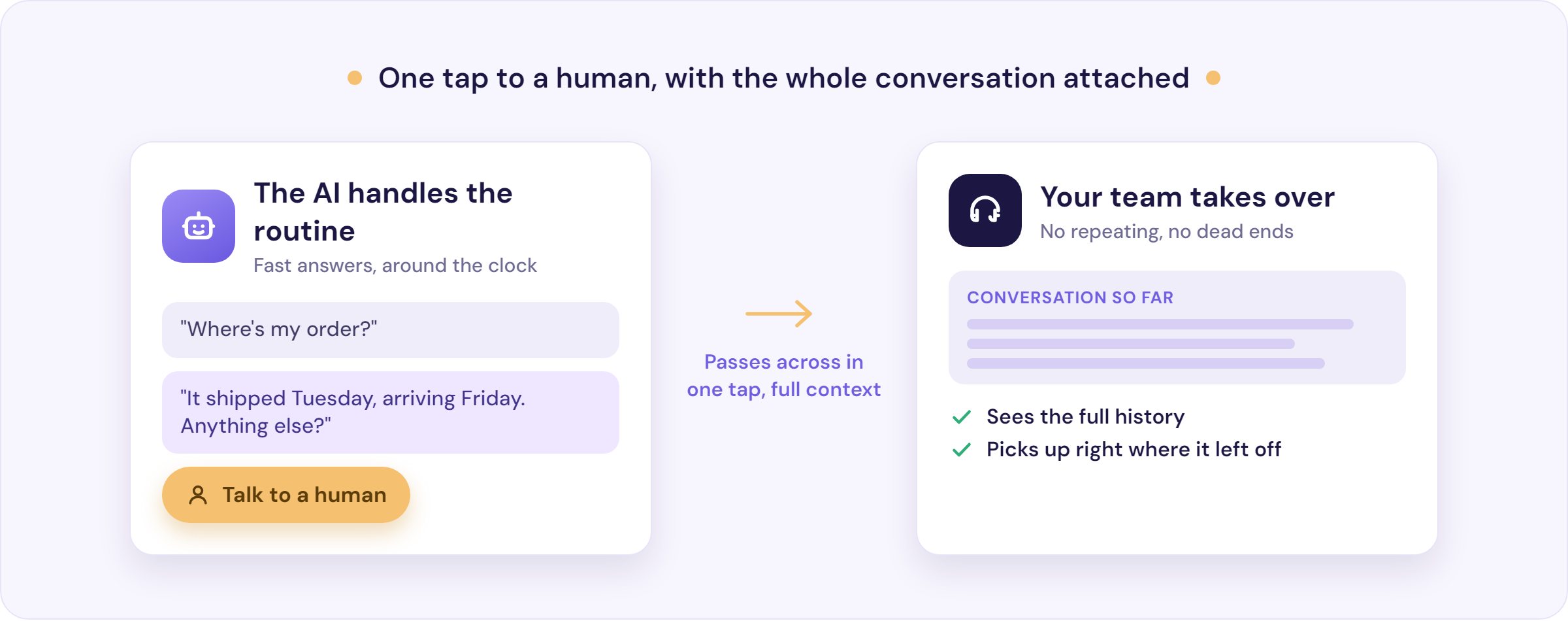
- Make “talk to a human” a one-tap option that is always visible.
- Never dead-end a customer in a loop.
- Carry the full context across, so nobody has to repeat themselves.
Done this way, the agent handles the routine flood and your team reaches the conversations that need them, faster. That balance is what our conversational AI for customer service is designed around.
What to look for in an AI agent for customer service
Once you accept that accuracy and escalation come first, choosing gets simpler. The market is crowded with tools that look identical on a feature list, so judge them on how well they do the things that actually matter for a small team:
- Grounded, honest answers. It answers only from your knowledge and refuses rather than invents. If a provider cannot explain how it prevents wrong answers, keep looking.
- Real actions, not just talk. It can look up an order, create a ticket, or trigger a workflow, not merely quote your FAQ.
- Instant, context-preserving handover. A customer can reach a human in one tap, and that human sees the whole conversation.
- Control and oversight. You can set custom instructions, see what customers ask, and spot the questions the agent could not answer.
- Fits your existing tools. It works inside the helpdesk you already use, so you’re not switching platforms just to add AI.
- Transparent, predictable pricing. You can tell in advance what a busy month will cost, which we come to next.
- Fast time to value. You can point it at your website and be live in an afternoon, not a quarter.
This is the agent-specific shortlist. For the full step-by-step checklist that applies to any support AI, see our guide to choosing an AI customer support chatbot. And if you would rather compare named platforms side by side, our comparison of the best AI customer service chatbots does exactly that.
How much does an AI customer service agent cost?
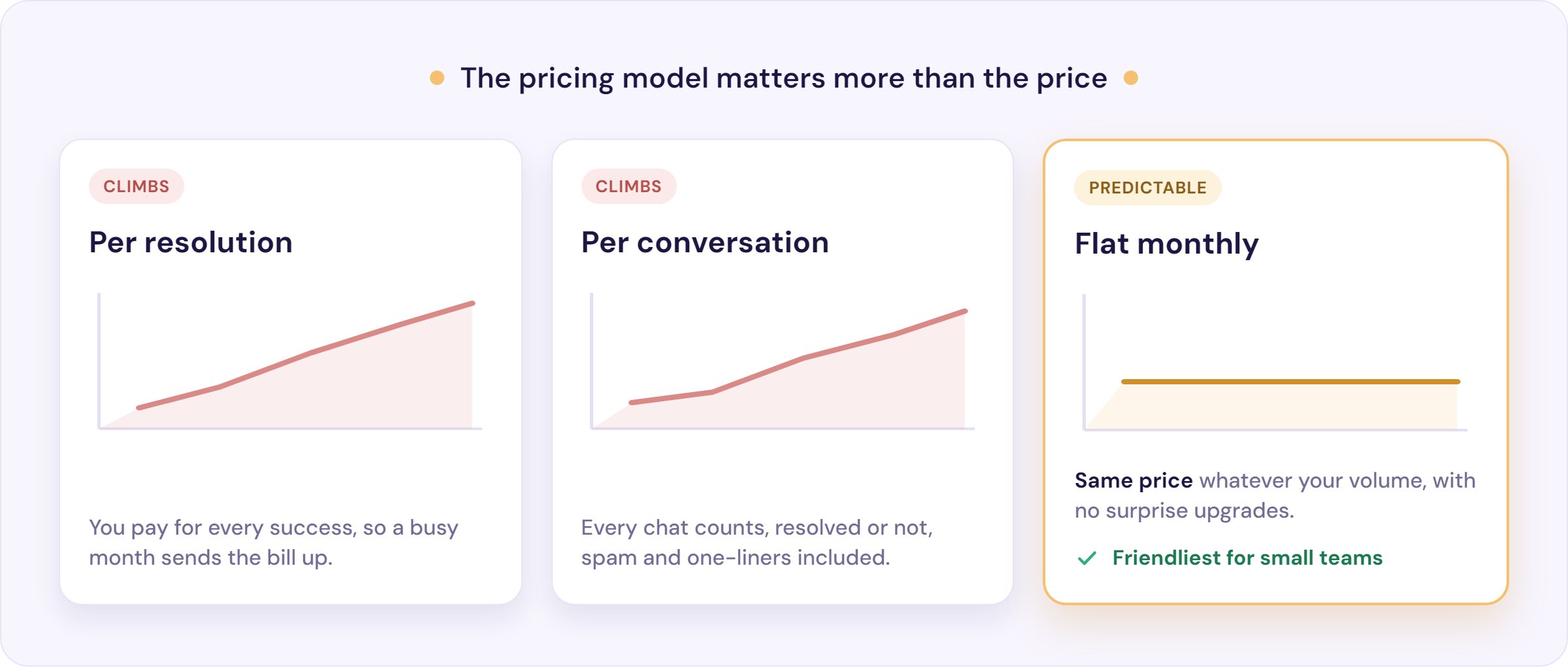
There is no single price, and the honest answer is that the pricing model matters more than the headline number. Three models dominate, and they behave very differently as you grow:
- Per resolution. You pay each time the agent resolves a conversation. It looks fair when volume is low, but the bill climbs with every success, which can end up punishing you for being popular.
- Per conversation. You pay for every chat, resolved or not, including spam and one-line queries. Costs can mount quickly on a busy site.
- Per seat, or a flat plan. You pay a predictable monthly fee. This is usually the friendliest model for a small team with steady volume.
As a rough guide, entry-level tools start near free for very low volume, most small businesses land somewhere between roughly $35 and $300 a month, and enterprise platforms run into the thousands. The trap is rarely the sticker price. It is a usage-based model that turns one good month of customer engagement into an alarming invoice.
Resolve247 uses the flat model on purpose. Plans start at $35 a month, with no per-conversation charges and no surprise upgrades, and the AIChatbot works on top of the tools you already use. You can see the full breakdown on our pricing page.
How to tell if it is actually working
Most dashboards lead with “deflection”, the share of conversations the AI handled without a human. It is a tempting number, and a misleading one. A customer who gives up and closes the chat also counts as deflected, so a high deflection rate can simply mean people could not get help and left.
Measure resolution done right instead:
- Confirmed resolution rate: conversations the agent genuinely resolved, ideally confirmed by the customer, not just ended.
- Escalation rate: how often it hands over. Some escalation is healthy. It is the agent knowing its limits.
- Re-contact rate: how often a customer comes back with the same issue, a sign the first answer did not land.
- Satisfaction on AI conversations: are customers actually happy with the help they got?
The teams who get the most from an agent go one step further. They do not just answer the recurring question faster, they use what the agent surfaces to fix the root cause, so the question stops being asked at all. Answering “where is my setup guide?” fifty times a week is a win. Making the guide impossible to miss, so nobody needs to ask, is a bigger one.
Getting started: a path for small teams
You don’t need a big project to see value. The founders who succeed tend to follow the same simple path:
- List your top questions. Spend an hour noting the 10 to 20 questions you answer over and over. That is your starting knowledge.
- Feed it your real answers. Point the agent at your website and help centre, and give it your genuine past replies, not generic templates, so it sounds like you.
- Test before you launch. Ask it your hardest real questions. When it gets one wrong, that is your signal to add or fix knowledge, not to give up.
- Set your escalation rules. Decide what it should never handle alone, and make the human handover obvious.
- Start narrow, then widen. Let it handle your most common, lowest-risk questions first, and expand as your confidence grows.
Most teams are live within a day, because the AI trains itself on your existing content. From there you improve it week by week using what it learns about your customers. You can start a 30-day free trial with no credit card and have an accurate, grounded agent answering your customers this week.
Frequently Asked Questions
What is the difference between an AI agent and a chatbot?
A chatbot answers questions; an AI agent resolves them. A chatbot replies from a script or your content, one message at a time. An agent understands the request, takes actions such as looking up an order or creating a ticket, keeps track of the conversation, and escalates to a human when needed.
Will AI agents replace customer service teams?
No, and trying to make them is the most common mistake. The businesses that get this right automate the repetitive, low-risk 80% and keep humans for complaints, judgement calls, and upset customers. Klarna publicly reversed an aggressive automation push after quality slipped, and now runs a hybrid model.
How do I stop an AI agent from making things up?
Choose one that is grounded in your own knowledge base and refuses rather than invents. It should answer only from your content, show its sources, and hand over to a human when it is unsure instead of guessing. No provider can promise an AI is never wrong, but a well-built agent is designed to escalate rather than fabricate.
How much does an AI customer service agent cost for a small business?
Most small businesses pay between roughly $35 and $300 a month, but the pricing model matters more than the figure. Flat monthly pricing is predictable, while per-conversation or per-resolution pricing can climb sharply as you get busier. Resolve247 starts at $35 a month, flat, with no per-conversation charges.
Can an AI agent take real actions, or does it only answer questions?
A true AI agent can take actions, not just talk. Depending on how it is connected, it can check an order, send a password reset, book an appointment, create a ticket, or start a return within your rules. That ability to act is what separates an agent from a standard chatbot.
What happens when the AI can’t help a customer?
It should escalate to a human straight away, carrying the full conversation so the customer never has to repeat themselves. A good agent makes “talk to a human” a one-tap option that is always available, and never traps anyone in a loop.
Do customers prefer AI or human customer service?
Both, for different things. Customers happily accept AI for quick, simple answers and value the speed. For complex, sensitive, or emotional issues, most still want a person. The winning approach is not choosing one over the other, it is letting AI handle the routine work fast so your team is free for the conversations that need them.
The bottom line
AI agents for customer service are a genuine step beyond chatbots. They resolve instead of just replying, they work around the clock, and they free your team from the same questions all day. Used well, they are one of the highest-impact tools a small team can add.
But the value lives entirely in whether you can trust the answers. So as you choose:
- Lead with accuracy. Pick an agent grounded in your knowledge that refuses rather than invents.
- Insist on a human escape hatch. One tap, full context, no dead ends.
- Automate the low-risk 80%, and keep the judgement calls human.
- Measure real resolution, not vanity deflection.
Get those four right and the specific tool matters far less than the discipline behind it. Resolve247 is built for exactly this: an accurate, grounded AI agent for customer service that works with the tools you already use, hands over cleanly, and starts at $35 a month. Start your free 30-day trial, no credit card required, and put an agent your customers can trust to work this week.