
Introduction
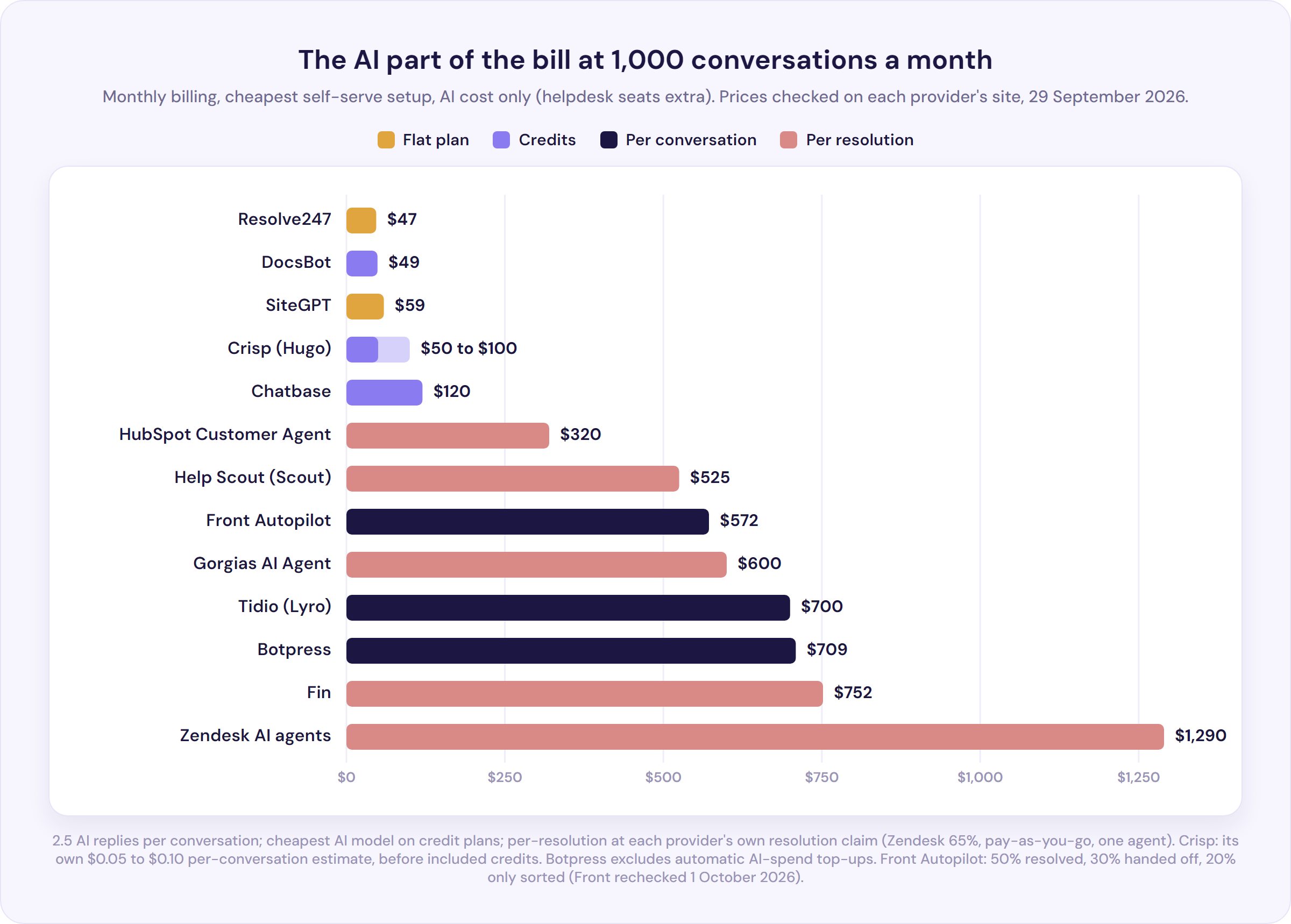
Take one small business with 1,000 customer conversations a month. Run that workload through the published pricing of 13 AI chatbot providers and the AI part of the bill ranges from under $50 to almost $1,300. The bots do broadly the same job. What changes is how each provider counts what you owe.
That is the real story of AI chatbot pricing in 2026. Some providers charge a flat monthly fee, some sell credits, some bill every conversation, and a growing number charge per “resolution”, a word that means something slightly different on every pricing page. Comparing chatbot pricing across units like that is hard, which is why so many buyers are surprised by their first real invoice.
This guide does the comparison for you. We checked every price on each provider’s own website on 29 September 2026, then worked out what each one costs at 300, 1,000 and 3,000 conversations a month. We also cover what counts as a billable resolution, what happens when you hit a limit, and the costs the headline price leaves out.
One disclosure up front: we make Resolve247, a flat-fee AI chatbot, so we have a view. We have kept our full case to one clearly marked section near the end, and where another pricing model is cheaper for your situation, we say so.
How Much Does an AI Chatbot Cost?
A standalone AI chatbot for a small business usually starts at $35 to $59 a month. AI built into a helpdesk such as HubSpot, Help Scout or Zendesk is usually billed at $0.50 to $2.00 per resolved conversation, on top of the seats you already pay for. Free plans exist, but they are sized for trying a bot out, not for running your support.
| Option | What it costs | What you get |
|---|---|---|
| Free plan | $0 | A small test allowance, such as 50 message credits a month on Chatbase or a one-off 50 AI conversations on Tidio |
| Standalone AI chatbot | $35 to $59 a month to start | A chatbot for your website with a monthly allowance (Resolve247 $35, Chatbase $40, DocsBot $49, SiteGPT $59) |
| AI inside your helpdesk | $0.50 to $2.00 per resolution | Pay-per-result AI on top of your helpdesk plan (HubSpot $0.50, Help Scout $0.75, Fin $0.99, Zendesk $2.00) |
| Build your own | Under a tenth of a cent to about 5 cents per answer in AI model fees | Plus the build, hosting and upkeep, which cost far more than the model |
Chatbot costs vary this much because the unit is different. A $35 flat plan and a $0.50-per-resolution meter can each be the cheaper option, depending on how many conversations you have and which helpdesk plan you are already on. If you just want a fixed number, Resolve247’s pricing starts at $35 a month for 2,000 AI messages. The rest of this guide shows how every other model compares.
The 4 Ways AI Chatbot Pricing Works
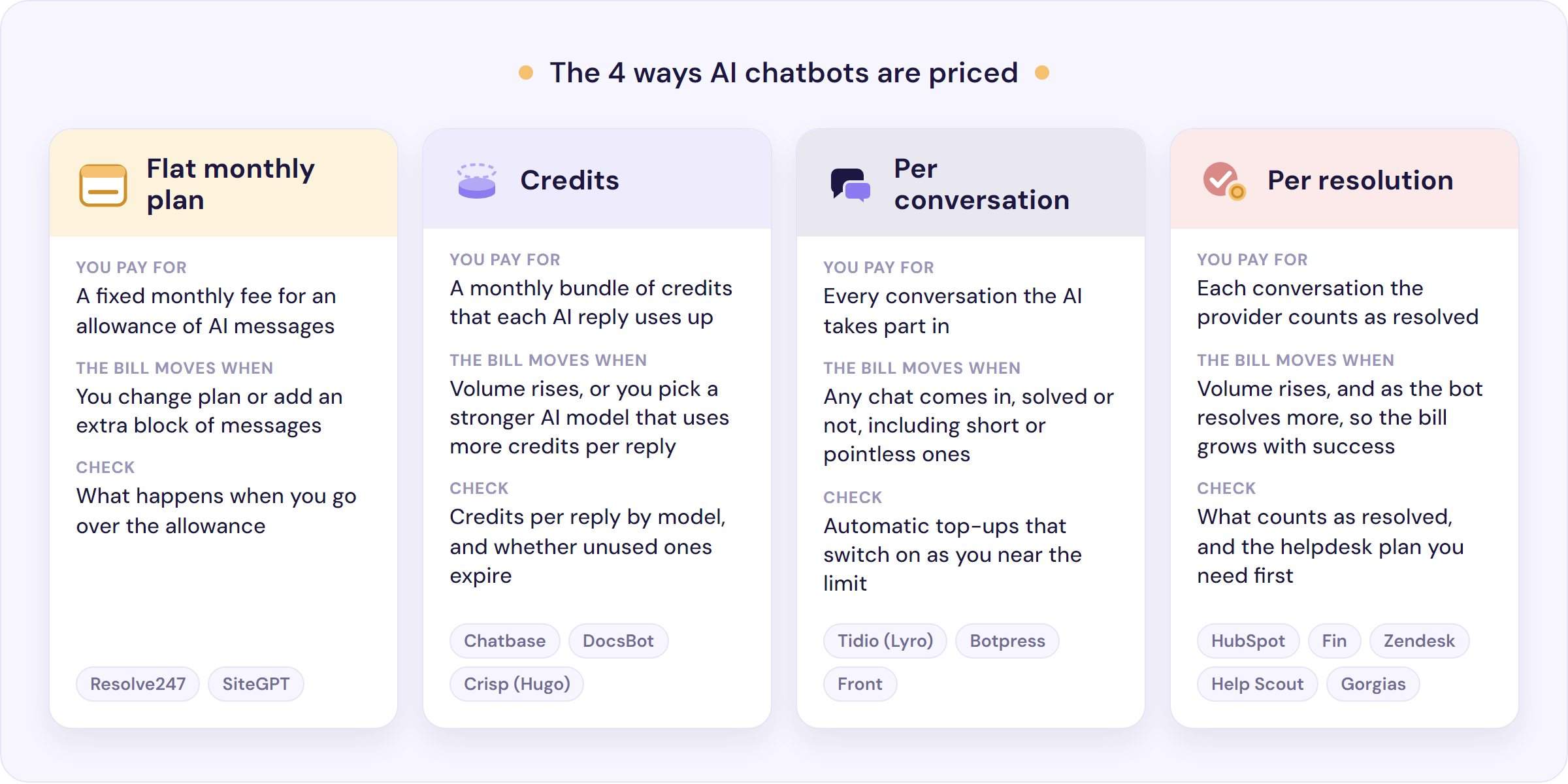
Almost every pricing page uses one of four chatbot pricing models. Knowing which one you are looking at matters more than the headline number, because it decides what makes your bill go up.
1. Flat Monthly Plan (With a Message Allowance)
You pay a fixed monthly fee for an allowance of AI messages, and move to a bigger plan if you need more. Resolve247 and SiteGPT price this way: Resolve247’s Starter plan is $35 a month for 2,000 AI messages, and SiteGPT’s Starter is $59 a month for up to 4,000 messages on its lighter model.
The strength is predictability: you know the bill before the month starts. The catch is the allowance itself. Check what a plan does when you go over, because “flat” plans handle that very differently, and check whether the allowance depends on the AI model. SiteGPT, for example, reduces your allowance tenfold if you switch from GPT-4.1-mini to GPT-4.1.
2. Credits
You buy a monthly bundle of credits, and each AI reply uses some of them. Chatbase (from $40 a month for 700 message credits) and DocsBot (from $49 a month for 5,000 AI credits) work this way. Crisp’s Hugo AI is similar: it draws on a dollar balance of AI credits included with each paid plan.
Credits let you choose which AI model answers, which is their real advantage. But the model sets the burn rate. Chatbase charges 1 to 6 credits per reply depending on the model, and DocsBot’s multipliers run from 1x to 50x, so the same month can cost several times more on a stronger model. Testing can use credits too: Crisp counts your test conversations against your AI credits, while Chatbase gives you a separate monthly test allowance.
3. Per Conversation
You pay for each conversation the AI takes part in, whether it solves the problem or not. Tidio’s Lyro AI agent is sold in tiers of AI conversations, from $39 a month for 50. Botpress includes 250 conversations in its $189-a-month Plus plan and adds packs of 100 for $65. Front’s Autopilot charges per conversation, at $0.05, $0.39 or $0.89 depending on whether it only sorts the conversation, hands it to your team or resolves it.
It is simple to understand, but you pay for the conversations the bot doesn’t solve, including short or unhelpful ones. Watch for automatic top-ups: on new accounts, Tidio’s monthly plans move up to the next tier at 95% of your allowance by default, and Botpress adds conversation packs automatically, with no way to switch that off.
4. Per Resolution (Outcome-Based)
You pay each time the AI “resolves” a conversation. This is now the most common model for AI built into helpdesks. HubSpot’s Customer Agent charges $0.50 per resolved conversation, Help Scout $0.75 per resolution for Scout (formerly AI Answers), Fin $0.99 per “outcome”, Gorgias $0.90 to $1.00 per automated interaction and Zendesk $1.50 to $2.00 per automated resolution.
The appeal is obvious: you only pay when it works. The catch is the definition of “works”, which we come to below, and the fact that your bill rises with every success. When Zendesk started billing automated resolutions, one admin summed it up on Reddit: “stuff I used to get free now counts as an AR.” Under per-resolution pricing, the better the bot gets, the bigger the bill.
To be fair to the model, each billed resolution should also be a chat your team didn’t have to handle, and if the bot resolves less, you pay less.
AI Chatbot Pricing Compared: 13 Providers
Here is where each provider’s pricing starts on monthly billing, checked on their own pricing pages on 29 September 2026. Prices are in US dollars (some providers show local currency depending on where you are) and exclude VAT or sales tax. Most providers discount annual billing, typically by 10% to 40%.
| Provider | Pricing model | Starts at (monthly billing) | You are billed for | You also need |
|---|---|---|---|---|
| Resolve247 | Flat plan | $35/mo for 2,000 AI messages | AI messages (each AI reply is one message) | Nothing extra; runs on your website or inside HubSpot and Crisp chat |
| SiteGPT | Flat plan | $59/mo for up to 4,000 messages | Messages (allowance reduced 10x when using GPT-4.1) | Nothing extra |
| Chatbase | Credits | $40/mo for 700 credits | 1 to 6 credits per AI reply, by model | Nothing extra |
| DocsBot | Credits | $49/mo for 5,000 credits | 1x to 50x credits per message, by model | Nothing extra |
| Crisp (Hugo) | Plan + AI credits | $45/mo Mini, including $5 of AI credits | About $0.05 to $0.10 per Hugo conversation (Crisp’s estimate) | A Crisp plan (Mini or above) |
| Tidio (Lyro) | Per conversation | $39/mo for 50 AI conversations | Every conversation Lyro replies to | Nothing extra (Lyro can run on Tidio’s free plan) |
| Botpress | Per conversation | $189/mo for 250 conversations | Conversations with 2+ customer messages | Nothing extra |
| Front Autopilot | Per conversation | $0.05 to $0.89 per conversation, by outcome | Each conversation it works on, once, at the highest outcome: triage $0.05, handoff $0.39, resolution $0.89 | A Front plan, from $35 a seat |
| HubSpot Customer Agent | Per resolution | $0.50 per resolved conversation | Resolutions (Professional plans include 3,000 credits, about 60 resolutions) | A HubSpot Professional or Enterprise plan (Service Hub Professional: $100 a seat plus $1,500 onboarding) |
| Help Scout (Scout) | Per resolution | $0.75 per resolution | Chats where the customer doesn’t ask for more help | A paid plan, from $30 a user |
| Gorgias AI Agent | Per resolution | $1.00 per automated interaction ($0.90 annual) | Tickets with no human needed for 72 hours, plus the ticket fee | A Gorgias helpdesk plan |
| Fin | Per outcome | $0.99 per outcome; 50-outcome monthly minimum on another helpdesk | Resolutions, plus Procedures it completes | Nothing on another helpdesk; an Intercom seat from $29 on Intercom |
| Zendesk AI agents | Per resolution | $2.00 per automated resolution ($1.50 prepaid) | Automated resolutions (5 to 10 a month per agent included) | A Zendesk plan; Suite Team from $69 an agent |
Zendesk is part-way through moving to a new “resolution allowance” model whose per-resolution prices are not published yet, so we have used the rates on its pricing page.
We have written full breakdowns for several of these providers: Chatbase pricing (plus a full Chatbase review), Tidio and Lyro pricing, Hugo AI pricing for Crisp, HubSpot AI agent pricing, Help Scout pricing, and Front pricing.
The Real Chatbot Cost at 300, 1,000 and 3,000 Conversations
Headline prices don’t tell you what you will pay. So we took each provider’s published pricing and worked out the AI part of the bill for a month at three realistic volumes.
How we worked it out:
- 2.5 AI replies per conversation, a typical short support chat. Your own analytics will show your real figure.
- The cheapest self-serve setup that covers the volume, on monthly billing, including each provider’s own top-ups and add-ons (but not Botpress’s automatic AI-spend top-ups, so its real bill may be a little higher).
- The cheapest AI model on credit-based plans (we show the effect of a stronger model below).
- Each provider’s own resolution claim for per-resolution pricing: HubSpot 70%, Fin 76%, Help Scout 70% and Gorgias 60%. Zendesk publishes only “up to 80%”, so we used 65%, a middle-of-the-range assumption, at its $2.00 pay-as-you-go rate with one agent’s included resolutions. Front charges every conversation Autopilot works on and publishes only “up to 70%”, so we used a middle-of-the-range mix: 50% resolved ($0.89), 30% handed off ($0.39) and 20% only sorted or routed ($0.05). A higher real resolution rate means a higher bill, and a lower one a smaller bill (with more chats left for your team).
- The AI cost only. Helpdesk seats and plan fees are extra and are listed in the table above.
Standalone AI Chatbots
| Provider | 300 a month | 1,000 a month | 3,000 a month |
|---|---|---|---|
| Resolve247 | $35 | $47 | $103 |
| DocsBot | $49 | $49 | $98 |
| SiteGPT | $59 | $59 | $118 |
| Chatbase | $80 | $120 | $310 |
| Tidio (Lyro) | $210 | $700 | Sales quote |
| Botpress | $254 | $709 | $1,689 |
Resolve247’s figures at 1,000 and 3,000 conversations use its optional extra-message blocks ($12 a month per 1,000 messages) on top of the Starter and Core plans. The SiteGPT, DocsBot and Chatbase figures include their own top-up packs or credits in the same way.
AI Inside a Helpdesk (on Top of Your Seats)
| Provider | 300 a month | 1,000 a month | 3,000 a month |
|---|---|---|---|
| Resolve247 inside HubSpot or Crisp chat | $35 | $47 | $103 |
| Crisp (Hugo) | $15 to $30 | $50 to $100 | $150 to $300 |
| HubSpot Customer Agent | $75 | $320 | $1,020 |
| Help Scout (Scout) | $158 | $525 | $1,575 |
| Front Autopilot | $172 | $572 | $1,716 |
| Gorgias AI Agent | $180 | $600 | $1,800 |
| Fin | $225 | $752 | $2,257 |
| Zendesk AI agents | $380 | $1,290 | $3,890 |
Resolve247 runs inside HubSpot’s and Crisp’s own chat widgets on any plan, including their free plans, at the same flat price as on your website, with no per-resolution fee. Crisp’s figures are its own estimate of $0.05 to $0.10 per Hugo conversation, before the $5 to $75 of AI credits each paid plan includes; Crisp does not publish its pay-as-you-go rate beyond that. Prepaying Zendesk’s resolutions at $1.50 would bring its 1,000-conversation figure down to about $968. Front’s figure moves with the outcome mix: 1,000 conversations cost about $404 if 30% are resolved and about $706 if 70% are, with the rest handed off or only sorted.
What the numbers show:
- Per-resolution pricing can be the cheapest option at low volume, if you already pay for the helpdesk. HubSpot’s Professional plans include 3,000 credits a month, enough for about 60 resolutions if nothing else uses them, so 100 conversations cost about $5 in extra AI fees.
- It scales in a straight line. Every conversation adds cost, so at 1,000 a month the per-resolution providers range from $320 to $1,290 before seats, against $47 to $120 for the cheaper standalone tools.
- Per-conversation pricing counts every chat, solved or not. At around $0.65 to $0.70 per conversation, Tidio and Botpress climb fastest among the standalone tools.
- The AI model moves credit bills. On Chatbase’s GPT-5.5 (4 credits per reply), 1,000 conversations cost $390 rather than $120. On DocsBot’s GPT-6 Sol (10x credits), they cost $245 rather than $49.
- Crisp’s Hugo is inexpensive per conversation if your support already runs on Crisp.
- You can use a third-party AI inside your existing inbox and chat widget. You don’t have to buy your helpdesk’s own AI to get AI in its chat. Resolve247 runs inside HubSpot and Crisp chat on a flat fee, and Fin can run on other helpdesks from $49 a month. Your team keeps the inbox it knows; only the AI bill changes.
Say you run an online store with about 1,000 chats a month and you already pay for Help Scout. Switching on Scout, its AI chatbot, would add roughly $525 a month at Help Scout’s own 70% claim, and more if a busy month brings more chats. A standalone chatbot on your website covers the same volume for $47 to $59 at list prices, though it runs alongside Help Scout rather than inside its Beacon chat widget.
What Counts as a “Resolution”? (And What Happens at the Limit)
The definition decides your bill, and it is the part of chatbot pricing buyers worry about most. “The biggest sticking point for me was the ‘resolution’ definition,” as one buyer who looked at Zendesk’s AI put it on Reddit.
Most providers define a resolution by what the customer does next, not by whether the problem was actually solved. If the customer doesn’t ask for more help, it usually counts.
Fin, for example, records an “assumed resolution” when a customer leaves for 24 hours without asking for further help. So a customer who gets a poor answer and gives up can look exactly like a happy one. One founder weighing up Fin on Reddit asked, before buying, whether that could mean paying “$1 for intercom to supply a link to an internal document”.
Here is how each provider defines what it bills, and what happens when you reach your allowance or cap:
| Provider | You are charged when | When you hit the limit |
|---|---|---|
| HubSpot Customer Agent | The agent shares a source or takes an action, and the visitor doesn’t ask for a human within 72 hours of their last message. A rep assigned by hand or by workflow doesn’t stop the charge. | On included credits only, the agent pauses until your reset. Once you buy credits, overage defaults to pay-as-you-go (for credits bought since 16 September 2026), with an automatic spend limit. |
| Fin | The customer confirms, or leaves for 24 hours without asking for more help. Completed Procedures count too. At most once per conversation. | Keeps going at $0.99 each. You can set an optional hard limit. |
| Zendesk AI agents | The request is resolved with no escalation to a human, and Zendesk’s AI verifies it. | Overage is on by default at pay-as-you-go rates. You can choose to pause the AI instead. |
| Help Scout (Scout) | The customer doesn’t ask for more help after the AI’s last answer. Once per chat. | Optional monthly cap. At the cap, Scout switches off until the next cycle. |
| Gorgias AI Agent | No human is needed within 72 hours. The helpdesk ticket fee applies as well. | Overage fees. No pause option is documented. |
| Tidio (Lyro) | Any conversation with at least one Lyro reply, resolved or not (an immediate handover isn’t counted). | Monthly plans on new accounts move up a tier automatically at 95%, on by default. |
| Chatbase | Every AI reply uses credits, set by the model. | The bot shows as “currently unavailable” unless auto-recharge is on. |
| Crisp (Hugo) | Every Hugo conversation, resolved or escalated. | Hugo stops and passes conversations to your team, unless you turn on pay-as-you-go. |
| Botpress | Any conversation with 2+ customer messages. | A 100-conversation pack is added automatically, and this can’t be switched off. |
| DocsBot | Every message, weighted by model. | The bot stops with an error message, unless auto-add credits is on. |
| Front Autopilot | Autopilot works on a conversation, charged once at the highest outcome: $0.05 triage, $0.39 handoff or $0.89 resolution. It counts as resolved if no teammate follows up within 24 hours on Autopilot Resolve (Front’s AI chat), SMS, WhatsApp and custom channels, or 72 hours on email and portal. | Keeps going on pay-as-you-go, billed monthly. Front sets a maximum number of conversations only if you ask. |
| Resolve247 | AI messages: each AI reply is one message. | A soft limit: your bot keeps answering and we talk to you about whether a bigger plan makes sense. No automatic charges and no automatic lock-in. |
Two practical points follow. First, ask whether you can set a hard spending cap. Fin, Help Scout and Zendesk let you set one, but you have to switch it on. HubSpot sets a spend limit automatically once you buy extra credits, and lets you pause the agent’s credit use.
Second, a behavioural definition means a confidently wrong answer can still be billed as a success, so accuracy matters as much as price. Our guide to AI support chatbot accuracy shows how to test a bot before you trust it with customers.
Hidden Costs Beyond the Headline Price
The headline price on a chatbot pricing page is rarely the whole bill. These are the extras that most often catch people out:
- The plan you need first. Per-resolution AI sits on top of helpdesk seats. HubSpot’s Customer Agent needs a Professional or Enterprise plan: Service Hub Professional is $100 a seat a month on monthly payments, plus a one-off $1,500 onboarding fee. Gorgias charges a helpdesk ticket fee on each AI-handled ticket as well as the AI fee.
- Branding removal. Taking the provider’s badge off your chat widget costs $99 a month on Chatbase, $59 on SiteGPT, $20 on Tidio and $15 on Resolve247. DocsBot includes an unbranded widget only on its $499 Business plan.
- Extra chatbots. An additional bot is $25 a month on Chatbase, $19 on DocsBot and $30 on Resolve247.
- Testing. Crisp counts your test conversations against your AI credits, so budget for them while you set up.
- No rollover. Unused credits and allowances usually expire at the end of each billing cycle. Chatbase, HubSpot, Crisp, Zendesk and Fin all say so.
- Automatic top-ups. Tidio’s monthly plans on new accounts upgrade at 95% of your allowance by default, and Botpress adds conversation packs automatically.
- Annual commitments. HubSpot’s monthly payment option still commits you for a year.
- Your own time. An AI chatbot is only “as good as your help center”, as one Intercom user put it on Reddit. Keeping your knowledge base current is work, whichever pricing model you choose.
Building Your Own AI Chatbot: What It Costs
Building your own bot on an AI model looks cheap on paper. According to OpenAI and Anthropic, current list prices per million input and output tokens are $0.10 and $0.50 for OpenAI’s GPT-6 Luna, and $1 and $5 for Anthropic’s Claude Haiku 4.5. OpenAI’s flagship GPT-6 Astra costs $10 and $50.
A grounded support answer might use about 3,000 input tokens and 300 output tokens. That works out at roughly $0.0005 an answer on GPT-6 Luna, $0.0045 on Claude Haiku 4.5 and $0.045 on GPT-6 Astra.
The tokens are the small part of the chatbot cost. A support bot also needs a way to read and search your content, hosting, a chat widget, a handover to your team, monitoring, and someone to update it when your products or policies change. That is why custom builds are often quoted as projects: one small-business owner on Reddit was quoted $2,900 for a one-off build plus AI usage fees, and replies suggested anything from a few hundred dollars to five figures. Our guide to building an AI chatbot walks through what is involved if you want to do it yourself.
Which Chatbot Pricing Model Is Right for You?
There is no single cheapest model. It depends on your volume, the helpdesk you already pay for, and how much a variable bill worries you.
- Very low volume, already on the right helpdesk plan: the built-in per-resolution AI is often cheapest. On a HubSpot Professional plan, the 3,000 included credits cover about 60 resolutions a month, which may be all you need.
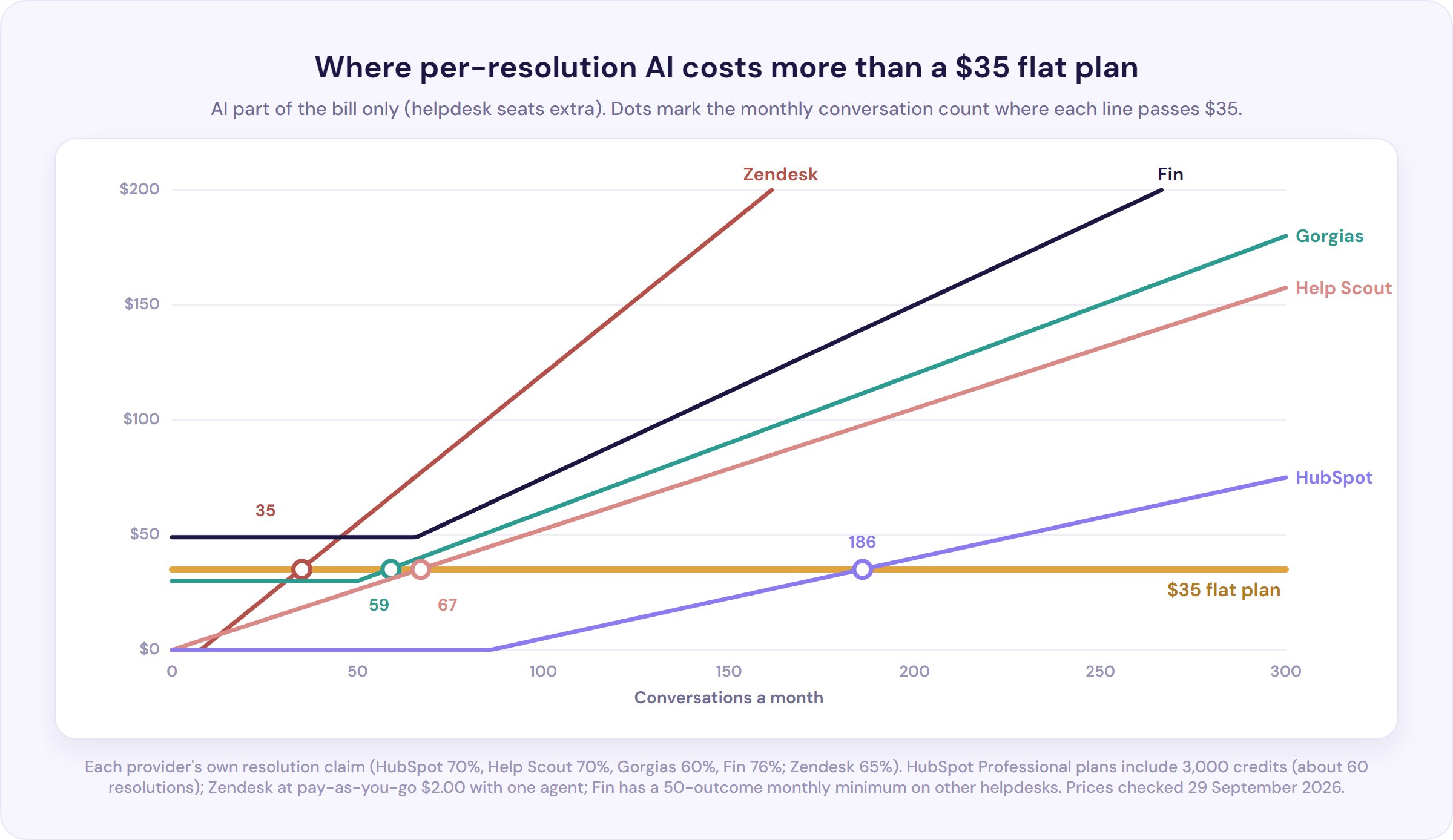
- Steady or growing volume: a flat plan usually wins past a fairly low break-even point. Against a $35 flat plan, the AI part of the bill passes $35 at about 35 conversations a month on Zendesk (44 if you prepay), 59 on Gorgias, 67 on Help Scout and 186 on HubSpot. Fin’s 50-outcome minimum on another helpdesk already costs about $49. These break-even points assume you already pay for the helpdesk plan. If you would have to upgrade to HubSpot Service Hub Professional just to get Customer Agent, the seat alone ($100 a month on monthly billing) costs more than a $35 flat plan at any volume.
- You want to choose the AI model: credit plans give you that control. Budget for the model you will actually use, not the cheapest one.
- You would rather pay only when it works: per-resolution pricing does exactly that, as long as you are comfortable with the provider’s definition and you set a cap.
Whichever way you lean, ask these seven questions before you sign:
- What exactly counts as a billable conversation, resolution or credit?
- What happens when I reach my allowance: does the bot stop, top up automatically or bill overage?
- Can I set a hard spending cap?
- Do unused credits or conversations roll over?
- Do my own tests use up my allowance?
- Which plan or seats do I need before I can buy the AI?
- Can I query or dispute a charge I think is wrong?
Our buyer’s guide to choosing an AI support chatbot covers the questions beyond price, and our comparison of the best AI customer service chatbots looks at the tools side by side. For the other side of the sum, what AI saves rather than what it costs, see how much AI can reduce customer support costs.
Where Resolve247 Fits
This is the part where we make our own case, so weigh it accordingly.
Resolve247’s AI chatbot charges a flat monthly fee. Plans start at $35 a month for 2,000 AI messages, where each AI reply is one message. There are no per-resolution fees and no credits to track, and we use one fixed set of AI models chosen for customer support, so there is no model menu eating into your allowance.
If you go over, your bot keeps answering. It is a soft limit: we will talk to you about whether a bigger plan makes sense, with no automatic charges and no automatic lock-in.
The AI answers from your own content, shows its sources by default and hands over to a human whenever a customer asks. It is backed by our anti-hallucination guarantee: if there is ever a hallucination, you get that month’s chatbot free.
The chatbot runs on any website with a single line of code, or inside your HubSpot (on any plan) or Crisp chat widget. Every plan also includes ResponseAssistant, which drafts replies for your team in HubSpot, Help Scout, Crisp and Front.
We are not the cheapest option in every case. If you already pay for a HubSpot Professional plan and handle only a few dozen chats a month, the credits it includes may cover HubSpot’s Customer Agent at no extra cost. But if your volume is steady and you want to know your bill before the month starts, you can start a free 30-day trial with no credit card required, or compare every plan.
Frequently Asked Questions
How much does a chatbot cost?
Standalone AI chatbots for small businesses start at about $35 to $59 a month. AI built into a helpdesk such as HubSpot, Help Scout or Zendesk is billed at $0.50 to $2.00 per resolved conversation, on top of seat fees. At 1,000 conversations a month, the AI part of the bill ranged from under $50 to almost $1,300 across the 13 providers we could price.
What is the cheapest AI chatbot?
It depends on your volume. At a few dozen conversations a month, AI already included in your helpdesk plan can cost little or nothing extra. For steady volume, the cheapest standalone options in our comparison were Resolve247 and DocsBot, at $35 to $49 a month for up to 1,000 conversations, with SiteGPT at $59. Credit-based plans cost more on stronger AI models.
What does per-resolution pricing mean?
Per-resolution pricing means you pay each time the AI resolves a conversation, for example $0.50 on HubSpot or $0.99 per outcome on Fin. Most providers count a resolution when the customer doesn’t ask for more help after the AI’s answer, so check each provider’s definition before you compare prices.
Is flat-fee or per-resolution chatbot pricing cheaper?
Per-resolution pricing is usually cheaper at very low volume, especially if your helpdesk plan includes some resolutions. A flat fee usually wins beyond a few dozen to a couple of hundred conversations a month. Against a $35 flat plan, at each provider’s own 70% resolution claim, Help Scout passes $35 at about 67 conversations and HubSpot at about 186.
How much does it cost to build a chatbot?
The AI model itself is cheap, at roughly $0.0005 to $0.05 per answer depending on the model. The real cost is building and maintaining everything around it: content search, hosting, the chat widget, handover to your team and monitoring. That is why custom builds are often quoted as one-off projects rather than monthly fees.
Can you get an AI chatbot for free?
Yes, to try one. Chatbase’s free plan includes 50 message credits a month and DocsBot’s includes 100 AI credits, while Tidio gives every account 50 Lyro AI conversations as a one-off batch. Several helpdesks offer AI trials too: Help Scout gives new accounts three months of Scout, its AI chatbot, and HubSpot and Fin offer 14 days. Resolve247 offers a 30-day free trial, with no card required.
The Bottom Line on AI Chatbot Pricing
AI chatbot pricing looks confusing because providers charge for different things. Put them on the same month and the picture gets much clearer:
- Per-resolution pricing is cheapest at very low volume, and climbs with every resolution as you grow.
- Credit plans are only as cheap as the AI model you pick.
- Per-conversation plans charge for the chats the bot doesn’t solve.
- Flat plans are the easiest to budget, as long as you know what happens at the limit.
This week, look up how many chat conversations you had last month and which helpdesk plan you are on, then find your row in the tables above. That tells you which model fits before any sales call does.
If a flat, predictable bill is what you are after, try Resolve247 free for 30 days, no credit card required.