
Introduction
Tidio pricing looks approachable at first glance: a free plan, then paid tiers from $29 a month. Look closer and the real cost depends on something the headline prices do not show, which is that Tidio charges through three separate meters at once, and its AI agent, Lyro, is billed per conversation on top of your plan.
Tidio is a genuinely capable platform. It combines live chat, ticketing and multichannel messaging with an AI agent that Tidio says resolves up to 67% of customer questions. But it prices human conversations, AI conversations and marketing flows as three distinct allowances, adds branding removal as a paid extra, and gives you only a one-off batch of free AI conversations rather than a monthly one. If you are budgeting for it, those details matter more than the sticker price.
This guide breaks down every Tidio plan, explains how Lyro AI pricing actually works, and lists the add-ons and catches that change your monthly bill. All figures were verified on Tidio’s own pricing page in September 2026. Where a flat-fee approach suits a support team better, we say so, and we make one of the alternatives ourselves, so we have flagged that clearly.
Tidio Pricing Plans at a Glance
Tidio sells its core Customer Service platform in five tiers. Three have public prices; Plus and Premium are quote-only. Every paid plan is billed per month, and annual billing gives you two months free.
| Plan | Price (Monthly) | Price (Annual) | Billable conversations/mo | Seats | Built for |
|---|---|---|---|---|---|
| Free | $0 | $0 | 50 | Up to 10 | Basic live chat |
| Starter | $29 | $24.17 | 100 | Up to 10 | Small sites |
| Growth | From $59 | From $49.17 | From 250 | Up to 10 | Growing support teams |
| Plus | From $300 + usage | Custom | Custom | Custom | Larger teams, custom limits |
| Premium | Contact sales | Custom | Custom | Custom | High volume, managed Lyro |
Tidio pricing verified September 2026 against Tidio’s pricing page. Prices are per month on monthly billing; annual billing gives two months free. Tidio shows the same figures in dollars and euros. Growth adds advanced analytics, permissions, automatic assignment and macros; Plus adds departments, multiproject, custom branding and discounted usage rates; Premium adds managed Lyro deployment and pay-per-resolution billing.

Two things stand out before you reach the fine print. First, Growth is priced by volume: $59 buys 250 billable conversations, and the price climbs in steps to $349 for 2,000, so a busy Growth account can cost more than Plus’s $300 starting fee. Second, and more importantly, the plan price above covers human conversations only. The AI agent that most people come to Tidio for is metered and billed separately, which is where the real budgeting starts.
The Three Meters: How Tidio Actually Charges
This is the part that catches people out. A Tidio subscription is not one allowance, it is three, and each is counted and topped up on its own.
- Billable conversations are the human side. Tidio counts a billable conversation as any live chat, ticket, email or social message that a human agent replies to or starts. Spam and unanswered messages do not count, which is genuinely fair, but the allowance is set per plan, from 50 on Free to 250 and up on Growth, and paid monthly plans move up a tier automatically as you near it.
- Lyro AI conversations are the AI side, counted separately. A Lyro conversation is any customer interaction with at least one reply from the AI agent, no matter how many messages it takes to resolve. This is the meter that matters most for AI support, and it has its own price.
- Flows visitors are the marketing side. Flows are Tidio’s no-code automation paths, and they are metered by the number of unique visitors they reach, from 100 on Free up to 100,000, again as a separate allowance.
The upshot is that your Tidio bill is the sum of three usage lines, not one. You can buy each product on its own or bundle them “in any configuration,” in Tidio’s words, which is flexible but makes your monthly cost hard to read off the pricing page. For a support team that wants a single predictable number, that is friction worth pricing in.
Lyro AI Pricing: What the AI Agent Actually Costs
Lyro is Tidio’s AI agent, and for most buyers it’s the reason they are on the pricing page at all. It’s worth understanding how it’s charged, because it isn’t included the way people expect.
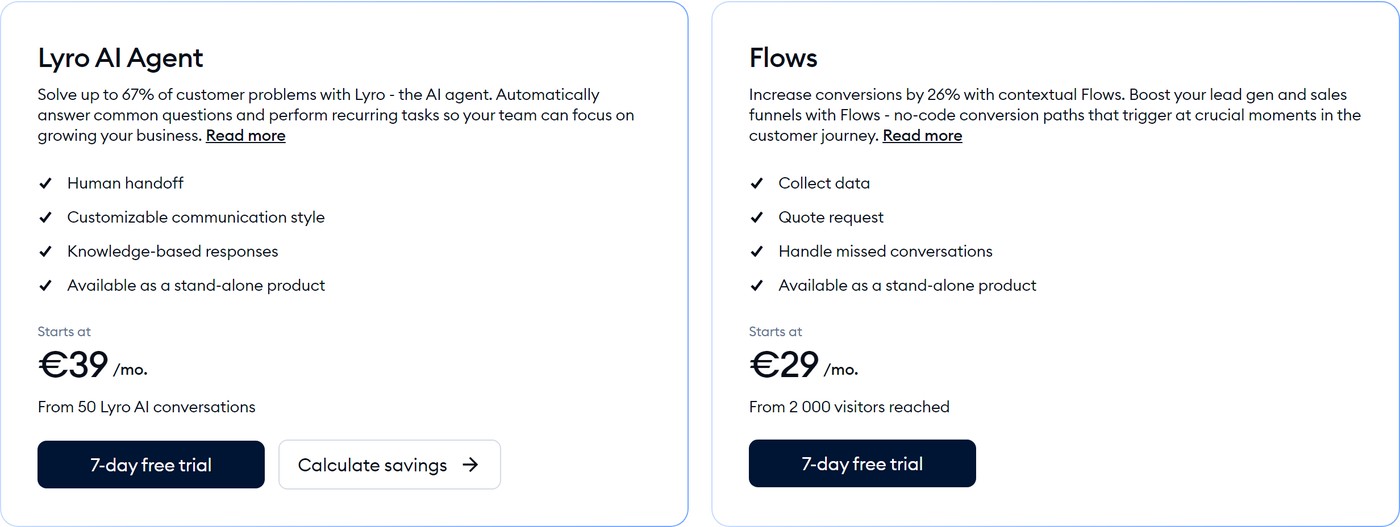
Every Tidio account starts with 50 Lyro conversations, but that batch is a one-off for the lifetime of the account, not a monthly allowance. To get Lyro conversations that refresh every month, you buy the Lyro AI Agent quota, which starts at $39 a month for 50 conversations and scales up through tiers to 1,000, with higher volumes on the Plus and Premium plans (Premium starts at 3,000 Lyro conversations). That works out at $0.78 a conversation at the 50 tier, falling to $0.70 from the 200 tier ($140) up to 1,000 ($700).
A few mechanics sit inside that:
- A Lyro conversation is billed per conversation, not per message. If Lyro replies a dozen times to solve one query, it still counts as one conversation, and nothing is deducted if Lyro hands straight over to a human. That part is reasonable. One caution: Tidio’s pricing FAQ says a customer who leaves and comes back still counts once, but its help centre says a thread closes after 15 minutes of inactivity, so a later return can count as a new conversation.
- The allowance is a tier, and on monthly billing it moves up by itself. You pick a bucket of conversations (50 to 1,000). On standard monthly plans, Tidio automatically upgrades you to the next tier when you reach 95% of it, a setting that is on by default for new accounts and can be switched off; annual and Plus plans do not auto-upgrade. There is no plain per-message pricing underneath.
- The paid quota runs on a 30-day cycle from payment. Tidio says your limit “refreshes 30 days from the moment you make the payment”, not on the first of the calendar month.
- Pay-per-resolution billing only appears at Premium, Tidio’s top, quote-only tier, which also carries a guaranteed 50% Lyro resolution rate. Smaller teams pay per conversation whether or not Lyro resolved the query.
One genuine strength is worth noting: Lyro is available as a standalone agent that you can add to Zendesk, Salesforce or another help desk, not only inside Tidio. If you like Lyro but not Tidio’s live chat, that flexibility is real. You can also add a Lyro quota on top of Tidio’s Free plan, and Tidio sells Lyro on its own as the “Core” plan, from $39 a month for 50 AI conversations.
The Add-Ons and Catches That Change Your Bill
Beyond the three meters, a few extras and details shape what you actually pay:
- Removing “Tidio branding” is a $20/mo add-on on the self-serve plans ($16.67/mo if billed annually). Custom branding proper is a Plus feature. So a badge-free widget on Starter or Growth is a recurring cost the headline price does not show.
- Growth’s price climbs with volume. Growth starts at $59 for 250 billable conversations and rises in steps to $179 for 1,000 and $349 for 2,000; Plus starts at $300 a month plus usage, so a busy Growth account can cost as much as Plus.
- Seats cap at 10 on the self-serve plans. More than that means Plus and a sales conversation.
- Annual billing saves two months but commits you for a year. The discount is worth having if Tidio is the right fit, but model your three meters on a real month first.
For a small team that wants Lyro AI plus a badge-free widget, the extras alone add around $59 a month ($39 for a starter Lyro quota plus $20 for branding removal) on top of the plan price, before any Flows.
What Tidio Actually Costs: A Worked Example
Say you are a small store on the Growth plan at $59 a month, and you want Lyro answering your common questions.
The $59 covers your human live chat up to the plan’s billable-conversation limit. Lyro is extra: a starter Lyro quota of 50 conversations a month adds $39, taking you to $98. If you want the widget without Tidio’s badge, that’s another $20, so $118 a month, and that still covers only 50 AI conversations. Busy months push you up the Lyro tiers, automatically on monthly billing (the next tier is 100 conversations for $75), or on to Plus, and if you also run Flows for lead capture, that is a fourth line on the bill.
None of this is hidden, exactly, but it’s spread across three meters and several add-ons, so you can’t read your monthly cost off the plan price. That’s the honest takeaway: Tidio rewards teams who want live chat, marketing flows and AI in one place and don’t mind assembling the pieces. For a support team that just wants an accurate AI agent on a predictable bill, the assembly is the friction.
Is Tidio Worth It?
For the right team, yes. Tidio is a strong, well-rounded platform. It brings live chat, ticketing and multichannel messaging across WhatsApp, Instagram, Messenger and email into one tool, adds no-code Flows that Tidio says lift conversions by 26%, and has native Shopify actions that suit online stores. Its free plan is genuinely usable for basic live chat, and Lyro is a capable AI agent that draws only on your own support content and can run standalone on other help desks.
It suits growing ecommerce and small businesses who want chat, marketing automation and AI bundled together, and who are comfortable managing three usage lines to get there.
It suits some teams less well. If you run customer support and want a single, predictable monthly bill, three separate meters work against you. If AI is your main reason for buying, the per-conversation Lyro pricing and the one-off free allowance mean the AI costs more than the entry price suggests. And Growth’s price climbs quickly with volume, to $349 a month at 2,000 billable conversations, before any AI.
None of that makes Tidio a bad product. It makes it a broad platform priced for flexibility rather than predictability.
If you are still weighing options, our guides to the best AI customer service chatbots and the best no-code chatbot builders compare the field side by side, our buyer’s guide to choosing an AI support chatbot walks through the questions that matter, and our guide to AI agents for customer service covers the agentic angle.
A Flat-Fee Alternative for Support Teams
If predictable pricing is what you are after, this is where we come in, so treat the next paragraph as us making our own case.
Resolve247 prices support AI as a flat monthly fee rather than across separate meters. Plans start at $35/mo and include a monthly message allowance, with no separate AI conversation meter to top up and no per-conversation counter to watch, so you know your bill in advance. The AI answers only from your own knowledge base, backed by an anti-hallucination guarantee and human handover, and it plugs directly into HubSpot, Help Scout, Crisp and Front rather than asking you to run your support inside another platform. Setup takes minutes, and the free trial runs for 30 days with no card required.
Tidio is the better pick if you want live chat, marketing Flows and AI in a single tool and do not mind metering each one. Resolve247 is the better pick if you run support, want a flat and predictable bill, and value a helpdesk-native bot with a hallucination guarantee. If that sounds like your situation, you can start a free 30-day trial, no card required.
Frequently Asked Questions
How much does Tidio cost?
Tidio has a free plan and paid tiers billed per month: Starter at $29, Growth from $59, and quote-only Plus (from $300 plus usage) and Premium plans. Annual billing gives two months free. Your real cost also depends on the Lyro AI agent, which is metered separately, and add-ons such as branding removal.
What is a Lyro conversation?
A Lyro conversation is any customer interaction that gets at least one reply from Tidio’s AI agent. However many messages it takes to resolve the query, it still counts as a single Lyro conversation, although Tidio’s help centre says a thread closes after 15 minutes of inactivity, so a customer who returns later can start a new one. Lyro conversations are metered separately from your human “billable conversations.”
How much does Lyro AI cost?
Lyro AI Agent pricing starts at $39 a month for 50 Lyro conversations, and scales through tiers up to 1,000, with higher volumes on the Plus and Premium plans (Premium starts at 3,000 Lyro conversations). Every account gets 50 free Lyro conversations, but that is a one-off for the account’s lifetime, not a monthly allowance. Pay-per-resolution billing is available only on the top Premium plan.
Is Tidio’s AI free?
Only to try. Tidio’s free plan includes 50 Lyro AI conversations, but they are a one-off batch for the lifetime of the account rather than a monthly reset. To keep Lyro answering every month you need a paid Lyro AI Agent quota, which starts at $39 a month.
Is there a cheaper Tidio alternative for customer support?
There are several, and the right one depends on your needs. For support teams that want flat, predictable pricing and direct helpdesk integrations, Resolve247 starts at $35/mo with a fixed monthly message allowance and no separate AI meter. For a side-by-side view of the wider field, see our guides to the best AI customer service chatbots and the best no-code chatbot builders.