
Introduction
Hugo AI pricing looks refreshingly simple at first: pick a Crisp plan, pay one flat monthly fee per workspace, and the AI is included. Look closer and the picture changes, because the AI you are actually paying for, Hugo, runs on a separate metered balance of “AI credits” that only stretches so far each month.
Hugo is Crisp’s AI support agent, and Crisp sells it inside its plans rather than as a separate product. That makes Crisp genuinely good value on paper: the base subscription is a flat fee per workspace rather than the per-seat pricing Intercom or Zendesk use, and Hugo is cheap per conversation.
But the credits that power Hugo are capped, they do not roll over, and when they run out the AI stops answering until your next billing cycle. If you are budgeting for it, that detail matters more than the sticker price.
This guide breaks down every Crisp plan, explains how Hugo AI credits actually work, and shows what the combination really costs once your support volume grows. All figures were verified on Crisp’s own pricing page in September 2026. Where a flat, all-in approach suits a support team better, we say so, and we make one of the alternatives ourselves, so we have flagged that clearly.
Hugo and Crisp: One Product, One Bill
If you have searched for Hugo AI pricing and landed on Crisp, that is not a mistake. Hugo is Crisp’s AI agent, the same way Fin is Intercom’s. You do not buy Hugo on its own and bolt it onto Crisp. You buy a Crisp plan, and Hugo is the AI that comes with it.
The two sites confirm each other. Crisp’s pricing page describes its product as “the one complete suite for AI-first customer support, including Hugo.” Hugo’s own site, hugo.ai, sells you a “Crisp Mini plan” as the thing you are signing up for, and badges itself “Powered by Crisp.” So when you compare Hugo AI pricing, you are really comparing Crisp pricing with the AI switched on.
One quick note before the numbers, because the name is crowded. “Hugo” is also a fashion label, an insurance company and a support outsourcing firm, none of which are this Hugo. Throughout this guide, Hugo means Crisp’s AI agent.
Crisp Pricing Plans at a Glance
Crisp sells one platform in four self-serve tiers plus a custom Enterprise plan. Every paid plan is a flat fee per workspace per month with a set number of seats (extra agents, at $10 each, are sold only on Plus), rather than the steep per-seat pricing of Intercom or Zendesk, which is one of Crisp’s real strengths. The number that changes the maths is the last column: the dollar value of Hugo AI credits included each month.
| Plan | Price (per month) | Seats included | Hugo AI credits included | Built for |
|---|---|---|---|---|
| Free | $0 | 2 | None | A first shared inbox |
| Mini | $45 | 4 | $5 | Early-stage teams |
| Essentials | $95 | 10 | $25 | Small support teams |
| Plus | $295 | 20+ | $75 | Omnichannel support |
| Enterprise | Custom | Custom | Custom | Large-scale teams |
Crisp pricing verified September 2026 against Crisp’s pricing page. Prices are per workspace on monthly billing. Mini adds a shared email inbox and triggers; Essentials adds the omnichannel inbox, a workflow builder, the AI chatbot and a knowledge base; Plus adds the full AI-first suite, ticketing, white labelling and 100-plus integrations.
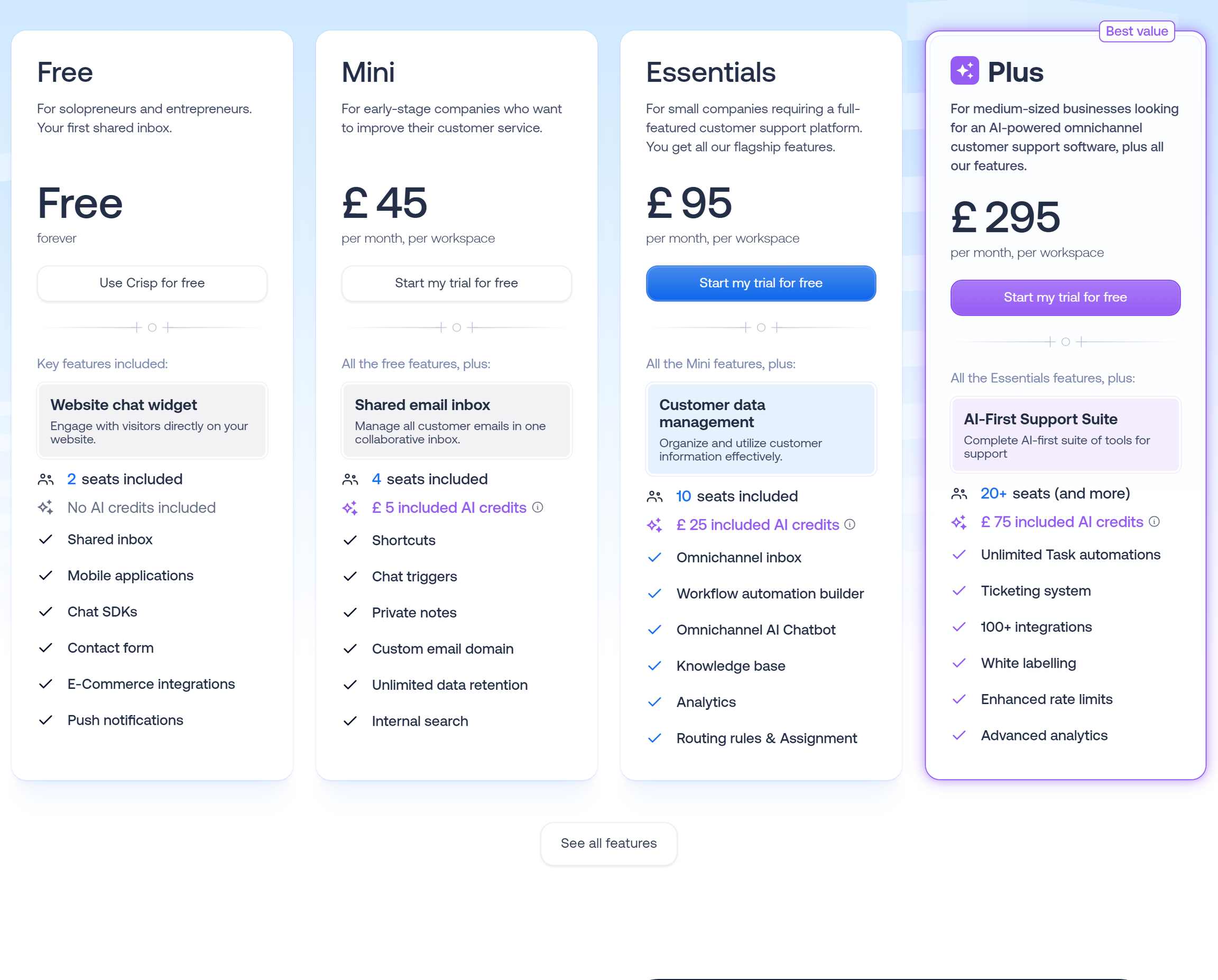
Crisp’s plan cards, captured from a UK connection so they display in GBP. Crisp charges the same figure in each currency, so these match the US dollar prices used throughout this guide.
Two things stand out before the fine print. First, the flat per-workspace fee is genuinely simple, and it is the opposite of the per-seat pricing that makes Intercom or Zendesk expensive as a team grows. Second, and this is the catch, the plan price covers the platform. The AI that most people come to Hugo for is the credits line, and that is metered separately.
How Hugo AI Credits Actually Work
This is the part that shapes your real bill. Hugo does not run on a flat allowance of conversations. It runs on a dollar balance of credits that it spends as it works, and Crisp’s own billing documentation explains the mechanics.
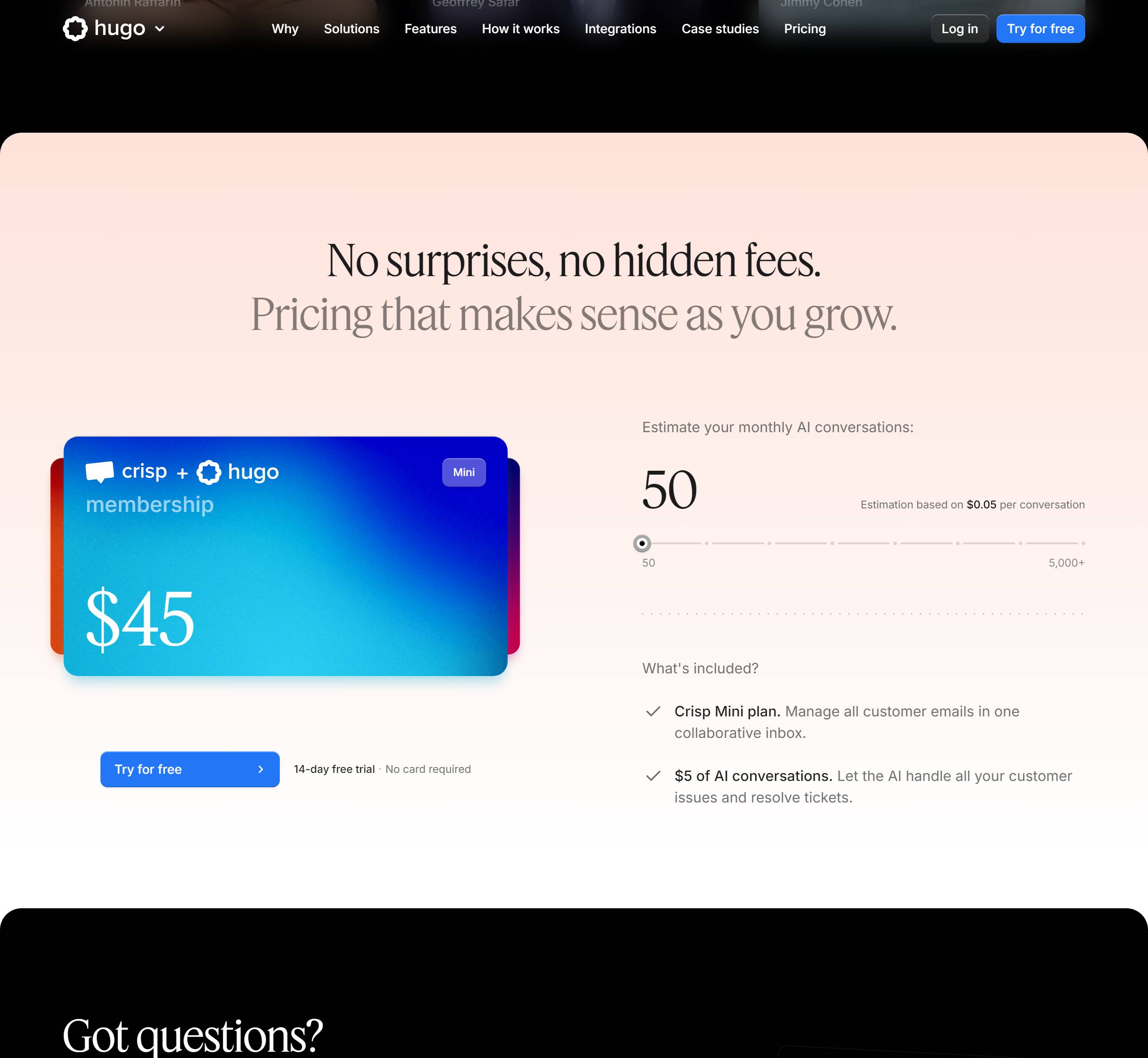
- Credits are token-based and billed per conversation. A Hugo conversation is the full exchange from its first reply until the chat is resolved, routed or escalated, not per message. Crisp puts the average at roughly $0.05 to $0.10 per conversation, and says the longer and more detailed the conversation, the more it costs.
- Each plan includes a fixed dollar amount, and no more. That is the $0, $5, $25 and $75 in the table above. At Crisp’s own estimate, $5 on Mini works out to around 90 automated conversations a month, $25 on Essentials to around 450, and $75 on Plus to around 1,350.
- The Free plan includes no AI. Hugo does not run at all until you are on at least Mini.
- Credits do not roll over. They reset every billing cycle, currently on the 4th of the month, so an unused balance is simply lost.
- A trial spends real credits. Crisp says “Hugo usage during a trial also consumes credits”, and pay-as-you-go “may remain unavailable until the trial ends”, so a trial shows you the included allowance rather than unlimited AI.
- Workflows are outside the meter. Crisp’s rule-based “Workflows are not billed as Hugo usage and do not consume Hugo credits”, so scripted routing can take simple jobs off Hugo’s balance.
- When the credits run out, Hugo stops. By Crisp’s own description, once the included credits are consumed “Hugo stops answering automatically and incoming conversations are escalated to human operators.” It stays that way until your credits reset the next cycle, unless you switch on pay-as-you-go billing to keep buying usage. Crisp does not publish a firm top-up rate.
That hard stop is the mechanic worth understanding. Under-provision your credits and your AI quietly goes dark in the middle of a busy month, handing every conversation back to your team until the meter resets. It is not bill shock. It is the opposite: the cost is capped, but so is the coverage.
The Catches That Change Your Bill
Crisp’s pricing is more honest than most, so this is a short list rather than a minefield. But a few details shape what you actually pay and how the AI behaves.
- No AI on Free. The free plan is a real shared inbox, but Hugo is not part of it. Trying the AI means starting at Mini.
- A big step between tiers, and seats can force it. Extra agents ($10 each per month) can only be added on Plus, so Mini tops out at 4 seats and Essentials at 10, and an 11th agent on Essentials means moving to Plus at $295, a $200 a month step. There is no tier between Essentials at $95 and Plus at $295, and Plus also brings ticketing, white labelling, the full AI suite and 100-plus integrations, so budget for it as both a headcount and a capability upgrade.
- Metered AI with a hard stop. As above, the AI switches off when credits are exhausted rather than billing on quietly, so continuity depends on sizing your credits, or your pay-as-you-go budget, correctly.
- One workspace per brand. Run two or three brands and you generally run two or three separate Crisp subscriptions, each with its own credits. Crisp does offer “20% off for 3 additional Workspaces” on Essentials and Plus, which softens the cost for multi-brand teams.
In fairness, the thing Crisp does not do is run up a shock bill. There is no $0.99-per-outcome meter like Intercom’s Fin, and no per-seat pricing that balloons with headcount. Hugo is cheap per conversation and the base plans are flat.
The trade-off you are accepting is a capped AI that stops rather than a metered AI that spirals. Which of those you prefer depends on whether predictable coverage or a predictable ceiling matters more to you.
What Crisp and Hugo Actually Cost: A Worked Example
Say you are a small support team on Essentials at $95 a month, using Hugo to answer common questions. The $95 covers the platform and up to 10 seats, which is the Essentials limit. Hugo runs on the $25 of credits included, which Crisp estimates at around 450 conversations.
| AI conversations / month | Included credits | Extra credits needed | Effective monthly cost |
|---|---|---|---|
| 450 | $25 | $0 | $95 |
| 1,000 | $25 | ~$28 to $55 | ~$123 to $150 |
| 2,000 | $25 | ~$78 to $155 | ~$173 to $250 |
Crisp does not publish a firm overage rate, so extra-credit figures use its own $0.05 to $0.10 per-conversation estimate for conversations beyond the 450 included on Essentials, billed via pay-as-you-go.
None of that is hidden, and none of it is expensive by the standards of enterprise AI support. But it does mean the number on the plan card is a floor, not your bill. A team that grows into real AI volume either watches its credits climb through pay-as-you-go or steps up to Plus at $295, which resets the same maths at a higher base. That is the honest takeaway: Crisp rewards teams whose volume fits neatly inside a tier, and asks a little planning of everyone else.
Is Crisp Worth It?
For the right team, yes. Crisp is a strong, well-rounded platform, and Hugo is a capable agent. Crisp brings live chat, a shared inbox, a knowledge base and omnichannel messaging into one tool at a flat per-workspace price, which is a genuinely fair model as you add people.
Hugo connects to your tools through the Model Context Protocol, lets you pick the underlying model (Crisp lists Claude, ChatGPT and others), is hosted in the EU with GDPR compliance, and can be built with a no-code, drag-and-drop flow builder. Hugo’s own site headlines resolving up to 60% of support tickets, and its customer stories cite 40% to 60% automation.
It suits teams who want chat, inbox and AI bundled in one place, whose seat count sits comfortably under a tier cap, and whose monthly AI volume fits inside the included credits or a modest pay-as-you-go top-up.
It suits some teams less well. If you want AI that never switches itself off mid-month, a capped credit balance works against you. If you would rather budget one flat number that includes the AI doing its job, the credits line adds a variable you have to watch. And if you are a small team that wanted to start on Free, Hugo is not available there at all.
If you are weighing the wider field, our guide to the best AI customer service chatbots compares platforms side by side, and our roundup of the best AI chatbot for Crisp covers the options specifically for Crisp users.
A Flat-Fee Alternative That Works With Crisp
If predictable AI is what you are after, this is where we come in, so treat the next part as us making our own case.
Resolve247 prices support AI as a single flat monthly fee with a fixed message allowance, rather than a separate credit meter that empties and stops. The AI keeps answering all month, with no point at which it goes dark because a balance ran out. Plans start at $35 a month, the AI answers only from your own knowledge base behind a money-backed anti-hallucination guarantee, and there is no separate per-conversation AI meter to top up.
And where Hugo resolves up to 60% of tickets on its own, Resolve247 is built to handle even more, up to 82% of everyday questions, so a larger share clears before it reaches your team.
Crucially, you do not have to leave Crisp to get it. Resolve247 runs inside Crisp, so you can keep Crisp’s inbox and add our AI as the layer that answers, and our guide to connecting Crisp to Resolve247 walks through the setup.
To be fair about it, Crisp with Hugo is the better pick if you want one all-in-one suite and your volume fits the credits. Resolve247 is the better pick if you want a flat, predictable AI bill, a money-backed accuracy guarantee, and AI that keeps answering all month. If that sounds like your situation, you can start a free 30-day trial, no card required.
Frequently Asked Questions
How much does Crisp cost?
Crisp has a free plan and three paid tiers billed per workspace per month: Mini at $45, Essentials at $95 and Plus at $295, plus a custom Enterprise plan. The base fee is charged per workspace, with extra agents at $10 each per month on Plus only. Your real cost also depends on Hugo, Crisp’s AI agent, which runs on metered AI credits included with each plan.
How does Hugo AI pricing work?
Hugo is billed through AI credits included with your Crisp plan: $5 on Mini, $25 on Essentials and $75 on Plus, with none on Free. Credits are token-based and spent per conversation at roughly $0.05 to $0.10 each, so Essentials covers around 450 automated conversations a month. Credits do not roll over and reset each billing cycle.
Is Hugo AI free?
No. Hugo is not available on Crisp’s Free plan at all, so using the AI means starting on at least Mini at $45 a month. Every paid plan includes a fixed dollar amount of AI credits, and once those are used up Hugo stops answering until the next cycle unless you enable pay-as-you-go billing to buy more.
What happens when Crisp’s AI credits run out?
By Crisp’s own description, once your included Hugo credits are consumed the AI stops answering automatically and conversations are escalated to human operators until your credits reset the next cycle. To keep Hugo running past the included allowance, you enable pay-as-you-go billing, though Crisp does not publish a firm top-up rate.
Is there a flat-price alternative to Crisp and Hugo?
Yes. For teams that want predictable AI pricing without a credit meter, Resolve247 charges a flat monthly fee from $35 with a fixed message allowance and no separate AI meter to top up. It runs inside Crisp as well as on any website, answers only from your own knowledge base with a money-backed anti-hallucination guarantee, and never switches off mid-month because a balance ran out.