
Introduction
If you searched for Hugo AI and kept landing on Crisp, that is not a wrong turn. Hugo is Crisp’s AI support agent, sold inside Crisp’s plans rather than as a product you buy on its own. The name is crowded, so the first job of this guide is to be clear about which Hugo we mean.
Hugo AI is Crisp’s answer to Intercom’s Fin: a native agent that reads a customer’s question, pulls an answer from your own knowledge, and can take real actions before handing off to a human. It launched on Product Hunt in February 2026 to a strong reception and has been improving quickly since.
This guide explains what Hugo AI is, how it actually works, which AI model sits behind it, and what it costs in plain terms. It also gives an honest verdict, including the parts most reviews skip, because the pages currently ranking for “Hugo AI review” are thin directory listings with no real testing behind them. We build one of the alternatives ourselves, so treat the final section as us making our own case, and everything before it as a straight, sourced explainer. All facts were checked against Crisp’s own documentation in September 2026.
What Is Hugo AI?
Hugo AI is the AI support agent built into Crisp, the all-in-one business messaging platform. You do not sign up for Hugo separately and connect it to Crisp. You take a Crisp plan, and Hugo is the AI that answers inside it. The relationship is the same as Fin and Intercom: a live-chat incumbent gave its AI agent its own name and website, hugo.ai, but it is one product and one bill.
Hugo replaced Crisp’s older, flow-based chatbot and a feature called Magic Reply, which only suggested replies for human agents. Crisp says it rebuilt the foundations to make the switch, deleting more than 100,000 lines of legacy code and rebuilding the chat widget, so that Hugo behaves like an agent that decides what to do next rather than a bot following a fixed script. In practice that means it holds context across a multi-turn conversation and can chain steps together, instead of dropping the thread the moment a customer goes off-script.
One quick disambiguation before the detail, because the name causes real confusion. This Hugo is not Hugo Boss, not Hugo the car insurer, not Hugo Inc the support outsourcing firm, not the Hugo static-site generator that developers use, and not the “Hugo” personal-assistant app on the App Store. Throughout this guide, Hugo means Crisp’s AI support agent, and nothing else.
| Hugo AI at a glance | Detail |
|---|---|
| What it is | Crisp’s native AI support agent (hugo.ai) |
| Made by | Crisp |
| Sold as | Part of Crisp plans, not a standalone product |
| Default AI model | GPT-5.6 Luna (OpenAI), and switchable |
| Pricing | Flat Crisp plan plus metered AI credits |
| Free option | 14-day trial, no card, and no permanent free AI tier |
| Data hosting | European servers, varying by the model you pick |
| Best for | Teams on Crisp with steady, predictable AI volume |
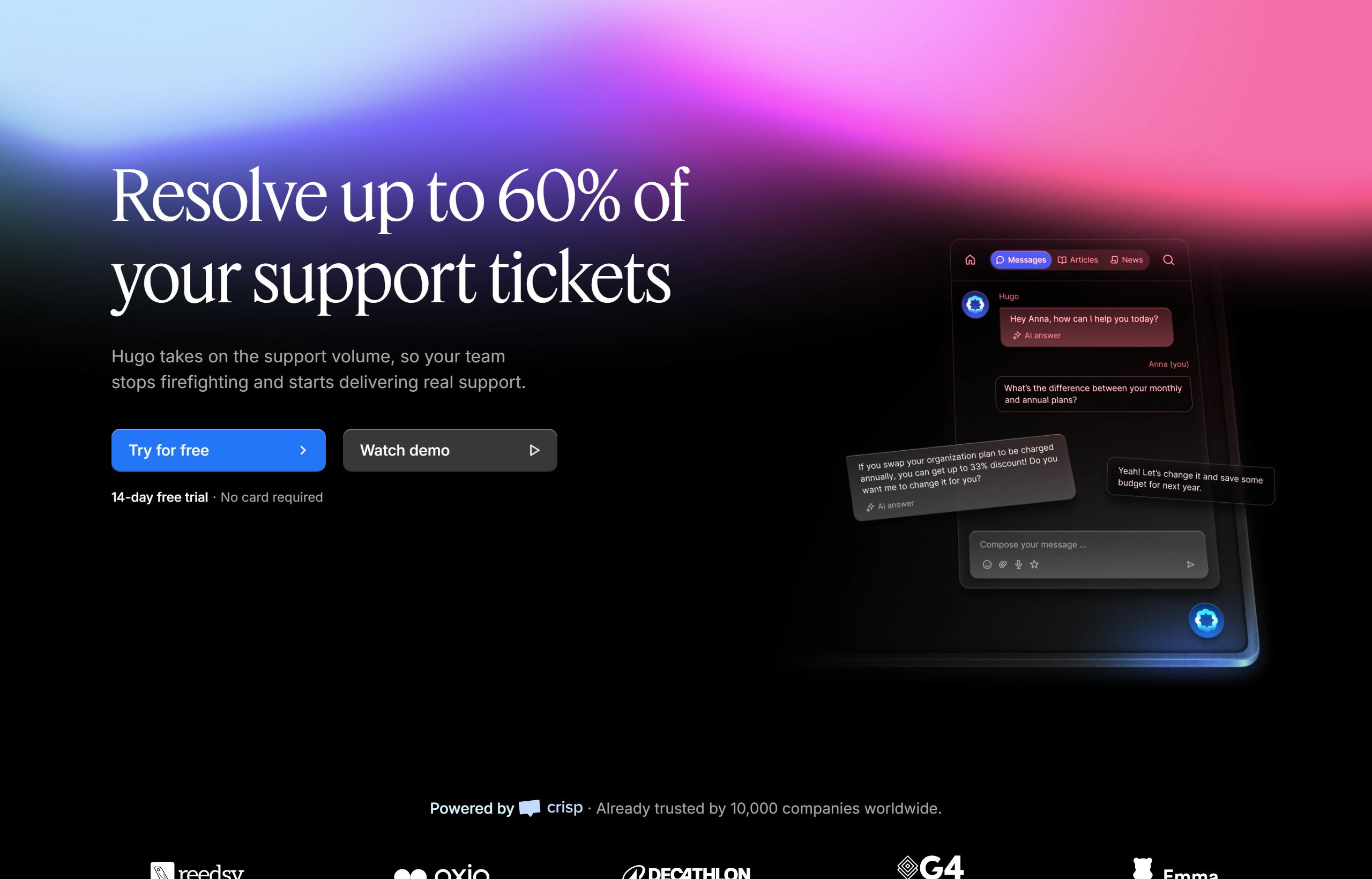
Hugo’s own homepage leads with resolving up to 60% of tickets and badges itself “Powered by Crisp,” the clearest sign that Hugo and Crisp are one product. Captured from hugo.ai in September 2026.
How Hugo AI Works
Under the marketing, Hugo is a fairly standard modern AI agent with a few things worth knowing before you commit.
- The AI model. Hugo does not lock you to one model. At the time of writing, Crisp’s own model-configuration documentation lists the auto-selected default as GPT-5.6 Luna from OpenAI, and the in-product picker offers OpenAI, Anthropic (Claude), Google (Gemini), Mistral, and a “Hosted by Crisp” option that keeps processing on Crisp’s own European infrastructure. Crisp names the model families rather than fixed version numbers, and notes that different models carry different credit costs and different regional hosting, so the exact default may shift over time.
- Actions, not just answers. Hugo connects to your other tools through the Model Context Protocol, which lets it look up live data and complete tasks rather than only reciting help articles. Crisp gives examples such as checking account details, tracking an order, or issuing a refund, and names integrations including Stripe, Shopify and WooCommerce, alongside automation tools like n8n, Zapier and Make.
- What it learns from. Hugo trains on your own content: FAQ-style question-and-answer snippets, your website via crawling, file uploads such as CSV, PDF and TXT, and your Crisp knowledge base, which it re-trains on automatically whenever you edit a help article.
- A no-code flow builder. For anything that needs a fixed sequence, such as triage or a booking request, Crisp provides a drag-and-drop builder so you can lay out the logic visually rather than in code.
- The channels. Hugo’s headline is “1 agent, 10 channels,” a subset of the roughly twelve channels the wider Crisp platform centralises. Crisp names the chat widget and email explicitly but does not publish the full list of ten, and it lets you choose which channels Hugo is allowed to handle.
When Hugo is unsure or hits a limit, it escalates. Crisp routes those conversations to your main inbox and added an “Automated Inbox” view that separates AI-handled chats from human-handled ones, so you can watch what the agent is doing. Setup is native: you switch Hugo on from the AI Agent menu inside Crisp, and there is a Playground sandbox for testing it before it goes live.
What Hugo AI Costs, in Brief
Hugo’s pricing has a wrinkle that deserves its own full teardown, so this is the short version. There are two layers.
The first layer is the flat Crisp subscription, charged per workspace rather than per seat: Free at $0, Mini at $45, Essentials at $95 and Plus at $295 a month, plus a custom Enterprise plan. That part is genuinely simple and predictable.
What the free tier actually gives you, though, is limited. One Trustpilot reviewer put it bluntly in May 2026:
“every feature that makes a chat widget actually useful (automated responses, away messages, AI agent, chat triggers) is locked behind paid plans starting at $45/month.”
Hugo is one of those paid-tier features, so trying the AI at all means starting at Mini.
The second layer is the one that shapes your real bill. Hugo runs on metered “AI credits,” and each plan includes only a fixed dollar amount of them: nothing on Free, then $5, $25 and $75 on Mini, Essentials and Plus. Crisp’s billing documentation puts a conversation at roughly $0.05 to $0.10, so those balances cover around 90, 450 and 1,350 automated conversations a month.
Those credits do not roll over, and they reset on the 4th of each month. When they run out, Hugo stops answering and escalates new conversations to your team unless you have switched on pay-as-you-go billing, and Crisp does not publish a firm top-up rate.
The takeaway for this explainer is simple: the plan price is a floor, not your bill, because the AI you came for is metered on top. If cost is your main question, our Hugo AI pricing guide works through the maths at different volumes.
The Details Most Reviews Miss
This is where a real look at Hugo earns its keep, because the thin listings that rank for it skip the parts that actually catch teams out. None of this is hidden, but it is easy to miss until you are live.
- Testing Hugo in the trial spends the same credits as real chats. The free trial runs 14 days with no card, but Crisp’s troubleshooting documentation confirms that Playground tests use the same infrastructure as live conversations and consume credits, and that pay-as-you-go is not available during the trial. Train and test the bot heavily and you can burn through your evaluation allowance before you have properly judged it.
- When the credits run out, the AI goes quiet. By Crisp’s own description, once the included credits are gone Hugo “stops answering automatically” and conversations are escalated to human operators until the next reset. The cost is capped, but so is the coverage, so under-size your credits and the automation can switch off mid-month.
- Unused credits are lost. Crisp confirms in a dedicated help entry that monthly credits do not carry over. A quiet month does not build a buffer for a busy one.
- “European servers” depends on the model you pick. hugo.ai states that all data is stored and processed on European servers, but the model-configuration doc notes that not all models offer the same region options, and only the “Hosted by Crisp” model is the explicit EU-sovereign path. If EU data residency matters to you, that is a setting to check rather than assume, especially if you select OpenAI, Anthropic or Google.
- Hugo is not a bolt-on. Adopting Hugo means adopting Crisp as your support platform. It is not a standalone agent you can add to another helpdesk, which is fine if you are moving to Crisp anyway, and a real consideration if you are not.
Is Hugo AI Any Good? Strengths, Limits and Who It Is For
On the whole, yes, Hugo is a capable, modern agent, and for the right team it is a strong option. It holds context across a conversation, can take real actions through your integrations rather than only answering, lets you choose the underlying model, and is cheap per conversation. Because it is native to Crisp, you get one vendor, one bill and a simple toggle to switch it on, and the EU-hosted model option is a genuine plus for European teams. Its case studies cite 40% to 60% of requests handled automatically, and a strong Product Hunt launch, among the top products of its day, shows there is real interest.
The limits are the flip side of that model. The metered credits can leave your AI switching itself off in a busy month, unused credits are lost, and the trial can be spent on testing before you have finished evaluating. Because Hugo only lives inside Crisp, there is no easy path to take it elsewhere.
Accuracy deserves an honest note too. Crisp positions Hugo as “grounded in truth,” answering only from your own data, but that is a design goal rather than a cast-iron guarantee: Crisp’s own troubleshooting doc has an entry for when “Hugo is hallucinating or giving a wrong response,” which it puts down to missing, conflicting or unclear guidance in your content. That is honest of Crisp, and it is the same reality every grounded AI agent faces, because accuracy depends on the quality of the source material and on how well the system is grounded. Go in with clear eyes rather than taking the headline at face value.
The model choice is worth a second look here too, because it is a genuine trade-off rather than a pure win. Being able to pick from OpenAI, Claude, Gemini, Mistral or Crisp’s own model is real flexibility, and the Crisp-hosted option is a plus if EU data residency matters.
The flip side is that a system built to run on any of them is, by design, not optimised for any of them. Because Crisp lets you pick the model, this places the responsibility of reliability on you, instead of it being reliable out of the box. Different language models (even from the same provider) behave differently, so a system prompt should be optimised for that particular model. The quality you get out of Hugo is partly your responsibility rather than something the vendor has already dialled in.
Hugo is new enough that the review picture is still thin. The AI-agent directories that rank for it show zero user reviews, so their star ratings are placeholders rather than evidence, and the genuine reviews on G2 and Trustpilot are only a few months old. They are worth reading, though, because early users describe the very things above in their own words. One customer success manager, writing on G2 in May 2026, credited the agent with saving his team hundreds of hours, then added:
“The Hugo AI agent also has inconsistent behavior at times: it can produce hallucinated responses, reply in a different language than the user’s message, and route conversations to the wrong inboxes.”
None of that makes Hugo a bad product, and the same reviewer clearly rates it. It is the honest picture of a young agent still settling in, worth knowing before you lean on it for answers you cannot easily check.
Hugo suits teams who are happy to run on Crisp, whose seat count and monthly AI volume fit comfortably inside a tier and its credits, and who want chat, inbox and AI bundled under one roof. It suits you less well if you want AI that never switches off mid-month, a single predictable bill that already includes the AI doing its job, or the freedom to keep your AI layer if you ever change platforms. If you are weighing the wider field, our roundup of the best AI customer service chatbots compares the main platforms side by side, and our guide to the best AI chatbot for Crisp covers the options for Crisp users specifically.
A Flat-Fee Alternative That Works Inside Crisp
If the credit meter is the part that gives you pause, this is where we come in, so treat the rest as us making our own case rather than a neutral review.
Resolve247 prices support AI as a single flat monthly fee with a fixed message allowance, not a separate balance of credits that empties and stops. The AI keeps answering all month, with no point where it goes dark because a meter hit zero and nothing to reset on the 4th. Plans start at $35 a month, the AI answers only from your own knowledge base behind a money-backed anti-hallucination guarantee, and there is no per-conversation AI meter to top up. Where Hugo’s headline is resolving up to 60% of tickets, Resolve247 is built to handle even more, up to 82% of everyday questions, so a larger share clears before it reaches your team.
The model question is handled differently too. Rather than hand you a menu of models and leave the results to your choice, Resolve247 has selected the model suited to each step and has tuned the system to work reliably out of the box. Getting accurate answers is our job to engineer, not a setting you have to pick correctly, so reliability is the default rather than something you configure.
Crucially, you do not have to leave Crisp to use it. Resolve247 runs inside Crisp as the AI layer that answers in your widget, and it also works across HubSpot, Help Scout and Front, so your AI is not locked to a single platform. Our guide to connecting Crisp to Resolve247 walks through the setup.
To be fair about it, Crisp with Hugo is the better pick if you want one all-in-one suite, you are staying on Crisp, and your volume fits neatly inside the included credits. Resolve247 is the better pick if you want a flat, predictable AI bill, a money-backed accuracy guarantee, AI that keeps answering all month, and the option to keep it if you switch platforms. If that sounds like your situation, you can start a free 30-day trial, no card required.
Frequently Asked Questions
What is Hugo AI?
Hugo AI is Crisp’s native AI support agent, available on hugo.ai and built into Crisp’s plans. It reads a customer’s question, answers from your own knowledge base, and can take actions through your integrations, such as checking an order, before escalating to a human when needed. You use Hugo by taking a Crisp plan rather than buying it separately.
Is Hugo AI the same as Crisp?
Hugo is Crisp’s AI agent, not a separate company or product. The relationship mirrors Fin and Intercom: Crisp gave its AI its own name and website, but Hugo is included in Crisp plans and billed as part of Crisp. You cannot buy Hugo as a standalone add-on for another helpdesk, so adopting Hugo means running on Crisp.
Which AI model does Hugo AI use?
Hugo lets you choose the model. As of September 2026, Crisp’s documentation lists the default as GPT-5.6 Luna from OpenAI, with a picker that also offers Anthropic’s Claude, Google’s Gemini, Mistral, and a Crisp-hosted model kept on European infrastructure. Different models carry different credit costs and regional hosting, and the default can change over time.
Is Hugo AI any good?
For teams committed to Crisp, Hugo is a capable, modern agent: it holds context across a conversation, takes real actions through integrations, lets you pick the model, and is cheap per conversation. The trade-offs are its metered credits, which can switch the AI off mid-month when they run out, no rollover on unused credits, and the fact that it only works inside Crisp.
Is there a flat-price alternative to Hugo AI?
Yes. For teams that want predictable AI pricing without a credit meter, Resolve247 charges a flat monthly fee from $35 with a fixed message allowance and no separate AI balance to top up. It runs inside Crisp as well as on HubSpot, Help Scout, Front and any website, answers only from your own knowledge base with a money-backed anti-hallucination guarantee, and never switches off mid-month because credits ran out.