
Most advice on how to deal with angry customers starts in the wrong place. It assumes someone is already shouting and asks, right, now what? But talk to real customers and you’ll notice the anger usually starts earlier, before a human is involved at all. It starts in the chatbot loop that keeps pointing them back to the same FAQ that already failed them. As one person vented in a support forum, the last thing they want is to be told to “just use our chatbot” when the chatbot only sends them back to the help pages they’ve already read.
By the time that customer reaches you, they’re not just cross about the product. They’re cross about being ignored.
That’s actually good news, because it means a lot of anger is preventable, and the rest is manageable with a method you can repeat under pressure. This guide gives you that method: seven steps that work, the exact words to say (and the ones that make things worse), how the approach shifts by channel, where to draw the line with genuinely abusive behaviour, and an honest answer to the question every support team is asking right now, which is whether AI should handle an angry customer at all.
We run support ourselves, so none of this is theory. Let’s start with why people get angry, because it’s rarely what you think.
Why customers actually get angry (it’s rarely about you)
Customer anger isn’t in your head, and it isn’t rare. In the 2025 National Customer Rage Study, 77% of customers reported experiencing a product or service problem in the past year. Of the people who hit a problem, two out of three said they felt rage, and half admitted they raised their voice to complain, which the researchers call a record high.
So why does a faulty product or a late order turn into a raised voice? Usually it isn’t the fault itself. It’s the feeling of being powerless: unheard, bounced around, or made to repeat the whole story for the third time. A former call-centre trainer summed it up well in a thread on handling abusive callers, pointing out that angry customers are almost always angry about the situation, not at you. That one reframe is the foundation for everything below, because you can’t calm someone down while you’re busy taking it personally.
Anger is really the flip side of good customer service. The same moments that build loyalty, handled badly, destroy it. And the cost is real: PwC found that 32% of customers would walk away from a brand they love after a single bad experience. Handle the moment well and you keep them. Handle it badly and you’ve taught them to leave.
If repetitive, low-value questions are what push your customers (and your patience) to the edge, that’s exactly the load the right AI assistant can lift, and we’ll get to how to do that without making things worse.
How to deal with an angry customer: the 7-step method
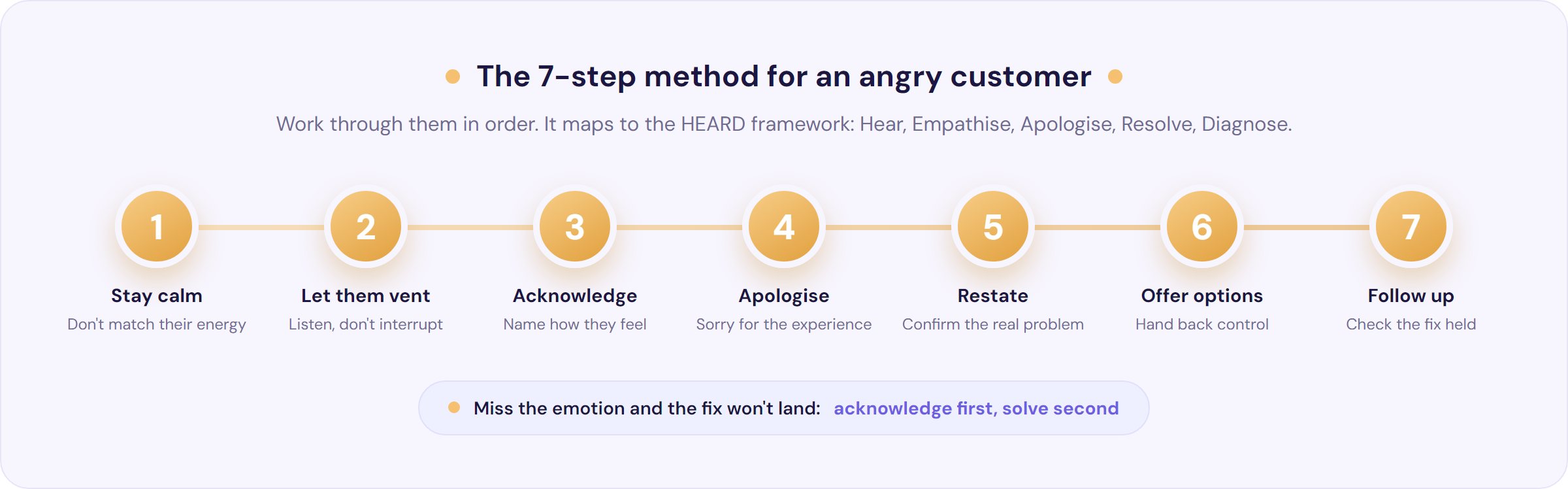
To deal with an angry customer, work through these seven steps in order:
- Stay calm and don’t match their energy.
- Let them vent without interrupting.
- Acknowledge the emotion and show you understand.
- Apologise sincerely for the experience.
- Restate the problem so they know you’ve heard it.
- Offer a solution, or options, so they regain some control.
- Follow up once it’s fixed.
If you’ve come across the HEARD framework (Hear, Empathise, Apologise, Resolve, Diagnose), this is the same idea, broken into steps you can actually feel yourself doing in the middle of a heated conversation. Here’s what each one looks like in practice.
1. Stay calm and don’t match their energy. Anger is contagious, and the quickest way to lose a conversation is to get defensive. Slow your breathing, drop your pace, and keep your tone level. One trick front-line agents swear by: smile while you talk, even on the phone or live chat. As one trainer put it, it’s nearly impossible to yell with a smile on your face, and that warmth carries into your words.
2. Let them vent without interrupting. A frustrated person needs to feel heard before they can take in anything you say. Let them get it out. Don’t leap to the fix, but don’t go silent either. In a tense moment, silence reads as indifference. As de-escalation coach Myra Golden says, anger demands a response, and staying quiet only lets it grow. A simple “I’m here, take me through what happened” keeps the door open.
3. Acknowledge the emotion and show you understand. Validate before you solve. Something like, “I can see why this is frustrating, I’d feel the same,” does more than any policy quote. Notice the word: frustrated, not angry. Labelling someone as angry tends to wind them up further, while “frustrated” tends to feel understood.
4. Apologise sincerely for the experience. A real apology isn’t an admission of legal fault, it’s an acknowledgement that their day got worse because of this. “I’m genuinely sorry this has happened, let’s put it right” costs you nothing and lowers the temperature straight away. Skip the robotic “we apologise for any inconvenience.”
5. Restate the problem so they know you’ve heard it. Play it back in your own words: “So the order arrived damaged and the replacement still hasn’t shipped, have I got that right?” This does two jobs. It proves you were listening, and it catches the gap between what they said first and what’s actually wrong.
6. Offer a solution, or options, so they regain some control. Anger thrives on powerlessness, so hand some power back. Where you can, give two options rather than one take-it-or-leave-it answer. “I can refund it today, or send a replacement on next-day delivery, which would you prefer?” A choice turns a victim back into a decision-maker.
7. Follow up once it’s fixed. This is the step nearly everyone skips, and the one that turns a rescued conversation into a loyal customer. A short message a day or two later, checking the fix held, tells them the resolution wasn’t just you wanting them off the line. It’s where trust is rebuilt.
What to say (and what to avoid): word-for-word scripts
“Show empathy” is useless advice at 4pm on a Friday when someone’s shouting. You need the actual words. Here are copy-and-paste lines for the moments that matter most.
- The opener: “Thanks for flagging this, and I’m sorry you’ve had to. Let’s sort it out together.”
- The acknowledgement: “I can completely understand why that’s frustrating. If it happened to me, I’d want it fixed too.”
- Sorry without admitting fault: “I’m really sorry this has been your experience. Let me look into exactly what’s happened.”
- The resolution: “Here’s what I’m going to do right now, and here’s when you’ll hear from me.”
- The boundary (more on this below): “I want to help you, and I can’t do that while being sworn at. If it stops, we can carry on.”
- The follow-up: “Just checking the replacement arrived and everything’s working, is there anything else I can do?”
The words you avoid matter just as much. Never tell an angry customer to “calm down,” it almost always does the opposite by making them feel dismissed. Swap flat refusals for what you can do instead.
| Say this | Not that |
|---|---|
| I can see why this is frustrating | Calm down / please relax |
| Here’s what I can do for you | That’s just our policy |
| Let me find out and come straight back | I don’t know |
| Let me check exactly what happened | You’re wrong / that’s not what happened |
| I’m sorry this has been your experience | Sorry for any inconvenience caused |
| Take me through what happened | You need to calm down first |
Channel by channel: chat, phone, email, and public reviews
The seven steps hold everywhere, but how you apply them shifts with the channel.
| Channel | What’s different | First move | Watch out for |
|---|---|---|---|
| Live chat | Fast, text-only, no tone of voice | Reply quickly and warmly, in full sentences | Cold canned responses reading as robotic |
| Phone | Tone and pace carry everything | Let them talk, slow your voice down | Talking over the vent |
| You get time to craft the reply | Acknowledge fast, even before you have the fix | Latency, silence inflames people | |
| Public / reviews | Everyone is watching | Respond publicly with empathy, then take it private | Arguing in the open |
Public anger is its own beast, because it’s asymmetric. One furious review or social post is visible to every future customer, and the Rage Study found that 43% of social media complaints simply go unanswered. That silence is a bad look. The move is to reply publicly and fast, own it, then invite them to continue privately: “I’m really sorry about this, I’ve sent you a direct message so we can put it right.” You show the audience you care without litigating the details in front of them.
A quick field guide to difficult customer types
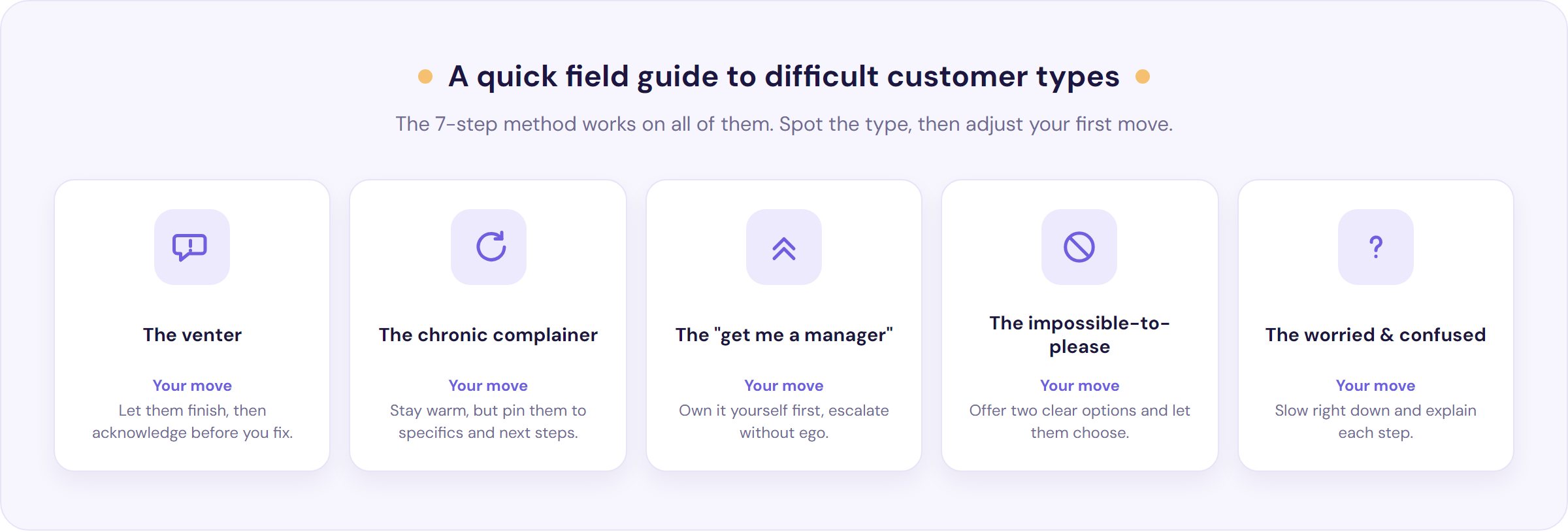
Not every difficult customer is the same, and spotting the type helps you choose your first move. The seven-step method still applies to all of them.
- The venter just needs to be heard. Let them finish, acknowledge, then move to the fix.
- The chronic complainer returns often. Stay warm but keep them to specifics and next steps.
- The “get me a manager” customer wants to feel important. Take ownership yourself first, and escalate without ego if they still ask.
- The impossible-to-please customer rejects every solution. Offer two clear options and let them choose, rather than an open-ended “what would make this right?”.
- The confused and frightened customer isn’t really angry, they’re anxious. Slow right down and explain each step.
For a deeper look at what separates a merely difficult interaction from a genuinely good one, our guide to what good customer service looks like covers the skills underneath all of this.
When you’re a team of one: handling angry customers solo
Most advice on angry customers quietly assumes you have a contact centre behind you, with managers to escalate to and colleagues to tap out. If you’re a founder or a team of one or two, none of that exists. You are the front line and the manager, and it’s your name on the company. When a customer asks for the manager and that’s you, our guide to handling escalations in a small team covers what to say.
A few things help when you’re on your own:
- Buy honest time. You don’t have to solve it on the spot. “I want to get this right for you, so give me until 3pm and I’ll come back with a proper answer” is completely fair, and it breaks the pressure.
- Write your hardest replies while calm. Draft your refund line, your out-of-stock apology, and your abuse boundary now, and save them. You won’t find the right words with your heart pounding.
- Take the routine off your plate. Every “where’s my order?” you answer manually is capacity you don’t have for the one genuinely upset customer who needs you. This is where an AI chatbot for small business earns its keep, absorbing the repetitive questions so your energy goes to the hard human conversations. It’s also one of the most effective ways to reduce your support ticket volume in the first place.
- Step away for sixty seconds. After a brutal one, stand up, walk to the kettle, breathe. You’ll handle the next person better for it.
Angry versus abusive: where to draw the line
Here’s the honest bit most guides skip. There’s a difference between an angry customer and an abusive one, and you’re allowed to act on it.
An angry customer complains about the situation, sometimes loudly, but stays aimed at the problem. Work the process, they’re usually reachable. An abusive customer aims at you: sustained personal insults, threats, harassment, slurs. That’s a different category, and “the customer is always right” was never meant to cover it. As one agent said about a colleague being screamed at, there’s a limit to how much you should have to take, and some customers go well past it.
Set the boundary clearly, in two steps, before you disengage:
- Warn once, calmly. “I understand you’re upset and I want to help. I can’t do that while being spoken to like this. If it continues, I’ll have to end the call, and you’re welcome to contact us again.”
- Follow through. If it carries on, end it as promised, without heat: “I’m going to end the call now. Please get back in touch when we can talk it through.” Then log what happened.
If you’re solo, give yourself the same permission a manager would. Protecting yourself isn’t a failure of service, it’s what lets you keep showing up for the customers who deserve it. And after a genuinely nasty exchange, take a proper break. Agent wellbeing isn’t soft, it’s how you last in this job.
Should AI handle an angry customer? (Honestly, no)
Plenty of vendors will tell you their bot can defuse anger. We build AI support software, and we’ll tell you the opposite: an angry customer is the one moment you most want a human, and good AI should know it.
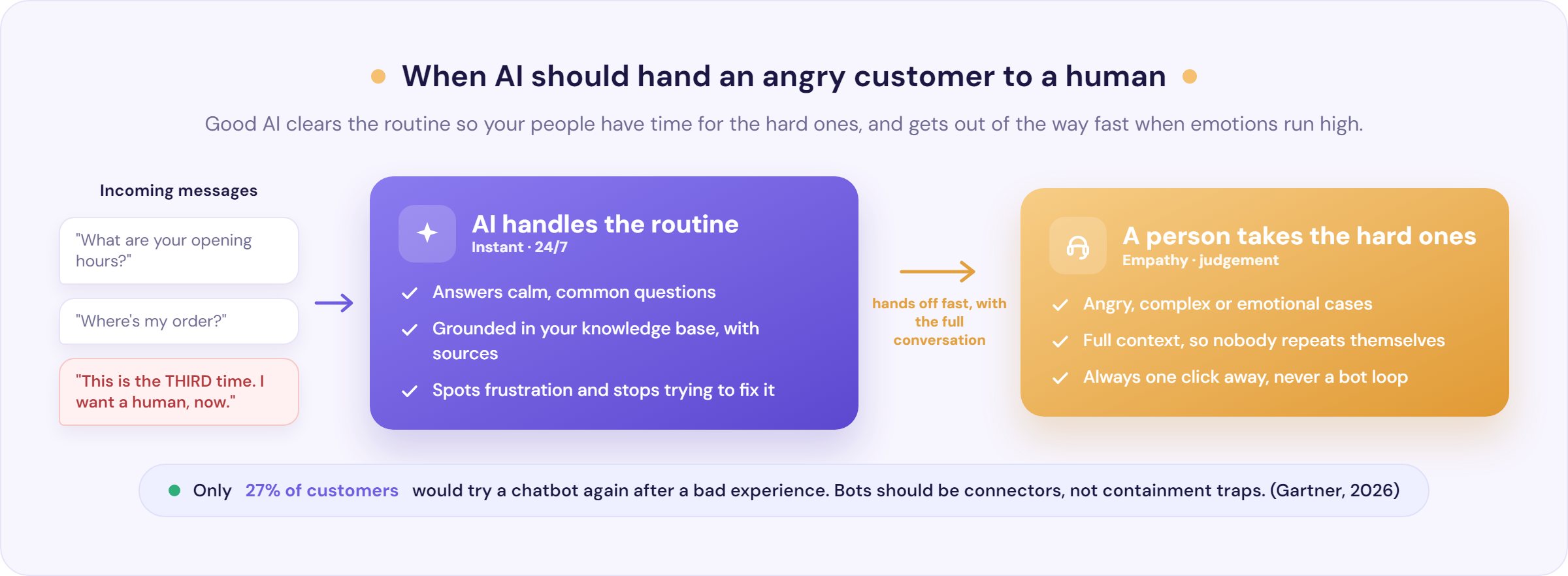
The data backs this up. Gartner found that only 27% of customers would be willing to try a chatbot again after a negative experience, and that 87% say access to a human agent is essential when a company uses AI in customer service. Push a furious person deeper into a bot and you don’t just fail to fix their problem, you burn their willingness to ever trust your automation again.
Real customers describe exactly this. In thread after thread, the fury isn’t only about the original problem, it’s about being trapped: pointed to the FAQ that already failed them, stuck in what one person called an automated maze. The most upvoted “solution” people share with each other is depressing if you run a support team, which is to type “agent, agent, agent” until the bot gives up and fetches a human.
So what should AI actually do when someone’s angry? Get out of the way, fast, and hand off well. Gartner puts it perfectly: chatbots should be “seamless connectors to human support, not containment traps,” and when a bot can’t resolve something confidently it should “provide a visible path to a human agent and pass along the information and context already collected.” A customer praised exactly this design in one thread, describing a company that shows which button summons a human right up front, no matter where you are in the menu.
That’s the model we build towards. Good AI in customer service should:
- Handle the easy 80% instantly, so your team has time and calm for the hard 20%.
- Recognise frustration and stop trying to “resolve” it, handing off to a human with the full conversation attached so nobody has to repeat themselves.
- Never invent an answer. A confident, wrong reply to an already-angry customer is a disaster, which is why our answers stay grounded in your own knowledge base with citations on by default and a money-backed accuracy guarantee.
- Always leave a one-click path to a person.
Used this way, conversational AI for customer service doesn’t replace your de-escalation skills, it protects the time you need to use them. If you’re weighing up tools, our comparison of the best AI customer service chatbots walks through what to look for. You can also see how our own AIChatbot handles handoff.
Turn an angry customer into a loyal one
There’s a well-known idea in customer service called the service recovery paradox: a customer whose problem you fix brilliantly can end up more loyal than one who never had a problem at all. The research on how strong that effect is remains debated, so don’t bank on it as a strategy. But the direction is real and it matches what front-line teams see all the time. A complaint handled with speed, honesty and a genuine apology is one of the best relationship-building moments you’ll ever get.
The customer who arrived furious and left feeling looked after doesn’t just stay. They tell people. That’s why the follow-up in step seven matters so much: it’s the difference between “they sorted my refund” and “you have to try these people, something went wrong and they were brilliant about it.”
Frequently Asked Questions
What are the steps to deal with an angry customer?
Deal with an angry customer in seven steps: stay calm and don’t match their energy, let them vent without interrupting, acknowledge the emotion, apologise sincerely for the experience, restate the problem to confirm you’ve understood, offer a solution or options, and follow up once it’s resolved.
What should you never say to an angry customer?
Never tell an angry customer to “calm down” or “relax,” as it makes them feel dismissed and usually escalates things. Avoid “that’s our policy,” “sorry for any inconvenience,” and “you’re wrong.” Replace them with what you can do, real acknowledgement, and a sincere apology for their experience.
How do you deal with an abusive customer, and when should you end the contact?
An angry customer targets the problem; an abusive one targets you with insults, threats or slurs. You don’t have to tolerate that. Warn once calmly (“I want to help, and I can’t while being spoken to like this”), and if it continues, end the call or chat politely and log the incident.
Should an AI chatbot handle angry customers?
No. Empathy and de-escalation are human strengths, and Gartner found only 27% of customers would try a chatbot again after a bad experience. Good AI should recognise frustration, stop trying to resolve it, and hand off to a human fast with full context, never trap an angry customer in a bot loop.
What is the HEARD method for dealing with angry customers?
HEARD stands for Hear, Empathise, Apologise, Resolve, and Diagnose. It’s a simple framework for angry-customer conversations: hear them out fully, empathise with how they feel, apologise for the experience, resolve the problem with clear options, and diagnose the root cause so it doesn’t happen again.
How would you deal with an angry customer in a job interview answer?
Give a short structured answer: stay calm, listen without interrupting, acknowledge their feelings, apologise for the experience, then take ownership and offer a clear solution. Finish with a brief real example where you turned a frustrated customer around, and mention following up to confirm they were happy.
The bottom line
Angry customers are the hardest part of support, and also the moment you can win the most trust. Nail the fundamentals and the rest follows: stay calm, let them be heard, apologise like you mean it, and give them a way forward.
Three things to put in place this week:
- Pre-write your three hardest replies (a refund, a delay, an abuse boundary) while you’re calm, and save them.
- Add a visible, one-click path to a human wherever you use automation, so nobody gets trapped.
- Agree your abuse line as a team, so protecting yourselves isn’t an in-the-moment judgement call.
And take the routine load off your plate so you have the capacity to handle the hard conversations well. Our AIChatbot answers your customers from your own knowledge base, with citations on by default and a human handover built in, so a frustrated customer reaches a real person fast instead of a dead end. You can start a 30-day free trial with no credit card, from $35 a month. Give your team back the time to be human when it matters most.