
Introduction
You already know what good customer service feels like, because you remember the last time you got it. Someone listened, owned the problem, and fixed it without making you jump through hoops. You probably also remember the opposite: shouting “agent” at a phone system that keeps offering you the FAQ. One customer recently described saying “agent” 15 times in a row before a system would even consider passing them to a person.
Most of us can name great service when we feel it. Far fewer teams can define what actually made it good, which is the part you need if you want to deliver it on purpose. That gap is what this guide closes. You’ll get a plain-English definition, real examples, the skills that make it happen, and how to measure it. You’ll also see where AI honestly fits, all from the point of view of a small team rather than a 200-seat contact centre.
One thing up front: we build AI support tools, so we have a stake in the AI part. We’re going to be straight with you anyway about where it helps and where it just gets in the way.
What is good customer service?
Good customer service is help that solves the customer’s problem quickly and accurately, on the channel they choose, and leaves them feeling respected rather than processed. It is not just being friendly. It is being useful, correct, and easy to reach, especially when something has gone wrong.
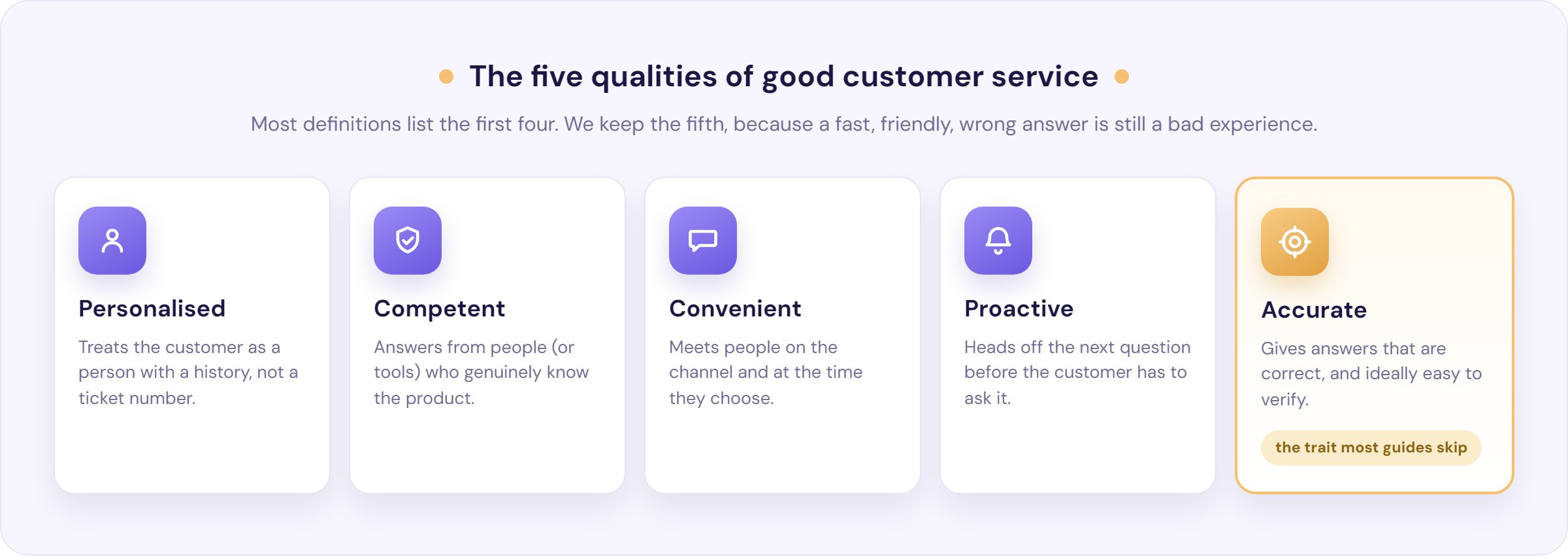
That last point matters more than the polish. A warm greeting means little if the answer’s wrong or the customer has to repeat themselves three times to get it. Good service tends to share five traits:
- Personalised to the customer and their history, not a scripted brush-off.
- Competent, from people (or tools) who actually know the product.
- Convenient, meeting people on the channel and at the time they choose.
- Proactive, heading off the next question before it is asked.
- Accurate, giving answers that are correct and, ideally, easy to verify.
That fifth trait, accuracy, is the one most definitions skip. We have kept it in on purpose, because a fast, friendly, wrong answer is still a bad experience.
The qualities of good customer service (the 3 Ps and beyond)
A popular framework sums the essentials up as the “3 Ps”: professionalism, patience, and a people-first attitude. Professionalism keeps you calm and clear under pressure. Patience gives the customer room to explain without feeling rushed. A people-first attitude treats the person as a person, not a ticket number.
Those three are the foundation, but great service usually adds a few more:
- Responsiveness. A quick first reply, even one that just says “we are on it,” lowers the temperature.
- Empathy. Naming how the customer feels (“that is frustrating, let me sort it”) does real work, especially when you have to deal with an angry customer.
- Ownership. One person seeing the problem through beats a chain of hand-offs. A customer on Reddit described a rep who went out of their way, pulling in other departments to solve an issue, and added: “I didn’t mind the holds at all.” Ownership buys patience that speed alone cannot.
- Consistency. The same quality on a Tuesday afternoon as on a Friday at 5pm.
Here’s the encouraging part for smaller teams: none of these needs a big budget. You don’t need enterprise software to listen, take ownership, or keep your word. If anything, a small team has the advantage, because the person answering usually has the context and the authority to just fix it.
Why good customer service matters
Good service is not a soft nicety. It’s one of the cheapest growth levers you have, and the numbers back that up.
- It drives repeat business. 88% of customers say good customer service makes them more likely to buy again, according to Salesforce’s State of the Connected Customer research.
- Speed and accuracy both influence the sale. In Zendesk’s 2026 CX Trends research, 86% of customers said a responsive and accurate resolution shapes their decision to buy. Note that it’s both together, not speed on its own.
- Bad service sends people to rivals. 73% will switch to a competitor after multiple bad experiences (Zendesk). One customer put the small-business version of that bluntly: “I give a place of business 2 chances then I vote with my wallet.”
- The stakes are enormous in aggregate. The Qualtrics XM Institute estimates $3.7 trillion in annual sales is at risk globally from bad customer experiences.
For a small business, the maths is even sharper. When you have hundreds of customers rather than hundreds of thousands, every churned account is a bigger slice of your revenue, and every fan who tells a friend is a bigger slice of your growth.
Customer service examples that get it right
Definitions are easy to nod along to. Examples are where “good” becomes concrete. Here are five, mixing well-known names with everyday scenarios, each with a takeaway you can copy.
1. The small brand that turned a one-star into a fan. A customer on r/CustomerService described ordering from a small gear company, hitting a problem, and getting it sorted so well that they called it the “best business I have ever had the pleasure of buying from.” What you can learn: a fast, generous fix when something goes wrong (a replacement shipped before the return is even processed) creates more loyalty than a flawless order ever would. This is the service-recovery paradox, and small teams are perfectly placed to use it.
2. The empowered frontline (Ritz-Carlton, reframed). The Ritz famously lets staff spend up to a set amount to fix a guest problem without asking a manager. You don’t need that budget. What you can learn: give whoever answers the authority to say yes to a refund, a replacement, or an exception, so customers are not stuck waiting for approval.
3. Proactive support (ecommerce). A customer’s parcel is running late. Instead of waiting for the “where is my order” message, the shop emails first: here is the delay, here is the new date, here is a discount for the trouble. What you can learn: solving a problem before the customer has to raise it turns a complaint into goodwill.
4. The reply that actually resolves (SaaS). A user reports a bug. The reply does not say “have you tried restarting.” It links the exact step in the docs, gives a two-line workaround for right now, and flags the fix. What you can learn: a competent, specific answer respects the customer’s time. Vague, generic replies are the ones that get escalated.
5. Remembering the regular (local and service businesses). A returning customer is greeted by name and asked about the thing they mentioned last time. What you can learn: a little history goes a long way. A shared note on the account lets any team member deliver that personal touch, not just the owner.
How to deliver good customer service (practical tips)
You can turn those examples into a repeatable standard. None of this requires an enterprise stack, and our 12 customer service tips go further.
- Know your product cold. Most frustration comes from a rep who cannot answer. A customer’s top pet peeve on Reddit was “being treated like I’m stupid” by someone who clearly knew less than they did.
- Reply fast, and set expectations if you cannot. A quick “we are looking into this, expect an answer by 3pm” beats silence every time.
- Never make people repeat themselves. Keep the history in one place so the next person can see it. Re-verifying the same details customers already gave is a classic trust-killer.
- Personalise. Use the name, reference the account, match the tone to the situation.
- Let customers help themselves. A good help centre or FAQ handles the simple stuff instantly. Our guide on reducing support tickets covers the quickest wins.
- Own the problem end to end. Whoever picks it up should see it through, rather than passing the customer around.
- Be proactive. Send the status update, the renewal reminder, the “we noticed this” note.
- Keep your word and close the loop. If you promise a callback, make it. Then confirm the issue is actually fixed.
- Use automation for the repetitive, not the personal. Let AI or customer service automation handle the “what are your hours” questions so your team has time for the ones that need a human.
- Measure it. You can’t improve what you don’t track (more on that below).
The customer service skills that matter
Great service is a set of skills, and most of them can be taught. They split into two groups.
Soft skills (how you handle the person):
- Communication. Clear, jargon-free, and matched to the customer’s tone.
- Active listening. Reading what is actually being asked, not just the words.
- Empathy. Acknowledging the feeling before jumping to the fix.
- Patience. Staying calm when the customer is not.
- Problem-solving. Getting to the root cause, not just the symptom.
- Adaptability. Handling a curveball without falling back on a script.
Hard skills (what you need to know and use):
- Product knowledge. The single biggest driver of a confident, correct answer.
- Clear writing. Most support now happens in text, where tone and precision live or die by the words.
- Tools and CRM fluency. Finding the account, the history, and the answer quickly.
- Working alongside AI. This is the newest hard skill, and many 2026 skills lists still leave it out. The modern support person knows when to trust the AI’s draft, when to override it, and how to take over the cases it hands up. As one support rep put it, AI “takes all the easy parts of the workload and leaves you with all the complaints,” which makes handling the hard cases well more valuable than ever.
Where AI fits into good customer service (honestly)
AI is now part of the customer service conversation, so it deserves an honest treatment rather than a sales pitch.
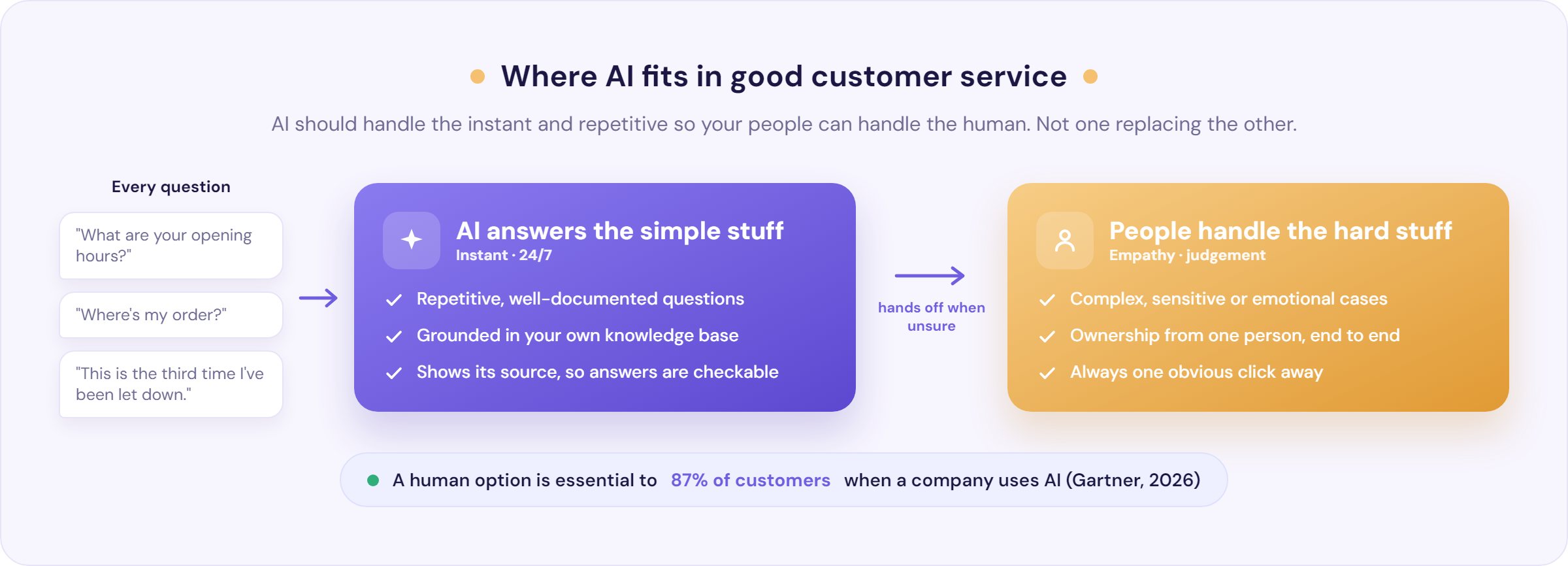
The useful framing is simple: AI should handle the instant and repetitive so your people can handle the high-empathy and complex. Done well, it means customers get an accurate answer at 2am without waiting, and a real person for the moments that need judgement or reassurance. Klarna’s AI assistant is the widely-cited example: it handled the work of around 700 agents and cut average resolution time from 11 minutes to under 2, running 24/7 across 23 markets in more than 35 languages. Crucially, it did not remove the human option.
That human escape hatch is not optional. Gartner found 87% of customers say it is essential to reach a human agent when a company uses generative AI. Support reps agree: as one noted, even a good bot leaves the angry cases, and “angry customers would want to vent at a real person anyway rather than a robot.” Trapping people in a menu that, in another customer’s words, is “really bad at resolving issues” is worse than no bot at all.
There is one more honest point that most vendors skip: good AI service means correct answers, not just fast ones. A support bot should be grounded in your own knowledge base, answer only from what it actually knows, and show its source so the customer (and your team) can check it.
Beware anyone who promises AI that “cannot” get things wrong. The honest promise is grounded, cited answers, a clear “I don’t know, let me get a human” when it’s unsure, and accountability behind it. We dig into this in our piece on AI support chatbot accuracy, and into the bigger picture in AI in customer service and our guide to AI agents for customer service.
If you want to see what a grounded, cited AI answer looks like on your own site, that is exactly what our AIChatbot is built to do, on top of the humans you already have.
How to measure good customer service
“Good” feels subjective until you put numbers on it. A handful of metrics turn a gut feeling into something you can track and improve.
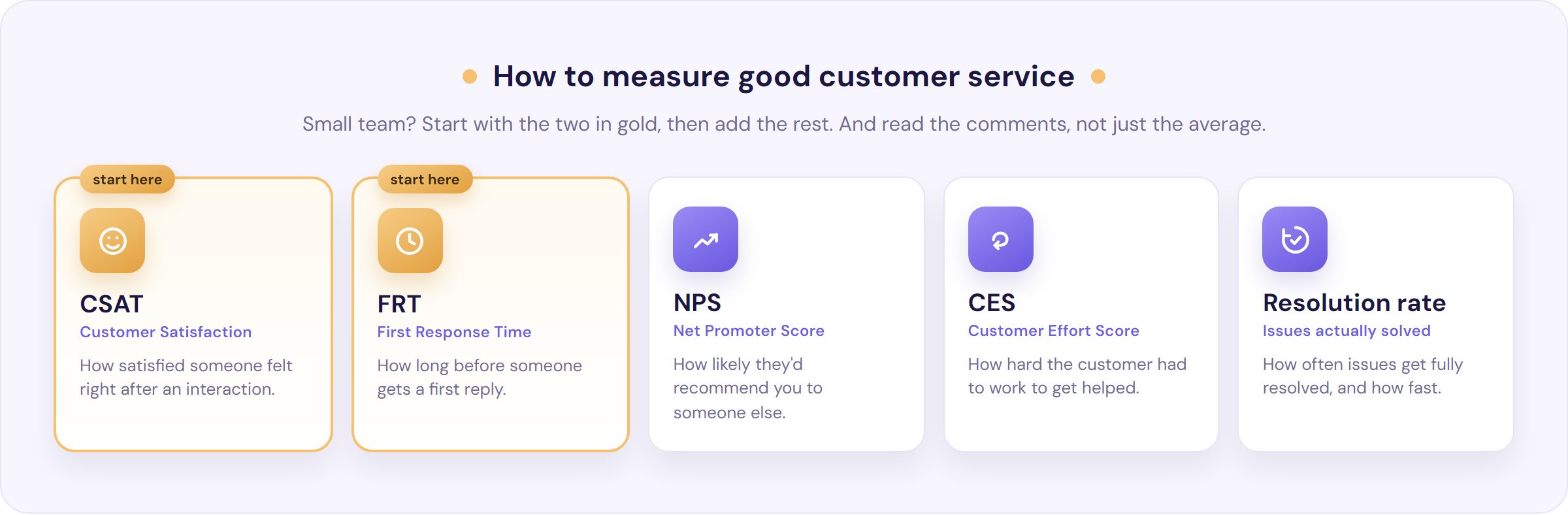
- CSAT (Customer Satisfaction). A simple “how satisfied were you?” after an interaction. The easiest place to start. You can work yours out with our CSAT calculator.
- NPS (Net Promoter Score). “How likely are you to recommend us?” A read on overall loyalty rather than a single interaction.
- CES (Customer Effort Score). How hard the customer had to work to get helped. Lower effort strongly predicts loyalty.
- First response time. How long before someone replies. Often the number customers feel most.
- Resolution rate and resolution time. How often, and how fast, issues actually get solved.
If you are a small team, start with two: CSAT and first response time. They are quick to set up and they cover the two things customers notice most, whether they felt looked after and whether they were kept waiting.
One caveat worth knowing. Survey scores can be distorted by kindness. As one customer admitted, they “always rate a 5 no matter what,” because they know a rep’s job may depend on it. So pair the scores with qualitative signals, actual comments, repeat contacts, and churn, rather than trusting the average alone.
Common customer service mistakes to avoid
Most bad service is not malice. It is a handful of avoidable habits:
- Slow or no reply. Silence reads as “we do not care.”
- Making people repeat themselves. Re-asking for details the customer already gave, or that the rep can already see.
- Canned brush-offs. A cheery “anything else I can help with?” that skips the actual help.
- No way to reach a human. The single most complained-about pattern of the AI era. If the bot cannot help, the exit to a person must be obvious.
- Condescension. Talking down to a customer who understands their own problem.
- Over-promising. A deadline you miss is worse than one you never set.
Notice how many of these are about respect and honesty rather than resources. Fixing them costs almost nothing.
Frequently Asked Questions
What are the 3 most important qualities of customer service?
The three most cited qualities are the “3 Ps”: professionalism, patience, and a people-first attitude. Professionalism keeps interactions calm and clear, patience gives customers room to explain, and a people-first attitude treats each person as an individual rather than a ticket. Most great teams also add responsiveness, empathy, and accuracy.
What’s an example of excellent customer service?
A classic example is turning a complaint into loyalty: a company ships a free replacement before the return is even processed, or proactively emails about a delayed order with a discount for the trouble. The common thread is a fast, generous fix that leaves the customer feeling looked after rather than processed.
What are the most important customer service skills?
The core soft skills are communication, active listening, empathy, patience, problem-solving, and adaptability. The core hard skills are deep product knowledge, clear writing, fluency with your support tools, and, increasingly, knowing how to work alongside AI, including when to trust it and when to take over.
How do you measure good customer service?
Use a small set of metrics: CSAT for satisfaction, NPS for loyalty, CES for how much effort the customer spent, and first response and resolution times for speed. Small teams should start with CSAT and first response time, then pair the scores with real comments and repeat-contact data.
Why is good customer service important?
Good service directly drives revenue and retention. Salesforce found 88% of customers are more likely to buy again after good service, while Zendesk found 73% will switch to a competitor after multiple bad experiences. For small businesses, where each customer is a larger share of revenue, the impact is even greater.
The bottom line
Good customer service is not a budget or a headcount. It’s a standard: solve the problem quickly, accurately, and with genuine respect, and make it easy for the customer to reach you when it matters. Small teams can hit that standard, and often do it better than the giants, because the person answering has the context and the authority to just fix things.
Three things to take away:
- Get the basics right first. Reply promptly, do not make people repeat themselves, and own the problem to the end.
- Use AI for the repetitive, humans for the hard. Let a grounded, cited assistant handle the instant questions 24/7, and keep an obvious path to a person.
- Measure it. Start with CSAT and first response time, and read the comments, not just the average.
If you want a head start, an accurate AI assistant can cover the simple, round-the-clock questions so your team’s energy goes where it counts. That’s the idea behind Resolve247, and you can try it free to see how it answers on your own content. Either way, if you’re still weighing up whether a bot belongs in your support at all, our guides to choosing an AI support chatbot and the best customer service chatbots are honest places to start.